
Your cart
There are no more items in your cart
Air Conditioners – 2026 Buying Guide
Categories :
Air Conditioning & Ventilation
, Trends & Inspiration
Every summer, the same question crops up as soon as the temperature hits 30 °C: is it finally time to get an air conditioner? And if so, which one? Between BTU ratings, energy efficiency classes, and portable, monobloc or split-system models, it’s hard to know where to start. This guide starts from scratch: how to choose the right size unit for each room, what air conditioning actually costs in terms of electricity, what the French regulations say, and the mistakes that turn a smart purchase into an energy-guzzling nightmare.
Portable, monobloc and split air conditioners: understanding the four main types
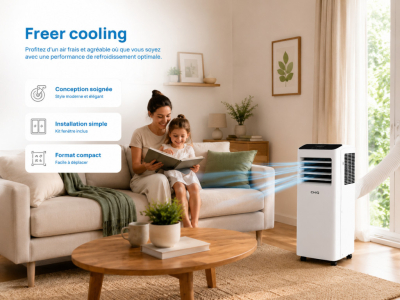
Portable air conditioners: the no-installation solution
This is the best-selling model in France, and for good reason: it requires no installation. Mounted on castors, it plugs into a standard socket and expels hot air outside via a duct fed through a slightly open window. A draught-proofing kit (supplied with most models) helps to minimise the ingress of hot air around the duct: a detail that makes all the difference to its actual efficiency.
Who is it for? Tenants, rooms measuring 15 to 35 m², and occasional use (heatwaves, bedrooms at night, home offices). It’s also the only type of air conditioner you can take with you when you move house.
Note: a portable air conditioner is, by its very nature, noisier than a split-system unit (as the compressor is in the room) and slightly less efficient, since the exhaust duct warms the ambient air slightly as it passes through. This isn’t a deal-breaker, but it’s a trade-off worth bearing in mind.

The fixed monobloc air conditioner: the compromise that doesn’t require a refrigeration engineer
Less well known, the wall-mounted monobloc unit houses the entire refrigeration circuit within a single indoor unit, fixed to the wall and connected to the outside via two simple holes of around 18 cm. As the circuit is factory-sealed, no certified refrigeration engineer is required for commissioning: this is its major advantage over split-system units, and a decisive factor when you want a fixed installation without involving an installer.
Who is it for? Homeowners who want a permanent and discreet solution, without an outdoor unit (particularly valuable in block-of-flats, as we’ll discuss below), and without installation costs.
The split-system air conditioner: the most efficient, but requiring installation
A split system divides the unit into two parts: the compressor (the noisy part) is outside, whilst the indoor unit is inside. The result: very quiet operation indoors — some models operate at under 25 dB, which is quieter than a whisper — and the best energy efficiency on the market.
Multi-split systems allow you to cool several rooms with a single outdoor unit.
Who is it for? Long-term home cooling. Bear in mind, however, that you’ll need a qualified professional with a certificate of competence to handle the refrigerant, and you’ll need to budget for installation costs on top of the unit’s price.
Air coolers: beware of confusion
They cost between €80 and €150 and often top the search results for ‘cheap air conditioners’. But an air cooler is not an air conditioner: it circulates air over water or cooling blocks and lowers the perceived temperature by 2 to 4 °C at best, whilst increasing the humidity in the room. Effective in dry air and as a supplementary cooling option, but disappointing during a humid heatwave. If your aim is to actually lower the temperature in a room, opt for a proper air conditioner with an external vent.
How many BTUs does your room need? The simple calculation rule
The BTU (British Thermal Unit) measures cooling capacity. The generally accepted sizing rule is: allow for approximately 100 BTU per m² for a room with a standard ceiling height (2.50 m) that is properly insulated.
| Room area | Recommended capacity | Typical use |
|---|---|---|
| 10 to 15 m² | 7,000 BTU | Bedroom, study |
| 15 to 25 m² | 9,000 BTU | Large bedroom, small living room |
| 25 to 35 m² | 12,000 BTU | Living room, lounge |
| 35 to 45 m² and over | 14,000 BTU and over | Large living room, open-plan space |
Then adjust according to three factors that product specifications almost never mention:
Exposure: a south-facing room or one under the eaves requires 10 to 20 per cent more power; a north-facing room, sheltered from the sun, requires less.
Ceiling height: for heights over 2.50 m, calculate based on volume (m³) rather than floor area.
Internal heat sources: bay windows, open-plan kitchens, multiple occupants, electrical appliances.
Under-sizing is the number one mistake: a unit that is too small runs constantly at full power, consumes more energy, wears out faster and never really cools the room properly. It’s better to have a properly sized 9,000 BTU unit than a 7,000 BTU unit running at full throttle.
What your air conditioner will really cost in electricity
This is the big blind spot in comparison guides: the purchase price is only part of the equation. A 9,000 BTU portable air conditioner uses around 1 kWh per hour of operation in cooling mode; a 14,000 BTU model uses 1.4–1.6 kWh/h.
Let’s do the maths for a typical summer: 6 hours of operation per day for 60 days, making a total of 360 hours.
- 9,000 BTU air conditioner (≈ 1 kWh/h): 360 kWh, or around €70 to €75 for the summer at the regulated tariff.
- 14,000 BTU air conditioner (≈ 1.5 kWh/h): 540 kWh, or around €105 to €115.
There are three key ways to significantly reduce this bill:
- Energy efficiency class and EER/SEER: at the same power output, an A+ class unit (EER 3.1) consumes around 15–20 per cent less than a standard A class unit (EER 2.6). With split-system units, the SEER can exceed 8: the difference in energy consumption becomes substantial over time.
- Inverter technology: the compressor adjusts its power output rather than operating in an on-off cycle. Once the set temperature is reached, it slows down rather than constantly stopping and restarting — this is the most energy-efficient control mode.
- Good habits: keep shutters and blinds closed during the hottest part of the day (the unit has to work less hard), set the temperature to 26 °C rather than 21 °C (every degree lower costs more), and use a timer or programme it to cool only when needed.
Reversible or not: air conditioning that also heats in winter
More and more models are reversible: they operate as air-to-air heat pumps and provide heating in winter. There are two main benefits: a single unit for year-round use, and heating efficiency that is far superior to that of a conventional electric radiator (for every 1 kWh consumed, a heat pump delivers 2 to 4 kWh of heat).
Point to bear in mind: on the energy label, a reversible model displays two separate energy efficiency classes – one for cooling and one for heating. Check both, especially if the heating mode will be used regularly: this is often where entry-level models fall short.
Noise: how many decibels for a peaceful night’s sleep?
Noise level is the most underestimated factor when buying a heat pump, and the number one cause of disappointment. Practical guidelines:
- Less than 35 dB: very quiet, suitable for a bedroom (this is the domain of split-system units, whose indoor unit operates at 20–25 dB).
- 50 to 58 dB: the level of a conversation. Acceptable in a living room.
- 62 to 65 dB: the typical noise level of a portable air conditioner running at full power. Disturbing if you’re sleeping right next to it.
For night-time use with a portable unit, two features make all the difference: Sleep/night mode (the unit reduces its fan speed and gradually raises the set temperature) and the 24-hour timer, which allows you to pre-cool the room before going to bed and then switch the unit off.
Regulations: what you’re allowed to install (and how)
This is a topic that hardly anyone discusses, even though it determines your choice:
Portable air conditioner: no authorisation required, no installation needed. You simply plug it in, that’s all.
Fixed monobloc unit: two holes in the façade. In a block of flats, drilling a hole in the façade generally requires the approval of the general meeting; in a detached house, no formalities are required in most cases.
Split system with an outdoor unit: installing the outdoor unit alters the appearance of the façade: prior notification to the local council is often required, consent from the owners’ association is almost always needed in blocks of flats, and a professional holding a certificate of competence must carry out the commissioning of the refrigeration circuit.
Refrigerants: European regulations are driving a shift towards refrigerants with low global warming potential. R290 (propane, GWP of 3) is now used in the majority of portable units; R32 (GWP 675) remains common in split-system units. For equivalent performance, R290 is the most sustainable choice — and this is becoming an increasingly important selling point.
Features that are (truly) worth it in 2026

Not all features are created equal. The ones that make a real difference to everyday use:
Wi-Fi and app control: switching on the air conditioner from the office so you can come home to a cool living room is the most commonly used feature in practice. Some models also offer voice control via Alexa or Google Home.
Dehumidification: all air conditioners dry the air as they cool it, but a proper dehumidification mode (often 20 to 30 litres per day) makes the unit useful outside of heatwaves, helping to combat damp and mould.
Automatic oscillation: even distribution of cool air rather than a localised blast of cold air.
Filtration: washable dust filters are the bare minimum; some models include antibacterial filtration, which is particularly beneficial for allergy sufferers.
Conversely, be wary of ‘X-in-1’ units where each additional function is of little practical use: it’s better to have an excellent 3-in-1 (cooling, ventilation, dehumidification) than a mediocre 5-in-1 that performs poorly across the board.
Maintenance and protection: extending the lifespan of your air conditioner
A well-maintained air conditioner retains its original efficiency for years:
Filters: clean with lukewarm water every 2 to 3 weeks during peak season. A dirty filter can reduce efficiency by 20 per cent.
Condensate tray (portable units): empty regularly depending on ambient humidity, except for self-evaporating models.
Winter storage: drain all water completely, clean the filters, roll up the ducting and store the unit upright, away from dust.
Outdoor unit (split and monobloc systems): clear away leaves and debris from around the unit, and consider using protective covers or perforated aluminium air-conditioner covers — these protect against the elements in winter and allow the unit to blend discreetly into your façade or garden, without obstructing ventilation.
In summary: which air conditioner suits which situation?
- Tenant, tight budget, summer use → 7,000 to 9,000 BTU portable air conditioner, R290 refrigerant, with window kit and night mode.
- Large living area, want smart connectivity → 12,000 to 14,000 BTU Wi-Fi portable air conditioner, reversible for use in mid-season too.
- Homeowner, fixed solution without major building work → reversible inverter wall-mounted unit, installable without a refrigeration engineer.
- Sustainable whole-house solution → split or multi-split system fitted by a certified professional, high SEER rating, guaranteed quiet operation in bedrooms.
- Ona tight budget, dry air, occasional supplementary cooling → an air cooler, provided you’re aware of its limitations.
The right air conditioner isn’t necessarily the most powerful or the most expensive: it’s the one whose capacity matches your room, whose energy consumption remains under control over time, and whose noise level is suitable for how you’ll be using it. With the 100 BTU/m² rule, a minimum energy efficiency rating of A and an eye on the decibel levels, you have everything you need to make a confident choice.
Discover our selection of portable air conditioners and our reversible monobloc air conditioners.
FAQ: your questions about choosing an air conditioner
How many BTUs for a 30 m² room?
Allow for around 100 BTU per m²: for a 30 m² room with a standard ceiling height, aim for an air conditioner rated at 9,000 to 12,000 BTU. Go for a 12,000 BTU unit if the room faces south, has lots of windows or is poorly insulated.
Does a portable air conditioner use a lot of electricity?
A 9,000 BTU model uses around 1 kWh per hour, which works out at around €70 to €75 for a whole summer (6 hours a day for 2 months). Inverter technology, a good energy efficiency rating and a set temperature of 26 °C significantly reduce this cost.
What is the difference between an air conditioner and an air cooler?
An air conditioner actually lowers the temperature using a refrigeration cycle and expels the heat outside. An air cooler humidifies the air to lower the perceived temperature by just a few degrees: it is a supplementary cooling device, not an air conditioning system.
Do you need a professional to install an air conditioner?
No, not for a portable unit (no installation required) or a fixed monobloc unit (factory-sealed circuit; just two holes are needed). Yes, for a split-system unit: handling the refrigerant requires an installer with a certificate of competence.
Can a reversible air conditioner replace a heating system?
In mid-season and in temperate regions, yes: in heat pump mode, it delivers 2 to 4 kWh of heat per kWh consumed, which is much more efficient than an electric radiator. In the depths of a harsh winter, it is best used as a supplementary heating source.
Which air conditioner is the quietest?
The split-system air conditioner, where the compressor is located outside: the indoor unit operates at under 25 dB. A portable air conditioner tends to run at between 62 and 65 dB at full power; in this case, opt for night mode and the timer setting for the bedroom.