
Your cart
There are no more items in your cart
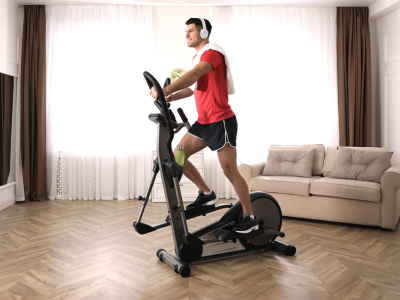
Elliptical – description and uses
Definition, features and history of the elliptical trainer
Definition and features
An elliptical trainer is not a bicycle, even though it resembles an exercise bike. In fact, this machine does not have a saddle. It is a cardio training machine, designed to improve cardiovascular and respiratory function. The elliptical trainer is a cross between a stepper, a rowing machine and an exercise bike. This machine is known as an elliptical trainer or elliptical bike. The term ‘elliptical’ derives from the machine’s elliptical shape and the elliptical movement of the pedals.
An elliptical trainer consists of a fixed flywheel, or inertia wheel, connected to two long pedals. The pedals are in turn connected to two handles positioned at the user’s shoulder height. An elliptical trainer is often fitted with a training console offering a range of programmes.
History
The elliptical trainer is a relatively recent invention. Its emergence coincided with the growth of large urban areas and the rise of intellectual professions, which do not require physical exertion. Like many innovations, it arrived on the French market around ten years ago, originating in the United States.
In recent years, the elliptical trainer has taken a prominent place in health and fitness centres as a cardio training machine. It has also found its way into people’s homes, often replacing the exercise bike. This machine offers numerous benefits and is highly adaptable to the needs of all types of exercisers, whether amateur or professional, beginner or experienced.
How an elliptical trainer works and who uses it
How an elliptical trainer works
The basic operation of an elliptical trainer is simple. You hold onto the handles. The vertical handles are moved in the same way as on a rowing machine, that is, back and forth. Your feet remain in constant contact with the pedals or footrests and follow the movement. Depending on the position of your feet and hands, you’ll work different muscle groups. The training console, a sort of on-board computer, is the trickiest part to use, but advice from a gym instructor will help you get to grips with it.
Elliptical trainers feature a resistance or braking system that allows you to adjust your training programmes. The brake is therefore essential to the machine’s operation. The most basic braking systems are belt-driven resistance systems. The strap wraps round the flywheel and the pedal. However, this type of resistance is not very durable and is quite noisy. The magnetic resistance brake, consisting of magnets around the flywheel, allows manual adjustment via a control on the handlebars. A similar system, which does not require manual adjustment, is available with a motor. Electromagnetic resistance works via an electromagnet. This latter type of brake is the most precise and smooth. The electromagnetic resistance system can be powered by electricity or by the pedalling motion.
When using an elliptical trainer, sportswear is required, in particular trainers or sports shoes. You might opt for shorts and a T-shirt. A bottle of water or an isotonic drink should be within easy reach. It is indeed essential to stay hydrated before, during and after your session. Finally, if a heart rate monitor is not built into the on-board computer, it remains essential when exercising on an elliptical trainer.
Elliptical trainer users
The elliptical trainer is suitable for people who want to lose weight and for those who wish to keep their bodies in good shape. Ideal for toning muscles, the elliptical trainer enables significant calorie expenditure. Using it improves blood circulation and heart function, and helps to lower triglyceride levels, blood pressure and improve glucose tolerance.
This machine is also recommended for people who have suffered physical injuries and need to resume physical activity. Doctors readily recommend exercises on an elliptical trainer as part of rehabilitation following an injury or even a heart attack, as well as for older people wishing to keep fit. People prone to back or knee problems, or those with mild tendonitis, can also use an elliptical trainer.
The elliptical trainer is an effective tool for athletes wishing to train for sports requiring good endurance: running, cycling, athletics, etc. For professionals, the elliptical trainer is the machine of choice for endurance training. There are virtually no contraindications to using an elliptical trainer, making it the ideal piece of equipment for fitness coaches.
Training on an elliptical trainer
Heart rate and target zone
Before starting a workout on an elliptical trainer, you need to know your maximum heart rate (MHR). This is calculated approximately by subtracting your age from 220. The formula is as follows: 220 – age = MHR. For a 40-year-old, the MHR would therefore be 180 (220 – 40). Heart rate can also be measured during specific training sessions.
The target zone corresponds to the exercise zone relevant to weight loss. It consists of a starting zone and an end zone, i.e. the maximum number of beats per minute that must not be exceeded. The formula for calculating the zone is: 60% × MHR for the lower limit and 70% × MHR for the upper limit. For a 40-year-old, the target zone for weight loss will be between 108 and 126 beats per minute.
Exercises aimed at weight loss actually involve reducing the amount of superficial fat located in the deepest layer of the skin, rather than the deep fat that serves as a reserve. During training, monitoring your heart rate is therefore the best way to ensure you do not exceed the pre-calculated target zone. This is done using a specialised sensor or a heart rate monitor.
Training duration
For the exercise to be truly effective, each session should last at least 30 minutes, or even 40 minutes. Training should take place between two and four times a week. Any shorter than this, calorie expenditure is insufficient and the physical exertion is therefore very low. It is advisable to train regularly rather than occasionally.
Each session must, of course, be tailored to the individual’s state of health and needs: you should choose between focusing more on muscle strength or, conversely, on building up endurance. A warm-up before the session is essential. To do this, set the resistance to the minimum. Rest periods should be included after each intense exercise. Keeping an eye on the heart rate monitor will help avoid sessions that are too intense or, conversely, ineffective because they are too far below the maximum heart rate. Warming up and taking rest periods are the best ways to avoid muscle soreness. Stretching after a session is beneficial.
Training at a higher level involves shorter but more intense sessions. These might, for example, consist of 4 sets of 2 minutes followed by 5 sets of 3 minutes, interspersed with recovery periods. Athletes who are already very fit can undertake even shorter and more intense sessions: lasting between 30 seconds and 2 minutes, by the end of which the maximum heart rate is reached. Sessions may also consist of 6 sets of 30 seconds followed by 2 sets of 1 minute. In this case, the heart rate exceeds 95 per cent of the maximum heart rate for that level of exertion.
Elliptical training for weight loss
Burning calories and losing excess body fat is the goal for many people. An elliptical trainer is a highly effective piece of equipment for this purpose. Exercising on an elliptical trainer also has a positive effect on mental well-being.
Lipids, or fats, are essential for brain development, help protect against cardiovascular disease, act as energy reserves and, more generally, are necessary for the proper functioning of cells. However, some of this fat is excess. The subcutaneous fat stored in the deepest layer of the skin is targeted by exercise programmes or diets designed to combat excess weight.
With an elliptical trainer, a person can burn off this subcutaneous fat much more quickly than with most fitness machines – and, above all, in a more enjoyable way. It has been proven that a person can burn a similar number of calories on an elliptical trainer as on a treadmill, but the experience is much gentler on the elliptical trainer. The pedals are used in both directions, which engages the muscles in different ways. Reverse pedalling exercises, for example, are effective for toning the glutes and the backs of the thighs.
Choosing your elliptical trainer
Choosing a model
Length and weight
Before buying an elliptical trainer, it’s best to try one out at a gym first. When buying an elliptical trainer, there are many factors to consider, starting with the user’s weight and height. The choice of an elliptical trainer will also depend on your fitness level, the features you want, and the design. The structure of the elliptical trainer, or frame, can be heavier or lighter and therefore more or less stable depending on the user’s weight. When using an elliptical trainer, the body is under constant strain. Consequently, a person who is slightly overweight will not be well-suited to an elliptical trainer that is too light, as this risks damaging parts and warping the flywheel.
The length of an elliptical trainer depends on the user’s height. A person over 1m80 tall should choose an elliptical trainer longer than 1m30. The frame of the elliptical trainer must be suitable for the user’s weight. A 16-inch model is preferable for a person of small or average height and is suitable for beginners. It also takes up less space in a room. A 19-inch model – that is, approximately 50 cm – will suit a larger, taller person and allow for longer strides.
The elliptical trainer’s flywheel
The weight of the flywheel should be a key consideration. A so-called ‘light’ flywheel – that is, weighing less than 8 kg – offers less resistance. It is suitable for a person of smaller stature. A flywheel weighing more than 8 kg will be more suitable for a taller person. The number of flywheel revolutions per pedal revolution – known as the gear ratio – should also be taken into account. For a higher-quality workout, a high gear ratio is preferable. There are two flywheel diameters: 40 and 50 cm. The 50 cm diameter allows for a higher gear ratio.
Front wheel or rear wheel? Most elliptical trainers are fitted with a rear wheel, but some models feature a front wheel. With a front-wheel machine, the body’s movement is similar to that of cross-country skiing. This can be beneficial for people with knee problems as there is much less strain on the knees.
Choosing the features and accessories for an elliptical trainer
The pedals along the pedal arm may be adjustable to change your body position.
Non-slip pedals are also available. An elliptical trainer may have a fixed handlebar or a handlebar with two grips. However, if you wish to give your whole body a workout, it is preferable to choose a model with two grips.
You should consider how easy it is to store and how it folds away. Choosing a stabiliser is also important. Some elliptical trainer models offer features such as castors and levelling feet. Levelling feet are attached to the base of the elliptical trainer. Accessories such as a fan and a bottle holder are available as optional extras.
Choosing an elliptical trainer with programmes
On-screen display
To ensure the best possible workout, an elliptical trainer is fitted with a training console offering a variety of programmes. These programmes provide valuable information on distance covered, average speed and workout duration. Depending on their level of sophistication, they can also display heart rate per minute, resistance level, calories burnt and a range of other data such as power in watts and pedalling cadence.
When choosing a training console, it is advisable to consider how you intend to use the elliptical trainer in the long term. You should take the screen’s visibility into account. A good-sized screen is preferable. Backlit LCD screens are available.
Programmes
Motivational programmes provide a pace to follow. The standard programme allows the machine to be adjusted to the resistance provided by the user. More complex programmes are also available. The pulse-control programme adapts to the user’s cardiovascular capacity by regulating resistance and pace. The ‘watts’ programme calculates an endurance level based on the user’s heart rate, age and weight. The customisable programme allows for tailor-made workouts.
The ergometer function is available on elliptical trainers with motorised magnetic and electromagnetic resistance. It allows you to programme workouts based on your heart rate. The most sophisticated elliptical trainers offer the option to save programmes for later use, or even to save programmes downloaded from the internet. There is also a ‘body impedance’ function, designed to measure body fat percentage: ideal for workouts aimed at reducing excess weight.
Prices and buying elliptical trainers
The price range is wide: between 100 euros and 9,000 euros. The average tends to be between 400 euros and 1,000 euros. The David Douillet elliptical trainer, for example, costs between 260 and 400 euros. BH Fitness models cost between 400 and 600 euros, whilst the VFit elliptical trainer costs around 400 euros. The Dunlop XC 150 elliptical trainer, weighing 12kg and featuring 16 difficulty levels, retails for around 1,000 euros.
On the website www.habitatetjardin.com, you’ll find the elliptical trainer that suits you best at the best price. This is because the set-up and running costs of a website are lower than those of traditional shops, so the savings are clearly reflected in the prices. What’s more, your elliptical trainer will be delivered straight to your door.
Advantages and disadvantages of an elliptical trainer
Advantages of the elliptical trainer
An elliptical trainer allows you to train both your cardiorespiratory and cardiovascular functions whilst providing a full-body workout. It engages numerous muscle groups: those in the legs and glutes (gluteus maximus and medius, adductors, quadriceps, calves) and those in the upper body (shoulders, abdominals, arms, chest, back). The main advantage of the elliptical trainer is that it is just as effective as running, without the negative effects. Indeed, with the elliptical trainer, there is no impact with the ground that can cause joint problems or damage to the knees. The elliptical trainer allows for a gentle workout whilst improving respiratory capacity and muscle mass. The movements produced by the elliptical trainer – which combine elements of running, walking and climbing stairs – are therefore low-impact.
The elliptical trainer is increasingly preferred to other gym equipment such as the treadmill and the rowing machine. When compared to the treadmill, the elliptical trainer is less stressful on the knees, ankles and spine. On the other hand, the treadmill does little to work the upper body. The same applies to the exercise bike. Conversely, the rowing machine, which puts more strain on the back, mainly works the upper body and is therefore a less comprehensive piece of equipment than the elliptical trainer.
Buying an elliptical trainer for your home pays for itself very quickly. Not only is it easier to train at home, but it is also cheaper than a gym membership. What’s more, it doesn’t take up much space and you can use it at any time, morning or evening. However, it is advisable to start exercising on an elliptical trainer in a more formal setting, such as a fitness centre, so that you can receive tailored advice on difficulty levels and intensity. For professionals in sports and fitness centres, purchasing one or more elliptical trainers has now become almost a necessity, particularly as this machine is highly sought-after by users, given its many benefits.
Disadvantages of the elliptical trainer
The elliptical trainer has far more advantages than disadvantages. The main disadvantage is the monotony, especially if you always stick to the same exercises. To break up the monotony, you can listen to music or watch television whilst exercising.
Furthermore, don’t hesitate to vary your pace and explore all the programmes available on the training console. There are also tiered exercise programmes, led by coaches and available in MP3 format. The list of benefits of using an elliptical trainer, compared with its minor drawbacks, explains the growing popularity of this innovative piece of equipment.