
Your cart
There are no more items in your cart
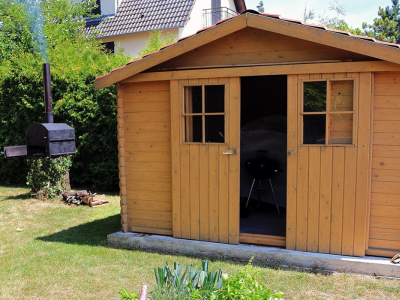
Garden shed – Maintenance
Garden shed – Protection
There’s no doubt that a wooden garden shed has plenty of charm. However, the wood needs to retain all its aesthetic qualities and strength. A garden shed is the best choice right from the start. In the industry, ‘high-end’ timber is treated from the outset in a pressurised autoclave (a large cylinder) in three computer-controlled phases.
This treatment produces the following effects:
- The air within the wood’s cavities is completely removed. The pores are opened.
- The sapwood is infused with mineral agents under pressure; these are natural, environmentally friendly preservatives.
- A new vacuum is created during the draining process. This involves removing any excess injected liquid, much like a sponge.
This treatment protects the wood against insects, fungi, rot and termites. It provides a guaranteed lifespan of over 10 years.
The treatment of other types of timber must be carried out by the owner in two stages:
- Before assembly, the components (timber planks, panels, gables, frames, etc.) must be coated with a first layer of insecticide and a second layer of fungicide on all sides.
- After assembly, a wood stain treatment must be applied to both the interior and exterior surfaces. The tinted paint filters out ultraviolet rays and helps the wood retain its original colour. The exterior wood stain treatment must then be reapplied once every two years.
Garden shed – Products
Choosing maintenance products
Choosing the right products for maintaining a wooden garden shed is important. Maintenance paints available on the market vary in quality:
- Wood stains that completely cover the wood and provide long-lasting protection? Less frequent maintenance = savings in time and money. Their main drawback is that they conceal the wood’s natural grain, which runs counter to the desire to blend the shed into the garden’s natural surroundings.
- Transparent wood stains that preserve the wood’s original appearance (grain, knots, pigments, etc.). In return, the garden shed will require more frequent maintenance.
- Class 3 wood stains are intended for above-ground timber, whilst Class 4 stains are used for timber buried in the ground.
Once you have chosen the product, you will need to buy the other supplies: impregnating oil, a synthetic thinner such as white spirit, and sandpaper in two grades (fine and coarse). The tools required for maintenance consist of a cloth, a flat brush, a short-pile wool roller and a hand brush. For garden sheds made of materials other than wood, maintenance will naturally depend on the material in question. In principle, the manufacturer will provide all the necessary advice upon delivery. It is therefore important to follow the instructions in the manual and to keep it in a safe place.
Maintenance steps
Maintaining a wooden garden shed is carried out in successive stages. It is advisable to proceed as follows:
- Preparing the wood:
- New timber with an intact finish should be sanded (in the direction of the grain) using fine-grain sandpaper. If the finish is damaged, sanding (on dry or wet timber) should be carried out using coarse-grain sandpaper. After cleaning, the wood should be coated on all sides with a layer of impregnating oil.
- Old wood (such as fir or cedar) must be degreased using synthetic thinner, then dried and sanded (the choice of sandpaper depends on the condition of the wood).
- Applying the wood stain:
- First, mix the wood stain according to the instructions on the label. Using a medium-sized flat brush, apply a first coat of wood stain in the direction of the grain to ensure the product penetrates as effectively as possible. Drying may take 4 to 6 hours. If the wood stain is satin-finish, the wood must be sanded before applying the second coat to ensure maximum penetration of the product.
- A minimum of three coats of wood stain is required for new timber.
Habitat et Jardin is, of course, here to answer any questions you may have regarding the protection of a garden shed.
Copyright protected under Articles L. 111-1 and L. 123-1 of the Intellectual Property Code.