
Your cart
There are no more items in your cart
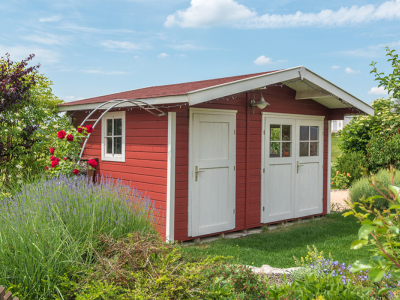
Garden shed - Price
Garden shed – Choosing the size and how it affects the price
Choosing the size of a garden shed
The factors influencing the price of a garden shed depend mainly on its size, the materials used, the design and the optional extras. It stands to reason that the size of the garden shed affects its price. It is therefore important to clearly define the floor space you require.
The choice of size will depend largely on the intended use. Whether you’re using it to store a few items, set up a workshop or even turn it into a temporary living space, the size you’ll need for a garden shed will vary accordingly. The size of this lightweight structure will depend on the usable plot area, whether the land is suitable for building on, and the available budget.
The size of a garden shed naturally depends on the available floor area. It also depends on whether the land is suitable for building on. For gross floor area (GFA) of up to 20 m², a simple declaration to the local council is sufficient. However, for areas exceeding 20 m², you must apply for and obtain planning permission.
From a practical point of view, small sheds (under 6 m²) are generally regarded as storage spaces for small tools or bicycles, but are not large enough to accommodate a workbench, for example. On the other hand, garden sheds measuring between 5 and 15 m² are suitable for storage or for carrying out activities requiring larger spaces. In this case, the garden shed is no longer just a simple storage space, but can become a DIY workshop or a space for any other leisure activity.
How size affects the price
From an area of around 15m² upwards, a garden shed is generally chosen to be converted into a temporary living space, such as an outdoor kitchen or a guest bedroom… In this case, there are more constraints. Firstly, a minimum height of 2.20 m must be maintained. Furthermore, better insulation is required than for a simple garden shed, which is more expensive. Natural light is also essential, so one or more sources of natural light (windows, doors, etc.) must be incorporated. These comfort features naturally increase the cost of the investment.
It makes sense that the price of a garden shed is proportional to its size. However, the type of fittings and materials used have a very significant influence on the overall cost of what is considered a lightweight structure. The smallest garden sheds have floor areas of less than 5m² and can cost between €200 and €1,000, depending on other factors such as the type and quality of the materials. These sheds, which are the cheapest, are only suitable for limited uses.
The next category comprises garden sheds with a floor area ranging from 5 to 10 m². These sheds can cost, on average, between €500 and €2,000 depending on their quality. Their size allows for more space-intensive uses. These are typically used as additional storage sheds.
Garden sheds measuring 10 to 15 m² can cost between €700 and €5,000. Those ranging from 15 to 20m², which offer the possibility of converting them into a living space such as a guest bedroom or an outdoor kitchen, can cost between €1,000 and €8,000. These price ranges are for guidance only, given the variables relating to the fittings and materials used in a garden shed.
Garden sheds – How materials affect the price
General information
As well as its size and fittings, the price of a garden shed depends on the construction materials used in its design. Indeed, the price of the materials chosen varies considerably depending on their type and quality. Generally, a garden shed is made of wood, metal (aluminium or steel) or PVC.
The choice between these different materials will depend on the available budget, intended use and climatic conditions.
PVC
A PVC garden shed is undoubtedly the cheapest option. However, it is less durable than wood or metal. PVC is the least expensive material to buy and also the cheapest to maintain. Indeed, PVC requires no maintenance whatsoever, but it is still only a medium-quality insulator.
The main drawback of a PVC garden shed is its appearance. Indeed, when situated next to the house, it tends to detract from the overall aesthetic appeal. A PVC garden shed can cost between €300 and €1,500, depending on its fittings and openings.
Steel or aluminium
Metal garden sheds are generally made of aluminium or steel. Metal garden sheds are more expensive than those made of PVC, but cheaper than wooden ones. They are very durable. However, metal garden sheds are poor insulators. Steel is strong and can provide good insulation, provided it is double-walled. A double-walled garden shed is naturally more expensive.
A metal shed is, however, more attractive than a PVC shed and requires only minimal maintenance. As with steel, it is recommended to choose a double-walled aluminium shed for good insulation. One of the advantages of aluminium is that it requires no maintenance, which is a great benefit over time.
Wood
A wooden garden shed is far more attractive than a lightweight PVC or metal structure. Indeed, in every case, a wooden garden shed will enhance the overall appearance of the property it complements. Furthermore, the various types of wood offer a pleasing range of colours and provide excellent insulation.
In principle, a wooden garden shed is more expensive than a metal one. However, it is worth noting that even within the category of wooden sheds, there are significant price differences. Indeed, the thickness of the planks and, above all, the type of timber used, cause costs to vary very significantly. Cedar and autoclave-treated pine are the most expensive, but require very little maintenance. On the other hand, Northern fir, for example, needs to be treated approximately every two years. Prices vary widely depending on the type of wood chosen (from €200 to €10,000).
The disadvantage of wood is that it requires regular maintenance, which represents a significant additional cost. For wood that is not rot-resistant, a coat of wood stain needs to be applied on average every five years. However, given all its benefits, a wooden garden shed offers numerous advantages.
Garden sheds – How design and options affect the price
Design
Nowadays, great importance is attached to a product’s design. As a garden shed plays a significant role in the setting of a home and garden, its aesthetic appeal is a key factor. This aspect cannot be ignored from a financial perspective.
The style of the shed, its finishes and its colour will inevitably affect the price. The more elaborate a garden shed is, the higher its price will be. The somewhat irrational nature of design can, in some cases, be reflected in the price of this lightweight structure, which is both practical and imbued with symbolism. Design is therefore a factor that can have a significant influence on the price of a garden shed. It is up to each individual to strike the right balance between practical needs and aesthetics.
Options
There are numerous options available for a garden shed. These mainly concern the windows, the roof and the insulation. The number and type of windows will have a direct impact on the overall cost of a garden shed. A garden shed converted into a living space will require more windows than one used simply for storage. The type of door – single or double, glazed or unglazed, secure or otherwise – and the materials used in its construction will increase the cost of the shed to a greater or lesser extent.
The type of roofing will significantly affect the total price, as there are several options available. You can choose from shingles, bituminous roofing sheets, slate, tiles, metal sheeting or PVC sheeting… Furthermore, depending on its intended use, the garden shed may be more or less well insulated.
In summary, it can be said that the price of a garden shed varies according to its size, the materials used in its construction and the options selected. Any price comparison must take into account the multitude of factors we have mentioned. The policy of low prices and high-quality products offered by HABITAT ET JARDIN is the best guarantee available to those considering the purchase of a garden shed.
Copyright belongs to the company (Articles L. 111-1 and L. 123-1 of the Intellectual Property Code).