
Your cart
There are no more items in your cart
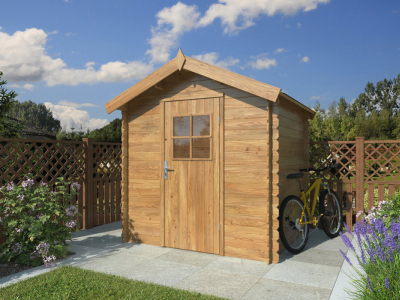
Garden shed – structure
Garden sheds – Materials and types of sheds
Choosing materials
The choice of material for a garden shed depends on the nature of the activity that will take place there (storage of equipment, workshop, etc.). Other factors may also come into play:
- Weather conditions: humidity levels, heat and wind can influence the choice.
- The environment: the garden shed must comply with the standards applicable in the region. It must not be an exception to these rules.
- Prices: these vary according to several criteria (material, surface area, finish and quality, design, etc.) within the budget allocated to this project.
- Awareness of sustainable development issues: the choice of timber despite its relatively high price.
Types of garden sheds
Traditional types
Depending on the construction material, there are three main types of traditional garden shed:
It should be noted that wooden models account for over 60 per cent of sales. Models made from pine or northern fir are sold at moderate prices. In contrast, those made from ‘marine’ or ‘exotic’ woods are considered ‘high-end’ products. In commercial terms, wooden garden sheds come in two different designs:
- ‘Panel sheds’ are constructed from panels over 10 cm thick, attached to thicker ‘frame covers’. They are mainly used for storing garden furniture, lawnmowers or garden tools.
- ‘Interlocking sheds’ are aesthetically similar to forest chalets. With optimal thermal insulation, they can easily be converted into a living space for the family.
PVC is the cheapest option on the market. It is available in a wide range of colours. Metal garden sheds, made from aluminium or hardened steel, are slightly more expensive.
Sophisticated and luxurious types
A garden shed – whether a basic, sophisticated or luxurious structure – is distinguished by its materials and design. Concrete is available in the form of slabs with a wood-effect finish (offering strength and durability). Concrete blocks are a sensible choice if the owner decides to carry out the work themselves. Resin is used in certain models sold as flat-pack kits (quick assembly). Sheet metal can be used in garden sheds with limited floor space.
Luxury garden sheds include the gazebo and the arbour:
- The kiosk is a legacy of the past. With a steel roof and supports, the kiosk is open on all sides. Overlooking the rest of the garden (the audience area), it used to host orchestras or brass bands (at evening events and private parties). Nowadays, the bandstand is once again becoming a romantic and luxurious reception area.
- The gloriette consists simply of steel supports and a roof covered solely by climbing plants or removable canopies.
Garden shed – Advantages and disadvantages
PVC garden shed
As well as their reasonable prices and a wide range of colours, PVC garden sheds offer various advantages:
- Assembly and dismantling: these tasks have become straightforward thanks to the instructions supplied with flat-pack models.
- Maintenance: used primarily for storing tools and equipment, these products require no maintenance.
Among the disadvantages of a PVC garden shed are:
- Durability: as they are not very sturdy, PVC products have a limited lifespan. When exposed to the elements, their colour fades quickly and their frame can warp.
- Aesthetics: as industrial products, they do not blend well with the natural surroundings. Their appeal is very limited.
- Insulation: with very poor insulation, PVC garden sheds are cold in winter and hot in summer. As a result, they are unsuitable as living or working spaces.
- Environmental impact: PVC garden sheds are made up of 43 per cent ethylene, a derivative of crude oil, a fossil fuel responsible for over 60 per cent of CO₂ (the primary GHG: greenhouse gas) in the atmosphere (global warming, climate change, etc.). Furthermore, oil is a non-renewable resource. Despite the recycling of some PVC waste, this product remains a source of pollution for our environment.
Metal garden shed
The main advantages of a metal garden shed are:
- Their strength: made from hardened (galvanised) steel or aluminium, metal garden sheds have demonstrated unrivalled durability. They are highly resistant to deformation.
- Maintenance: they require only the bare minimum. An anti-corrosion product may suffice without the need to call in a professional.
- Steel and the environment: amongst waste materials, and given its magnetic properties, steel can be easily separated and recycled. It is 100% recyclable, and can be recycled an infinite number of times without losing its properties. This helps to conserve iron ore resources, the raw material used in steel production.
Their main drawbacks are:
- Their fragility: with the exception of double-walled models, a metal garden shed struggles to withstand strong gusts of wind in regions such as Normandy or Brittany. If you are obliged to buy a steel or aluminium garden shed (for financial or other reasons), you must ensure it is protected from the wind.
- Appearance: with a few exceptions, the design and appearance of a metal garden shed are rather unattractive.
Wooden garden shed
Environmental benefits
There is no doubt that wood is considered a renewable natural resource. In France, annual forest growth is estimated at 81 million m³, whilst logging does not exceed 50 million m³. Despite the summer’s forest fires, wood remains an abundant resource. Ordering a wooden garden shed helps to reduce pressure on other resources (minerals, energy, etc.).
As a natural material, timber preserves the beauty of the countryside. Using timber encourages public authorities to invest in forest management, which is highly beneficial in combating global warming (through photosynthesis, forests are the second-largest reservoir of CO₂ after the ocean). In the long term, the panels or planks of a garden shed are easily recyclable: they can be turned into fuel, composite timber or various types of agglomerated materials. Wood waste poses no danger to the environment. When treated with organic products, wood does not emit any chemicals, unlike PVC.
Economic benefits
With insulation properties far superior to those of steel, PVC and even other building materials such as stone, brick and cement, timber helps to reduce energy bills. This factor is particularly important to bear in mind for garden sheds fitted with heating or air conditioning. Assembling and dismantling a wooden garden shed is quick and easy, unlike with PVC or metal structures (which involve heavy equipment, etc.), saving both time and money.
Unlike other types, a wooden garden shed can be erected on low-cost foundations. Water consumption is minimal. Unlike PVC (which can warp, etc.) and metal (which can rust, etc.), wood stands the test of time.
Copyright protected under Articles L. 111-1 and L. 123-1 of the Intellectual Property Code.