
Your cart
There are no more items in your cart
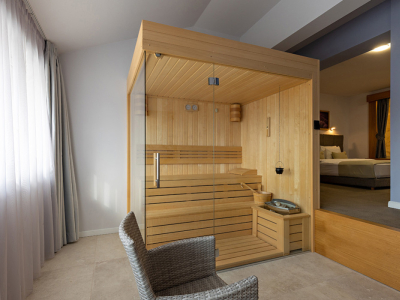
Sauna – Definition
Sauna – Description
Sauna is a Finnish word derived from ‘savuna’, meaning ‘in the smoke’. It is one of the few Finnish words to have been adopted into the French language. Until the mid-20th century, translators used the feminine form to reflect the Finnish steam room. However, nowadays ‘sauna’ is accepted in the masculine form to correspond to the Finnish-style dry steam bath. ‘Sauna’ thus refers to a dry steam bath. ‘Sauna’ also describes the wooden huts, fitted with benches, where one takes a dry heat bath. Finally, ‘sauna’ refers to the apparatus used to take a steam bath. On a larger scale, ‘sauna’ refers to a public or private establishment comprising several rooms for dry steam bathing. A sauna cubicle is slightly larger than a shower cubicle.
To generate the steam in a sauna, hot stones are placed in stoves. These are then doused with water drawn from a small wooden basin using a ladle. People undress in the changing room before entering the hot room. They choose a seat that suits them on the benches. The highest seat is the hottest. Between sessions in the sauna, participants sometimes plunge into a hole cut in the ice nearby, as is customary in Finland.
Sauna – History
The sauna in Finland
Origins
In the beginning, the Finns built the sauna before their living quarters. In the *Kalevala*, which recounts the mythological history of Finland, the main characters used the sauna constantly. People living in country homes used to take a dip in a lake or river after the sauna, whatever the season. In winter, they would always start by cutting holes in the ice in preparation for the sauna.
Archaeologists have discovered that the earliest Finnish saunas were large holes dug into hillsides. They were large enough to accommodate an entire tribe. The holes were covered with a roof to protect users from the cold and rain. They were later converted into underground saunas.
The original purpose of the sauna was therefore to take a hot steam bath, to wash and purify the body. Furthermore, the sauna provides a sense of well-being in every season. Later, the use of the sauna – definition – was discovered in the medical field. Before hospitals existed, Finnish women gave birth in family or communal saunas. And the wounded were treated in saunas, as hygiene was better there.
Modern history
Mastery of woodworking later made it possible to build small wooden huts, stacked in the style of log cabins. These types of huts spread throughout Europe. They became smoke saunas, commonly known as ‘étuves’ in France. The sauna has existed for around 2,000 years in Scandinavia and Finland. It was invented by the Finns as an effective way of combating the effects of extreme cold on the body. The sauna was also a means of inducing sweating to eliminate toxins. At the same time, the body was cleansed and left feeling more relaxed.
The sauna is also a popular family tradition. It is enjoyed by families as well as the wider community. The Finns regard the sauna as a place to unwind, in a friendly and hygienic atmosphere. Admission to the sauna is separate for men and women. Furthermore, the sauna plays an important part in Finnish social life. The sauna is not just a place to wash, relax and refresh the mind. It is also a place for conversation, discussion or negotiation.
A house without a sauna would be out of the ordinary for a Finn. Finns go to the sauna once a week, usually on a Saturday. However, there is no set rule on how often one should go to the sauna. Finns go whenever they feel like it. In a Finn’s city flat, the sauna is heated by electricity. At their holiday home, they still use a wood-burning stove. The sauna is prepared every evening during the summer, particularly when doing strenuous work.
For a Finn, going to the sauna seems as natural as having a meal or going to bed. The sauna is such an integral part of everyday life for Finns that they have incorporated it into their sayings. One example is ‘sisulla saunaan’, which means ‘let’s bravely go to the sauna ’. And then there are ‘saunassa sappi sammuu’ and ‘vihtoen viha viilenee’, which translate as ‘the sauna extinguishes bitterness; the birching soothes resentment’.
Finland is teeming with saunas. There are nearly 2 million saunas for a population of over 5 million. Nowhere else in the world is the sauna held in such high regard as in Finland. The Finnish Naval Academy is home to the country’s largest sauna. A ‘sauna village’, comprising around thirty saunas from all over Finland, has been set up in Muurame as an open-air museum. All this shows that the sauna truly plays an important role in the lives of Finns. Sweden and Finland have taken the art of the dry steam bath to the highest level. At the start of the 20th century, Finnish athletes competing at the Olympic Games, as well as soldiers, declared to the whole world that their achievements were down to the benefits of the sauna.
It is worth noting that the best saunas currently available on the market are Finnish. And they are constantly improving. Whilst they were originally heated with wood and gas, the use of electricity is now becoming predominant. All practical sauna accessories come from Finland. Saunas can be installed in gyms, sports clubs, and health and rehabilitation centres. Today, the sauna has grown considerably in popularity worldwide.
The sauna around the world
The sauna in America
Some North American Indians practised sweat bathing in a tent or in a hut made of stone, earth or wood. This practice was sometimes even incorporated into their religious rites. The water was heated using stones that had been heated beforehand. Archaeological excavations have also revealed the existence of sauna facilities amongst the Aztecs and the Maya 1,200 years ago.
In South America, the Pueblo Indians used steam baths. The Native American tribes of Canada and the United States were already familiar with the sauna. They used sweat lodges made of branches. Here too, the steam was produced using stones heated over a wood fire.
The sauna in Europe
The sauna in Central and Western Europe
Europe had also taken an interest in the sauna, following the Finnish tradition. However, in the Middle Ages, nudity and the gathering of naked people in the same room were banned by the Catholic Church in Central and Western Europe. Public bathhouses and steam rooms were therefore closed down. The reason given was that the sauna was blamed for the widespread devastating diseases of the time, such as the plague. It was believed that these diseases took hold in the body when the pores were dilated. They were thus thought to trap the putrid vapours inhaled in the sauna. This subsequently gave rise to the practice of so-called ‘dry’ hygiene, championed in France by Louis XIV.
However, in countries such as Russia and the Nordic regions, which adopted Christianity much later, the sauna continued to be practised. Both the Orthodox and Lutheran churches recognised the hygienic benefits of the sauna for the general population. In Russian folklore, it is said that a small, tamed spirit – sometimes mischievous, sometimes cruel – inhabits the bathhouse. The Russian sauna was made from a wooden log and fitted with a stone stove inside. The sauna was operated by pouring water over the hot stones. In the 18th century, this steam bath system spread throughout Central Europe.
The sauna in Greece, Rome and Ireland
Bathing establishments already existed in Greece 700 years before Christ. Shortly afterwards, most gymnasiums incorporated these sauna rooms. The sauna experience in these establishments took place in two stages: first dry air, then humid air. Afterwards, bathers would rinse themselves with hot and then cool water.
Rome had adopted the method of using these sauna baths by the 4th century BC. Large establishments offering a variety of activities began to appear. The sauna technique – as defined – involved spending time in a hot room with dry air, followed by rinsing with cool water.
The sauna was practised by the Irish in the 11th century. The hut was built from piles of stones stacked one on top of the other. Twigs and peat were used to heat the sauna stones. Once the hut had been heated, the bathers removed the embers and covered the floor with reeds and peat. One had to crawl to enter the sauna. This tradition disappeared in the 19th century.
Readers wishing to find out more about the sauna are invited to refer to the other articles on the subject on this website.
Copyright protected under Articles L. 111-1 and L. 123-1 of the Intellectual Property Code.