
Your cart
There are no more items in your cart
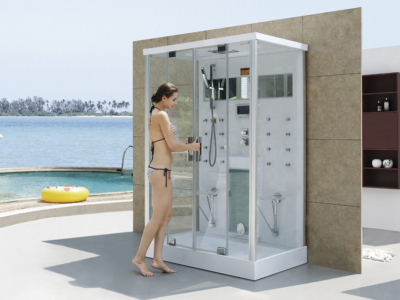
Shower cubicle – description and uses
Definition and history of the shower cubicle
Definition
A shower cubicle is defined by the following elements:
- its walls
- the raised shower tray with its drain,
- the transparent doors,
- thermoformed profiles and fixed panels,
- the complete set of taps and fittings and assembly screws (often made of stainless steel)
- the drain plug.
The shower enclosure can also be fitted with various optional extras such as a built-in seat, storage shelves or even a mirror. The shower enclosure is often supplied as a flat-pack kit and can be assembled in half a day. However, it is essential to connect the water supply and drainage.
Various models are available for purchase, including those made from polyester or impact-resistant polystyrene. The walls and doors, meanwhile, are made from synthetic or safety glass, and range in size from 70 cm to 1 metre on each side. The doors can be either sliding, folding or hinged.
As for the fittings, the trend is towards hydromassage shower columns, sometimes with steam room or even sauna functions. For families with children, it is best to choose thermostatic mixers to avoid any risk of accidents. The interior of the shower cubicle should measure at least 80 x 80 cm to ensure greater comfort.
As for shower trays, most are made of acrylic or sanitaryware ceramic.
As for bespoke shower trays made of tiles, marble or stone, only professionals are qualified to install them.
History
Thanks to Egyptian and Greek paintings and wall frescoes, we can trace the ancient origins of showering. The use of showers has probably existed ever since humans learnt to store and pour water. Indeed, as early as the 5th century BC in Delphi, gymnasts used cold-water showers fed from the mouths of sculpted animals.
In France, it is believed that the practice of showering was introduced by Jean Pidoux, a physician at the court of King Henry III. He wrote a treatise entitled ‘The Virtue and Use of the Fountains of Pougues and the Administration of the Shower’, published in 1597. In this collection, he set out the rules to be followed when taking showers and even described the various types of shower available. However, he very quickly encountered mistrust of water on the part of the medical profession. Indeed, at that time, water was regarded as a vector for the spread of disease. It was therefore not until the end of the 18th century that showering came to be regarded as essential.
From the 19th century onwards, public bathhouses began to proliferate. However, the shower did not appear in France until around 1872, thanks to Dr Merry Delabost, chief medical officer at Bonne-Nouvelle prison in Rouen. In order to improve prisoners’ hygiene, he proposed replacing baths – which were too time-consuming and too costly – with communal showers featuring individual hot-water jets. Merry Delabost explained it as follows: ‘It is by no means a question of providing prisoners with a sense of well-being. A prisoner’s good health makes it possible to require them to perform work, the proceeds of which reduce the costs of imprisonment accordingly.’
Showers were very quickly adopted by other public authorities. It was only later that the general public began to benefit from them, thanks to the establishment of public bathhouses. The first public bathhouse opened its doors in Austria in 1887. In France, it was not until 1899 that Charles Cazalet established the first public bath and shower facilities, first in Bordeaux in 1893 and then in Paris in 1899. The shower cubicle is of much more recent origin.
Installing a shower cubicle
Installation techniques and steps
Several steps are required to install a shower cubicle. Firstly, before any work begins (and particularly in the loft), the stability of the floor must be checked. As for the actual fitting of the shower cubicle, this is also a very delicate process, particularly when it comes to ensuring it is watertight. It is also important to consider the water vapour produced by the shower, which must be removed by installing a low or high vent, or via a mechanical ventilation system.
In practical terms, there are four main stages involved in installing a shower cubicle:
- Firstly, position the shower tray on the floor without water and trace its outline on the floor. You should also mark the vertical projection of the drain.
- Next, fit the drain plug into the hole in the shower tray. Place sealing washers on either side. Next, mix a rich mortar and spread it inside the outline of the shower tray to a thickness of approximately 5 cm.
- Next, position the shower tray, wiggling it slightly to ensure it sits securely on the bed of mortar.
- Finally, fit the trap beneath the drain and connect its outlet to the waste pipe.
The taps and the shower bracket are fitted into the pre-drilled, thermoformed holes provided by the manufacturer. A PVC pipe is then used to connect the shower hose to the mixer tap and the drain plug to the waste pipe. You must also connect the hot and cold water hoses to the main water supply. Finally, to ensure a watertight seal, a mould-resistant sanitary silicone sealant must be applied along the edge of the shower tray and the profiles.
Drain and shower tray
Fitting a shower cubicle begins with installing the drainage system. After marking out the outline of the shower tray and positioning the drain, you must measure its height relative to the support surface of the shower tray. This technique helps determine the position of the drainpipe. Next, the pipes of the drainage system must be assembled and connected to the existing drainage system. It is also essential to ensure a gradient of at least two centimetres per metre, so that the water can drain away properly. As for the shower tray, you must check that it is perfectly level before fixing it in place with cement or plaster.
It is also essential to provide a PVC drainpipe for the shower cubicle, generally with a diameter of 32 mm. Next, a PVC floor drain is fitted into the shower floor. The drain must then be positioned so that the pipe has a slight slope.
Most shower trays are square and measure 90 x 90 cm. However, some are available in 80 x 80 cm and even 70 x 70 cm sizes. There are also shower trays with a removable panel and a pre-fitted trap.
Fitting the taps
There are two types of taps:
- Mixer taps
- Mixer taps.
A flexible hose connects the tap to the shower head. Sometimes, the shower head can also be mounted on the wall in a suitable bracket. Once the shower enclosure is assembled, all that remains is to fit the taps. In most cases, the holes required for fixing and for the water supply pipes are pre-drilled by the shower enclosure manufacturer.
The taps should be secured and connected to the water supply pipes at the rear of the cubicle using washers and nuts. Only then can you connect the hose to the mixer tap. As a final step, and to check that the shower enclosure is working properly, you must pressurise it and check for leaks for 24 hours.
Integrating the shower enclosure into the room
Nowadays, the shower enclosure has become an essential feature of the bathroom. That is why choosing a shower enclosure has become crucial to the overall design of the room. All the more so as the range available on the market continues to grow, offering:
- integrated shower enclosures
- corner showers
- hydro-massage cubicles
- spa shower enclosures…
Before buying a shower enclosure, you need to decide which features are best suited to the layout of your bathroom and your budget. Indeed, accessories and other options available in shops often add to the final cost. The advantage of a shower cubicle is that it can be installed in any bathroom provided there is a minimum amount of space, a water supply and a drain.
Indeed, the design of a shower cubicle depends on the available space and, of course, the budget you wish to allocate to it. For some, a shower cubicle is simply a means of personal hygiene. For others, a shower cubicle must incorporate hydrotherapy functions. In all cases, the shower cubicle must also take into account the layout of the cold and hot water supply pipes, as well as the drainage options available on the premises.
Specialist shops offer bespoke fitting of shower enclosure components to suit a variety of situations:
- in an attic,
- under a sloping roof section
- in a recess,
- in a V-shape or at an angle
- against a wall or between a spa bath and a wall.
The dimensions of external and internal fixtures in the bathroom, such as sanitary ware, radiators, towel warmers, storage units and taps, must also be taken into account to ensure they do not obstruct the opening of the shower cubicle. In most models, the direction of opening cannot be reversed. You must therefore decide on this when placing your order.
Consequently, to choose the right shower enclosure, you must take into account its location and internal dimensions, as well as the drain’s flow rate and the shape of the shower tray. Nor should you overlook the safety and ease of maintenance of the panels, or the style of door opening, not to mention the height of the panels and the overall watertightness.
The different types of shower enclosure
The traditional shower enclosure
The so-called ‘traditional’ shower enclosure consists of:
- a raised shower tray with its drain, which may, incidentally, be sold separately. The most traditional option remains the ceramic or glazed stoneware tray, which is highly resistant and durable.
- two or even three fixed, thermoformed panels
- transparent panels
- taps and fittings.
A wide range of opening systems are now available:
- an internal door
- external door,
- sliding doors
- folding doors, etc.
For particularly small bathrooms or those with very narrow passageways, round or pentagonal shower enclosures prove to be the ideal solution.
There are various shapes of shower cubicles:
- classic square ones: a square shower tray fitted in a corner
- a corner cubicle with a rounded shape on the outside of the corner, ensuring ample space
- a rectangular shower cubicle
- a so-called ‘fully enclosed’ shower cubicle: this model is enclosed on all sides. These cubicles can be adapted to any shape, from square to round
- Walk-in showers, which are characterised by the absence of a shower tray, sitting flush with the floor.
The hydromassage shower cubicle
Hydromassage shower enclosures comprise the same components as a standard shower enclosure. The difference is that they feature a system of jets which direct water onto different parts of the body to provide a massage. Hydromassage shower cubicles bearing the NF mark meet specific quality requirements. These ‘sanitary installations’ standards (No. 91.140.70) regulate the mechanical and hydraulic operation of the shower cubicle to ensure both watertightness and safety.
There are two types of hydromassage shower cubicles:
- the multi-jet system cubicle. This is supplied directly from the mains water supply. It is the ideal solution where there is high water pressure and flow rate. With this multi-jet system, all the jets operate simultaneously and at the same rate.
- the sequential-system shower enclosure. This allows each nozzle – most of which are electronically controlled – to operate independently, enabling control over the speed and rhythm of the jets.
A hydromassage shower cubicle requires high water pressure and flow rate. It is advisable to install a hot water storage tank of approximately 300 litres. Instant water heaters are generally not sufficient. This type of shower enclosure uses between 20 and 30 litres of water per minute. For a water-recycling shower enclosure, you should allow for 100 to 250 litres. However, water recycling still results in savings. Conventional systems require a minimum pressure of 3 bar. Where the pressure is insufficient and space permits, a booster pump can be fitted. Water-recycling shower cubicles, on the other hand, require a pressure of just 2 bar.
The jets in hydromassage shower cubicles can be controlled manually or via an electronic control system, which, in this case, requires a mains power supply. Hydromassage offers several benefits that are attracting an increasing number of customers:
- muscle relaxation;
- relief from certain types of pain;
- body toning…
Sometimes, this type of shower cubicle even offers aromatherapy functions (diffusion of scents).
The shower cubicle with a steam room function, known as a ‘balneo’
Some hydromassage shower cubicles are fitted with a steam room option that produces steam at a temperature of between 35 and 50 °, with humidity levels of nearly 90 per cent.
This type of shower cubicle offers numerous benefits. From an aesthetic point of view, the temperature helps open the pores, thereby rehydrating the skin. From a biological point of view, these shower cubicles help eliminate acidic toxins through perspiration.
The hydrotherapy shower cubicle therefore comprises:
- a hydro-massage system
- a misting system
- aromatherapy
- a steam room function
- chromotherapy: the principle of chromotherapy involves matching vibrations and rhythms to each colour.
The shower cubicle with a recycling system
The shower cubicle fitted with a recycling system operates in two distinct modes:
- In normal mode: the shower draws ‘fresh’ water.
- In recycling mode: in this case, a 50-litre water reservoir is filled. It is then used in a closed circuit to avoid wastage. Up to 150 litres of water can thus be saved during a shower lasting approximately 15 minutes.
A 10-minute shower in a hydromassage cubicle typically uses around 300 litres of water. Water recycling therefore enables significant savings to be made. This type of equipment is becoming increasingly widespread.
Prices and benefits
The price of a shower cubicle varies depending on several factors:
- the quality of the materials
- the features built into the cubicle
- the dimensions and shape of the shower cubicle.
For an entry-level shower enclosure, you can expect to pay between €200 and €400 for one with plastic panels and doors. However, for less than €200 (including a mixer tap, hose, shower head and shower screen), a standard bath can be converted into a combined bath and shower unit. This is obviously the most economical and easiest option.
In the mid-range, for a price of between €400 and €800, you can find a shower enclosure with a hydro-massage option. The top-of-the-range starts from €800 and offers more meticulous finishes and a hydro-massage function. For several thousand euros, some shower enclosures offer a steam room function and sometimes even a sauna. In this top-of-the-range category, you can also find multi-person shower enclosures.
However, shower enclosures very often come with additional features that drive up the cost:
- a fold-away seat
- built-in radio
- mirror and other accessories
- storage shelf
- hydromassage jets
- slatted floor
- steam room function
- aromatherapy, chromotherapy…
The hydromassage shower cubicle is therefore the most expensive option. In fact, you can expect to pay between €1,000 and €1,500 for such a unit. Some top-of-the-range models can cost several thousand euros. But when you love your body, you don’t count the cost!
Options and accessories for a shower cubicle
Walk-in shower and monobloc shower
The walk-in shower has its origins in the legendary Roman baths. It is the ideal solution for those seeking freedom in terms of shape and size. The walk-in shower is fully tiled or clad in teak, stone, and sometimes even mosaics or pebbles. Fitted with a central drain, the walk-in shower is entirely at ground level. There is no door at the entrance to the cubicle. There is no visible break between the bathroom floor and the shower.
Walk-in showers feature walls that are built and tiled in the same way as the bathroom walls. Sometimes, for a more contemporary look, a glass screen may be fitted. However, this system requires specific waterproofing work.
Hydromassage columns and massage rails
Hydromassage shower enclosures are currently a rapidly growing market amongst private homeowners. These enclosures consist of a unit fitted with a shower tray, accompanied at the rear by a water jet rail system for massages. The shower head can be adjusted to control the strength and type of jets. Hydromassage jets are fitted to the rear of the shower enclosure to provide a full-body massage.
Several models are available, but most have a shower head mounted on a swivel arm for a vertical massage. In the more sophisticated models, jets are integrated directly into the shower enclosure for a full-body massage. Most spa shower cubicles automatically alternate between sequences of hot and cold water to invigorate the body. These spa shower cubicles come fitted with transparent glass doors. These doors have the advantage of minimising splashing. However, installing a spa shower cubicle can be a complex process.
If the shower cubicle is already installed but does not have a hydrotherapy function, it is possible to add features such as a multi-jet shower head, a mixer tap or even a hydro-massage column. The hydrojet shower column is positioned at the back of the shower and features nozzles and jets to provide a massage and drainage. Usually made of plastic, these columns are very easy to install and are suitable for almost all systems with a minimum water pressure of 1.5 bar.
Latest-generation shower enclosure
Opal Body shower enclosure
The Opal Body shower enclosure features rounded sliding doors and a front panel made of transparent toughened safety glass. The doors are mounted on suspended bogie rollers, allowing them to open very smoothly and completely silently. These doors, with an access width of 60 cm, can be fitted on either the right-hand or left-hand side.
The panels and shower tray, meanwhile, are made from special thermoformed plastic. This shower enclosure is fitted with six jets offering a massage function, as well as a thermostatic mixer tap and a hand shower with adjustable spray settings. It is also possible to include a steam room function by fitting the shower enclosure with a dome, a separate steam generator and, in some cases, a control panel.
Oaz Body shower enclosure
Among the latest generation of shower enclosures is the new OAZ 90 Body. This shower enclosure features partitions and a pivoting door made from toughened safety glass with aluminium profiles. The door opens silently as it is mounted on suspended bogie rollers. This shower enclosure includes a moulded tray with a non-slip base.
It is also fitted with:
- adjustable feet
- a siphoned drain
- 6 massage jets
- a shelf
- an exclusive thermostatic mixer tap
- an adjustable shower head
Of course, a steam room function may also be available.
The shower: an eco-friendly solution
It has been shown that a shower uses less water (80 litres on average) than a bath (150 litres). A shower therefore has the advantage of using less water and taking less time. Another advantage of showering is that it is far less drying on the skin.
Conversely, a hydromassage shower cubicle, fitted with several jets, uses a great deal of water (around 300 litres for a 10-minute shower). That is why opting for hydromassage shower cubicles fitted with a water-recycling system helps to reduce this wastage. Our daily use of the shower should encourage us to make the most of its benefits. Everyone can find something to suit them in the wide range of shower enclosures offered by Habitat et Jardin. Com.