
Your cart
There are no more items in your cart
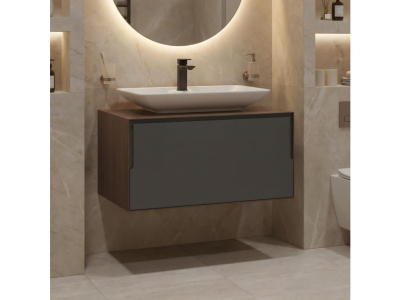
The Ultimate Guide: How to Choose a Bathroom Washbasin?
Categories :
New Arrivals: Kitchen & Bathroom
, Trends & Inspiration
, Vanity unit
The washbasin has become an essential feature of the bathroom. More modern than the traditional washbasin in many settings, it also allows you to experiment with sizes, shapes, materials and styles to create a room that is both practical and attractive.
But with such a wide variety of models available, how do you choose the right bathroom washbasin? What size should you go for? Should you opt for a single or double washbasin? A countertop or built-in model? And how do you match it to your bathroom cabinetry?
In this guide, Habitat et Jardin takes you step by step through the process of choosing a washbasin suited to your space, your habits and your style.
Washbasin or sink: what’s the difference?
Before choosing your bathroom fittings, it’s worth distinguishing between a washbasin and a sink.
A washbasin is generally a freestanding sanitary fixture, either wall-mounted or mounted on a pedestal. A basin, on the other hand, is designed to be integrated into a vanity unit or placed on top of a bathroom cabinet. This configuration offers more scope for personalising your bathroom layout.
The washbasin also has a significant advantage: it integrates easily into a set of bathroom furniture. This allows you to combine storage space, a vanity unit and a washbasin in a single installation.
Nowadays, there are numerous configurations available: countertop basins, recessed basins, single or double-basin units, wall-hung or freestanding units… The choice depends primarily on the layout of your bathroom and your day-to-day needs.
1. Start by measuring your bathroom
Before choosing a washbasin, measure the available space accurately.
The width of the wall isn’t the only factor to consider. Also bear in mind:
- the available depth;
- how far doors and drawers open;
- how you move around the room;
- the location of the shower or bath;
- the position of water supply and drainage points;
- the space available in front of the vanity unit.
In a small bathroom, every centimetre counts. A compact vanity unit may therefore be a much better choice than a wider model, which would obstruct movement.
Conversely, in a family bathroom or a spacious master suite, a wider unit can offer greater comfort and storage space.
What width of vanity unit should you choose?
There is now a wide variety of sizes available. To help you find your way around:
| Approximate width | Suitable layout |
|---|---|
| 40 to 50 cm | Small bathroom, toilet with washbasin, very limited space |
| 60 cm | Compact bathroom or for daily use by one person |
| 80 cm | A good balance between comfort and space requirements |
| 90 to 100 cm | For a couple or a spacious bathroom |
| 120 cm and over | Large room or double washbasin, depending on the model |
The Habitat et Jardin range includes compact models measuring 40 and 45 cm, as well as units measuring 50, 60, 65, 85 and 100 cm, making it easier to adapt the furniture to different bathroom layouts.
Our advice: never choose your unit based solely on the available width. Also check its depth and the space actually needed to move around in front of it.
2. Single or double washbasin: which to choose?
This is one of the first questions to ask when several people use the same bathroom.
The single washbasin
A single washbasin is particularly suitable for:
- small bathrooms;
- bathrooms used by only one person at a time;
- homes where space is limited;
- compact master bedrooms.
It generally allows you to keep more space free whilst offering good everyday comfort.
The double washbasin
The double washbasin is particularly useful in a family bathroom or a master suite used by two people at the same time.
It offers several advantages:
- two separate taps;
- greater convenience at peak times;
- a better-organised shared wash area;
- a look that is often more balanced in larger rooms.
On the other hand, a double washbasin requires more width and space around the vanity unit.
The right choice therefore depends on how you intend to use the space. For a small room, it is often better to opt for a single, well-sized washbasin rather than insisting on installing two taps.
3. Countertop or built-in washbasin: which configuration should you choose?
The installation method influences both the style of the room and the layout of the vanity unit.
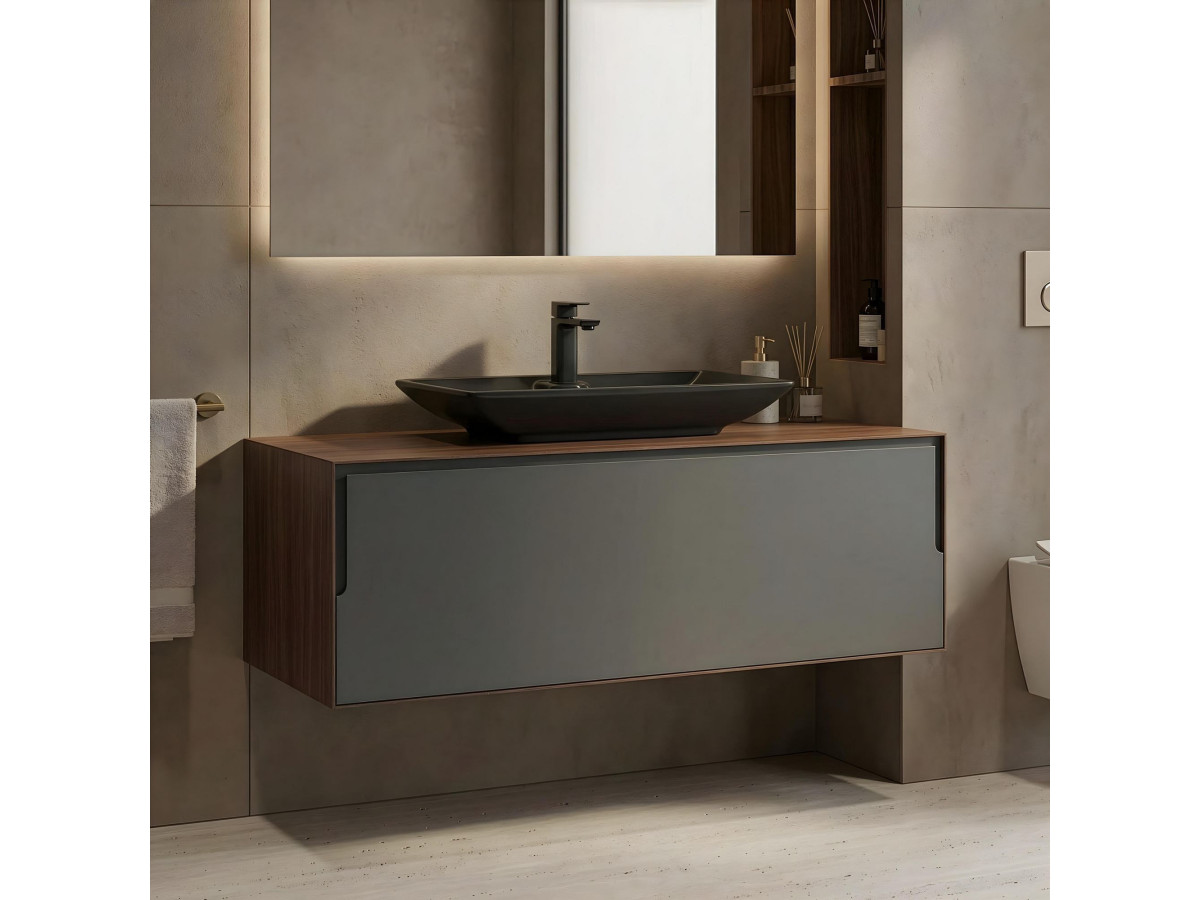
The countertop basin
As the name suggests, a countertop basin is installed directly on a vanity top or a suitable unit.
It is particularly appealing for its decorative appearance. Its shape is visible and plays a key role in the bathroom’s style.
It helps to create a:
- contemporary;
- minimalist;
- natural;
- elegant;
- more original, depending on the shape and material chosen.
The inset washbasin
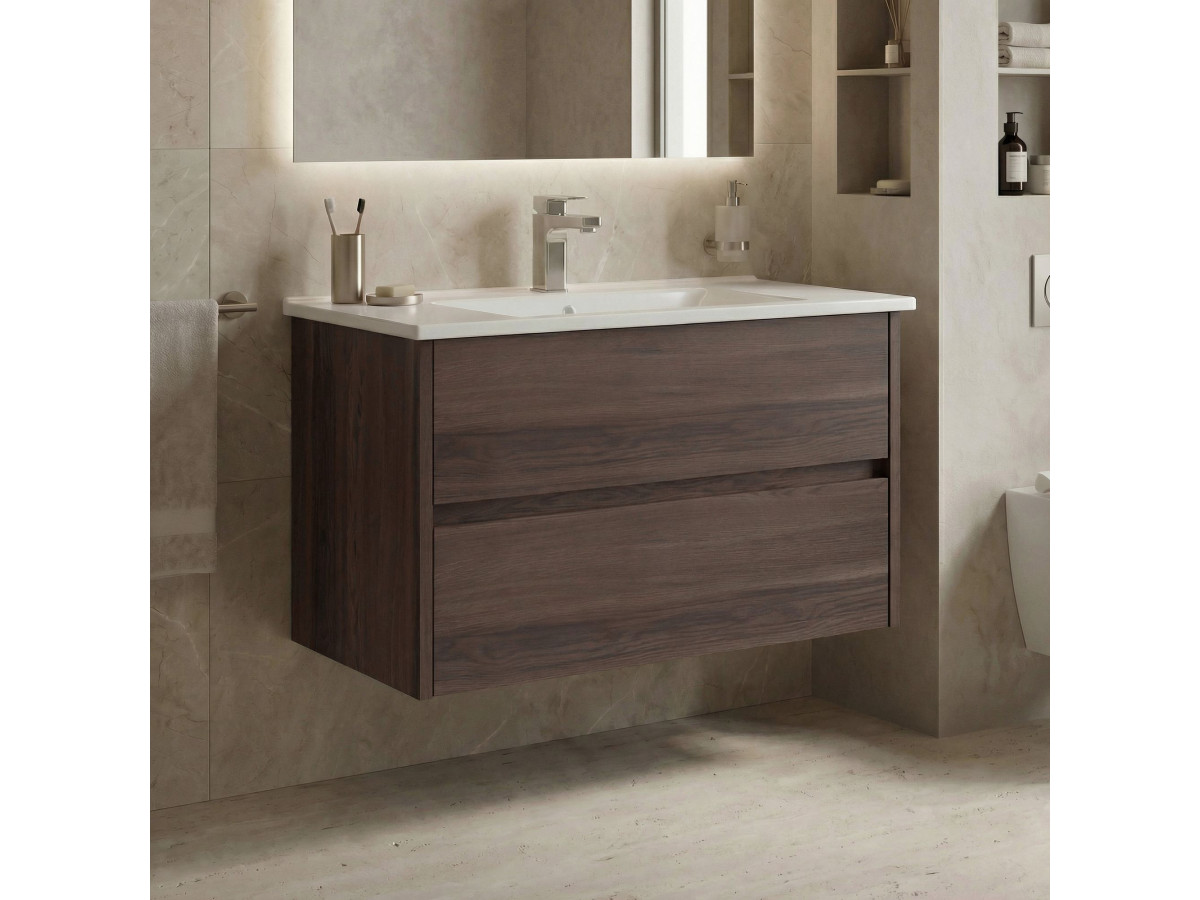
The inset washbasin is integrated into the vanity unit.
It generally has a more discreet and sleek appearance. It can also make cleaning the vanity top easier, as there is less of a raised edge around the basin, depending on the design of the model.
Which option should you choose?
Choose a countertop basin if you want to add a real decorative touch to your space.
Opt for a built-in washbasin if you’re looking, above all, for a simple, uniform installation that blends easily with your bathroom furniture.
4. What depth should you choose for a washbasin?
Depth is often overlooked when making a purchase, yet it has a direct impact on comfort of use.
A unit that is too deep can restrict movement. Conversely, a unit that is too shallow may offer less comfort or storage space.
In a small room, a shallower unit can therefore be particularly useful.
Some of the solutions offered by Habitat et Jardin are designed for compact spaces. For example, the Ferla 40 model measures 40 x 22 x 50 cm and the Conza 45 model with mirror measures 45 x 26 x 75 cm.
These sizes can meet the needs of bathrooms where depth is a major constraint.
5. What height should a vanity unit be?
The installation height should allow users to stand comfortably whilst taking into account the overall layout of the room.
Before fixing your unit in place permanently, bear in mind:
- the height of the occupants;
- the height of the unit;
- any thickness of the worktop;
- the height of the washbasin, if it is countertop-mounted;
- the taps;
- the position of the mirror.
A countertop basin, in particular, adds height to the vanity unit. You should therefore consider the total height of the installation, not just that of the unit itself.
A good tip: try positioning the basin before fixing it in place to check that the height suits you.
6. Which shape of washbasin should you choose?
The shape has a significant impact on the bathroom’s aesthetics, but also on how the space is perceived.
The rectangular washbasin
This is a particularly good choice for contemporary bathrooms.
Its straight lines blend easily with modern furniture and create a very structured visual layout.
The round washbasin
Visually softer, it adds a more organic decorative touch.
It works particularly well with:
- wooden furniture;
- natural-style interiors;
- spa-style bathrooms;
- minimalist interiors.
The oval washbasin
It strikes a balance between the straight lines of a rectangle and the soft curves of a circle.
It adds a touch of elegance whilst remaining highly versatile in terms of décor.
Key point: the ideal shape is one that suits the style of the vanity unit, the available space and your habits.
7. What material should you choose for a washbasin?
The material affects the appearance, feel, durability and maintenance requirements.
Common options include ceramic, resin and various composite materials.
When making your choice, look out for:
- ease of cleaning;
- resistance to everyday wear and tear;
- susceptibility to scratches;
- the manufacturer’s recommended care instructions;
- the desired appearance.
For a heavily used family bathroom, opt for a solution that is suitable for regular and simple maintenance.
8. Choosing a suitable vanity unit
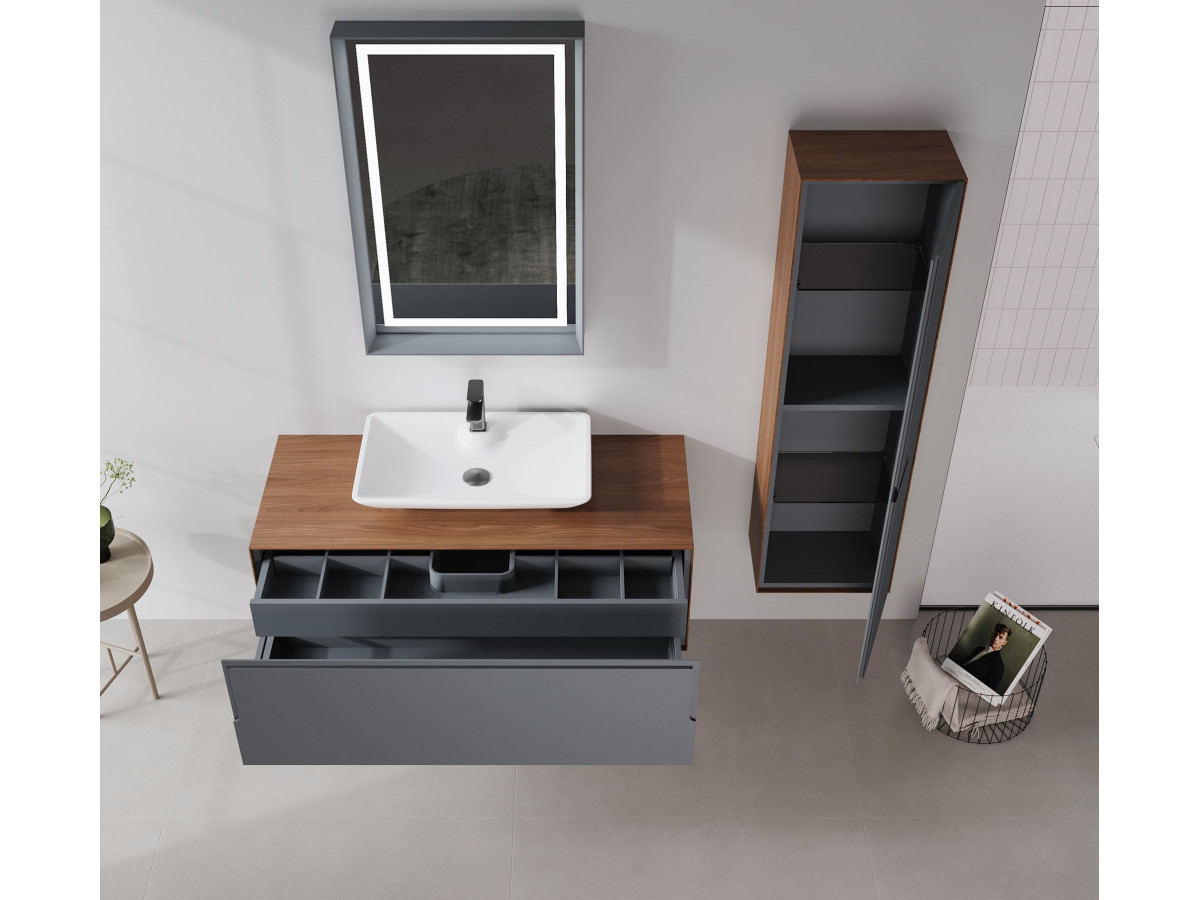
The washbasin should not be chosen separately from the vanity unit.
The vanity unit must fulfil three functions: support the washbasin, provide storage and blend harmoniously into the room.
Before making your purchase, check:
The dimensions
Make sure the width and depth of the unit are suitable for the room.
Storage
Drawers, doors, niches or compartments: choose according to the items you wish to store.
Toiletries, towels, hairdryers and accessories should be easy to organise.
Installation type
A wall-mounted unit visually frees up floor space and can create a sense of lightness.
A freestanding unit, on the other hand, can have a stronger visual presence and adapt to different layouts.
The style
The unit should complement the rest of the room: mirror, taps, tiling, shower, bath and accessories.
Habitat et Jardin’s current range includes single-bowl units, sets with mirrors and various finishes such as white, anthracite or various wood-effect finishes.
9. What colour should you choose for your washbasin unit?
The colour can completely transform the atmosphere of the bathroom.
White
White remains a safe bet for creating a bright room that’s easy to coordinate.
Anthracite or a dark shade
Dark shades add more character and can create a contemporary bathroom.
They work particularly well when paired with light-coloured walls or wooden features.
Wood-effect
Wood-effect finishes bring a warmer, more natural feel.
They are particularly well-suited to creating an atmosphere inspired by wellness or Scandinavian style.
More original colours
Colours such as green, blue or warmer shades can give the furniture more personality.
The key is to ensure consistency with the other elements in the room.
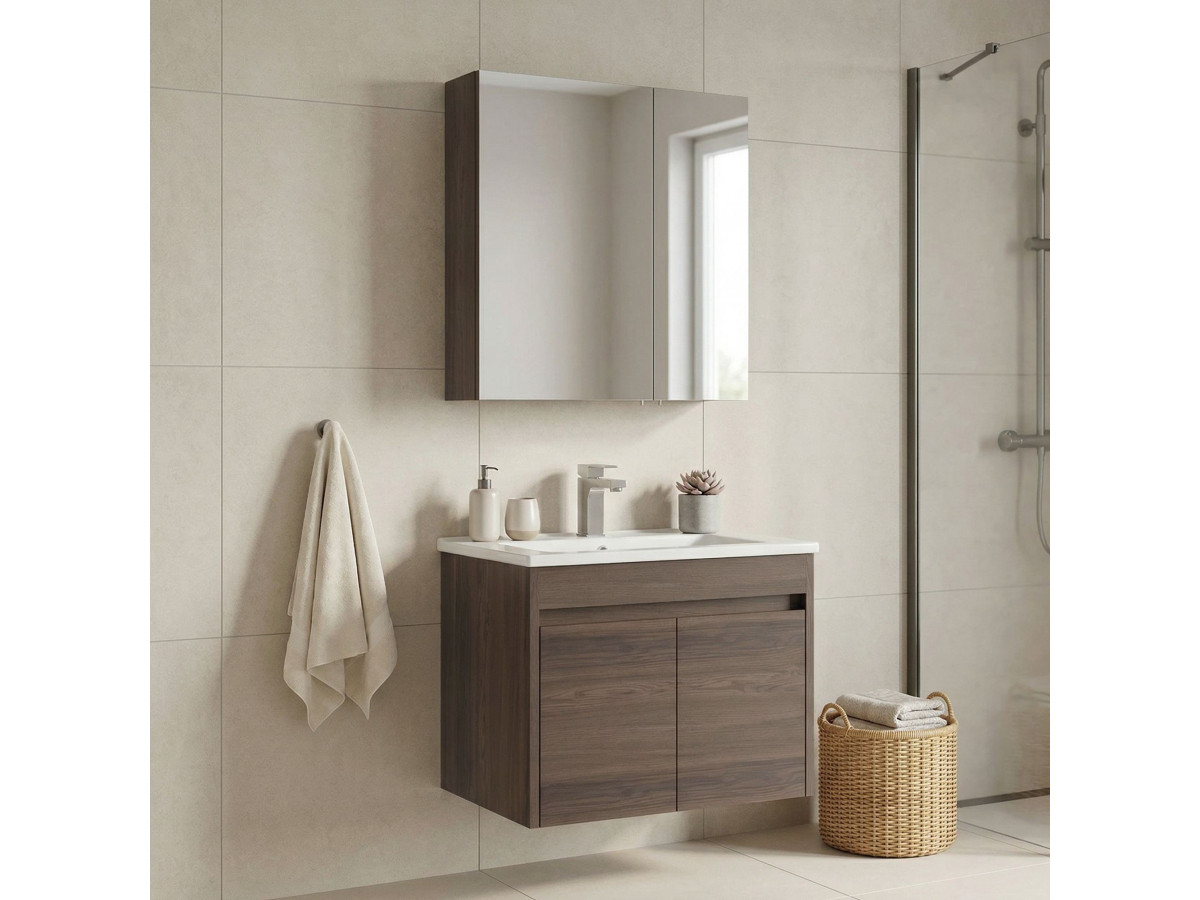
10. Washbasin and mirror set: why choose a set?
Pairing a vanity unit with a mirror can simplify the layout of your bathroom.
A set ensures consistency in size, style and finish.
This solution can be particularly useful during a renovation, when you want to refresh your space quickly without having to spend ages searching for different items.
11. Which washbasin should you choose for a small bathroom?
In a small bathroom, priority should be given to ensuring there’s enough space to move about.
A few simple rules can help:
Opt for a width suited to the room. A unit measuring 40, 45, 50 or 60 cm may be more suitable than a larger model.
Pay attention to the depth. A few centimetres less can make a real difference in a narrow room.
Opt for closed storage. This helps keep the room looking tidier.
Consider wall-mounted units. They can create a greater sense of space by leaving more of the floor visible.
Pair the washbasin with a mirror. A large mirror can help to make the room appear bigger.
12. Which washbasin should you choose for a family bathroom?
In a family bathroom, comfort and storage capacity are key priorities.
A wider basin generally makes everyday use more convenient.
Depending on the space available, you might consider:
- a large single-basin unit with plenty of storage;
- a double-basin unit;
- a unit and mirror set;
- several associated storage areas.
Functionality must remain the priority: it’s better to have a unit that’s perfectly suited to the room than one that’s too big and gets in the way.
13. Mistakes to avoid before buying a washbasin
Choosing based solely on style
A washbasin may look very attractive but still be ill-suited to your everyday needs.
Forgetting about depth
Depth directly affects movement around the room.
Failing to check the dimensions of the washbasin and the vanity unit together
You must check that the various components are compatible before installation.
Neglecting storage
A vanity unit isn’t just a base for the washbasin: it’s also an essential storage space.
Forgetting the taps
The type of washbasin chosen can influence the choice and positioning of the tap.
Failing to plan for connections
Before buying, check the location of the water supply and drain pipes.
Choosing a double washbasin for a room that’s too small
Two basins are only useful if they genuinely improve comfort without making the bathroom less pleasant to use.
14. The 5 questions to ask yourself before choosing a washbasin
- How much space do I actually have available? Measure the available width and depth, without forgetting the space needed to move around.
- How many people will be using the washbasin? A single person, a couple or a family will have different needs.
- How much storage do I need? Work out what needs to be stored in the vanity unit.
- What style do I want to create? Contemporary, natural, minimalist, cosy or more original: your washbasin must blend in with the rest of the room.
- How much maintenance am I prepared to carry out? Choose a material and finish that suit your cleaning habits.
Our pre-purchase checklist
- ☐ available width
- ☐ available depth
- ☐ clearance space
- ☐ number of users
- ☐ single or double basin
- ☐ installation type
- ☐ material
- ☐ colour and finish
- ☐ storage capacity
- ☐ mirror position
- ☐ tap position
- ☐ water supply and drainage
- ☐ maintenance required
So, which washbasin should you choose?
The best choice isn’t necessarily the largest or most stylish washbasin. It’s the one that best suits your space, your habits and your preferences.
For a small bathroom, opt for a compact and functional solution. For a family bathroom, focus on comfort and storage. For a master bathroom, you might want to go for a double washbasin and an aesthetically pleasing installation.
Finally, always remember to choose the washbasin and vanity unit as a set. The dimensions, installation method, style and connections must all be consistent to ensure a fit-out that is both practical and harmonious.
Discover Habitat et Jardin’s vanity units
Once you’ve defined your criteria, explore our selection of bathroom vanity units: compact models, single or double basins, wall-mounted units, sets with mirrors and a range of finishes to fit out your bathroom according to your space and style.
FAQ – Bathroom washbasins
What is the difference between a washbasin and a sink?
A washbasin is generally a freestanding sanitary fixture, whilst a basin is designed to be built-in or placed on top of a unit or vanity top.
What width of washbasin should I choose?
The width depends on the available space and the number of users. For a small bathroom, compact models may be particularly suitable. In a larger room, a wider basin or a double basin can improve comfort.
Is a countertop or built-in washbasin better?
A countertop washbasin places greater emphasis on aesthetics and design. A built-in washbasin generally offers a more discreet and integrated look.
Is a double washbasin really useful?
It can be very practical when two people regularly use the bathroom at the same time. However, it requires sufficient width and space around the vanity unit.
What depth should a vanity unit have in a small bathroom?
There is no one-size-fits-all depth: it depends on the room and its layout. In a narrow space, opting for a shallower unit can help maintain better circulation.
How do you choose the colour of your vanity unit?
Choose a colour that complements the rest of the bathroom. White brings light, dark shades add character, and wood finishes create a warmer atmosphere.