
Your cart
There are no more items in your cart
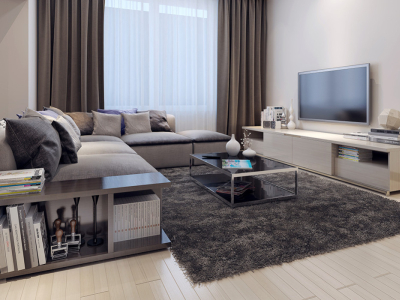
TV stand – description and uses
Definition and history of the TV stand
Definition
As its name suggests, a TV stand is designed to support or house a television set. At the very least, it consists of a shelf or table comprising a horizontal top resting on a base formed by one or more legs or various supports. The TV stand is designed to support the television set, positioning it at eye level for viewers whilst they are seated. When viewers are sitting in a normal position – at a dining table, for example – the TV stand will be at the same level or slightly higher. In a living room, however, this modern piece of furniture may be positioned lower to match the lower seating height of those watching television.
A TV stand can therefore be a simple unit designed solely to hold the television. It can also be a more substantial piece of furniture, capable of holding not only the television but also ornaments, vases, books, picture frames, etc. In other cases, the TV stand may also serve as a sideboard for crockery or kitchen linen. It may therefore feature several shelves, drawers or storage compartments. Depending on viewers’ habits, this unit may be placed in the dining room, the living room or the bedroom. The design of the TV stand can be adapted to suit the style of the room in question.
History
The history of the TV stand is naturally intertwined with that of the television itself. We owe the invention of the first television set to John Baird, a Scotsman, and it was in the 1930s that he brought the first consumer receiver to market. Yet we feel as though the television has always been part of our everyday lives. In France, the first live television broadcast took place in 1950, on the only channel broadcasting at the time.
Today, technological advances have made it possible to bring to market devices that are compact in size and whose performance is well established. Against this backdrop, TV stands have had to adapt and be designed to suit different needs and the chosen audio-visual equipment. Aesthetics have been combined with functionality and safety. All manner of materials have been used to design TV stands. The features of TV stands are constantly adapting to technological developments in the televisions themselves.
Choosing a TV stand
General principles
Regardless of the design, the size of the TV stand is determined by the television equipment it will support. Before making a choice, it is important to decide which devices, in addition to the television, will be housed within the stand: set-top box, DVD player, games console, home cinema system, etc. Each device must be assessed (ventilation requirements, weight, frequency of use) in order to position it correctly and optimise its performance. Electromagnetic interference between multiple devices should be avoided, as should issues with electrical components overheating.
The size of the TV unit is important, and whilst flat-screen TVs take up less space in terms of depth, the unit must be wide enough to ensure maximum stability. Shelves and shelves must be able to support the weight of the devices and prove reliable over the long term. Corner units save space but are usually made of wood, which limits the choice. Finally, the unit’s location will also be a key factor in the user’s choice (size of the room, need for mobility, etc.) in order to find the perfect balance between practical needs and visual appeal.
Different types of furniture
Open or closed units
There have been considerable advances in the aesthetics of televisions. Screens now look almost like decorative objects, which do not need to be enclosed. The numerous cables connecting the television to other related devices can be housed in cable ducts or modular drawers, making it very easy to gather them together and conceal them. Access to each connection and ventilation for the devices will be optimal with an open TV unit.
A closed unit allows you to conceal all audiovisual equipment, cables and connections. The safety of the equipment is enhanced with a lockable unit, as it is inaccessible to young children, for example, and the risk of the equipment falling is eliminated. It is important to check in this type of setup that the unit has all the necessary vents to ensure proper ventilation of the devices. Some highly advanced models feature a ‘cooling door system’ which ensures air circulation even when the unit is closed. To save space, sliding doors are preferable.
Mobility and/or modularity of the TV unit
Even though the television is fixed and usually installed in the main room of the house, the user may wish to purchase a unit that allows them to move their television between different locations. They may also wish to move it around the room for a special occasion to ensure excellent visibility for everyone (such as showing photos to friends…) without it being a permanent fixture. The choice should therefore be a model fitted with castors and a braking system for greater safety. It is also possible to use a fixed unit featuring a telescopic movable section or one that can be detached and used as an optional extra.
The modularity of the unit is evident in its design and the various layout options it offers. This might include shelves that can be positioned at different heights and adjusted to accommodate all video and audio equipment, as well as media (CDs, DVDs, etc.). The storage capacity of this TV unit is a major attraction, as it can bring all audiovisual equipment together in one place. In a small space, this is a real advantage, as the unit takes up the same floor space whilst offering a large storage capacity. It may also take the form of a column to which the screen is mounted – also well-suited to small spaces – and which appeals thanks to its sleek design and the various options for mounting the screen.
Wall-mounted or ceiling-mounted brackets
The question arises as to whether a wall-mounted or ceiling-mounted TV mount constitutes a piece of furniture. In fact, it is a discreet version of a TV stand. Indeed, whilst it cannot be moved, it can simply be adjusted. The wall or ceiling mount comprises a part to be fixed to the wall, and it is important to check its strength to ensure it can support the weight of the television. Plasterboard walls are not always suitable for this type of installation. Another part attaches to the television, and the two components then slot together to position the set either flush against the wall or higher up. Here too, you should check that the television is compatible with the mounting bracket before installation, as the position of the mounting holes can vary depending on the model (VESA standard).
These models offer great freedom in terms of the screen’s tilt and orientation whilst optimising viewing comfort. Of course, saving space is one of the major advantages of this type of TV stand configuration. The same applies to aesthetics and how it blends into the room, as nothing is visible apart from the screen, and design concerns are no longer an issue.
Position in the room and TV stand materials
Space in the room
The position of the TV stand is crucial, primarily to minimise eye strain. The recommended distance is at least four times the diagonal size of the screen for cathode-ray tube televisions. This distance has decreased with the advent of HD televisions. Generally speaking, to avoid poor image quality (pixelation), it is advisable to sit at a sufficient distance from the screen.
Lighting is also important, and bright lighting will reduce the contrast of the image, making it appear paler. Reflections on television screens are also extremely disruptive to clear viewing. This is why the TV stand must be positioned in such a way as to avoid any of these issues.
TV stand materials
In terms of aesthetics and design, there is a wide variety of models available, and although the primary function of a TV stand is to house and support the television equipment, it plays an important role in the home’s interior design. Solid wood remains a fine material which, thanks to its robustness and the variety of finishes available, is well-suited to the manufacture of TV stands. It is, however, a more traditional choice, often with a rustic and imposing style, but its cost is considerably higher than that of other materials. To give it a more ‘cosy’ look, it can be painted in on-trend colours (taupe, white, grey…) and thus blend in with an existing interior and the style already present in the room.
Furniture made from particle board or chipboard is more budget-friendly. It comes in a variety of shapes and colours, offering greater flexibility in terms of layout. TV stands made of glass and steel feature a more modern design, playing on understated elegance and the effects of transparency and light. This style is more contemporary and offers better value for money than solid wood furniture. On the other hand, glass units are more prone to showing dirt; fingerprints and dust are more visible on this type of surface, even though they are easy to clean.
Beyond simply holding the television, the TV stand has become an important part of home décor. Its design contributes to the atmosphere the occupants wish to create in their home. Available in a vast array of styles, this piece allows for bold choices and contributes to the sense of well-being we all seek in our homes.