
Your cart
There are no more items in your cart
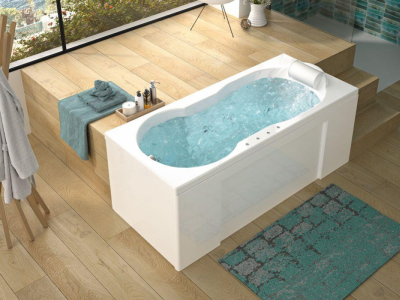
Whirlpool bath: description and uses
History and definition of the whirlpool bath
History of the bath and the whirlpool bath
History of the bath
In ancient times, the Greeks and Romans were already using bathtubs for bathing. These were tubs made of stone, marble or metal. In the Middle Ages, the bath was a simple wooden tub. The metal bath (enamelled cast iron or galvanised sheet metal) of the 18th century gave way, at the start of the 19th century, to bathtubs made of tinned copper, thick zinc or enamelled cast iron, and, more rarely, of stone or marble. Very recently, bathtubs made of acrylic and other modern materials such as Toplax and ABS-reinforced acrylic have appeared…
The bath was introduced to France by the Romans during the Crusades. In its early days, the bath was a kind of public steam room. In the early Middle Ages, people frequently visited these steam rooms to bathe. Towards the end of this period and during the Renaissance, these baths were accused of being a source and a means of spreading disease. As these places were also regarded as venues for debauchery, they were consequently banned.
This rejection of personal hygiene through bathing lasted until the end of the 17th century. In 1770, Paris had only nine bathing establishments! It was not until the end of the 19th century that hygiene and cleanliness were once again taken seriously. The medical profession, the army and various trade union movements contributed to their rehabilitation and widespread adoption. It is worth noting that, at that time, one in two French people only took a bath once every two years!
It was not until the early 20th century, at the end of the First World War, that a culture of hygiene was revived. Its development was made possible by the introduction of running water and sewage systems. Water heating was also a decisive factor. In Parisian blocks of flats, bathwater was heated by gas-fired bath heaters. Thus the bathroom was born, becoming a feature exclusively of city dwellings at the start of the 20th century.
The bath has therefore only been regarded as indispensable for the last seventy years or so. Before that, personal hygiene consisted simply of washing with water from a basin. Since 1930, the bath has undergone continuous modernisation and was first installed in the bathrooms of the wealthy. By 1962, 26 per cent of French people had a bath or a shower in their bathroom. With the widespread installation of bathrooms in homes, the bath has since gained widespread acceptance. Against this backdrop, it is not surprising that the whirlpool bath has only become available very recently.
History of the whirlpool bath
The ‘spa’ bath dates back to 1956, whilst the first bath with massage jets appeared in 1968. Its predecessor, the individual bath with water heating, was devised by Ambroise Paré. This famous French surgeon created the first hydrotherapeutic bath, also known as the ‘Marmite à Plantes’, to treat his patients.
Nowadays, the whirlpool bath is regarded not only as a ‘precious’ space, into which one immerses one’s body to wash and purify oneself, but also as a place for treatment, relaxation and wellbeing. The whirlpool bath, with its dual cleansing and massaging action, is gaining an ever-growing following. It is currently becoming increasingly popular, as it is an effective way of combating stress and other pressures of modern life.
Definition of a whirlpool bath
The term ‘whirlpool bath’ is short for ‘balneotherapy bath’. It is a bath that resembles a conventional bath but falls within the field of hydrotherapy. However, in addition to hot and cold water inlets, it features water jets and air jets known as hydrojets, which classify it as a hydrotherapy bath. These are powered by a small electric motor via nozzles. These nozzles – numbering between six and twelve depending on the model, and either adjustable or fixed – are distributed across the base and sides of the whirlpool bath. Their position determines the type of treatment available. The water temperature varies depending on the type of massage. It ranges from 25 to 37°C. A programming system controls the temperature, the power of the jets, their direction, the intensity of the lighting, and so on. Most whirlpool baths are fitted with an automatic disinfection system using ozone or another product, such as chlorine or bromine.
The whirlpool bath replaces the standard bath in the bathroom. As it operates as a closed-circuit system, it uses no more water than a standard bath. It is filled with tap water, which is drained after the bath. Its purpose is to allow both washing and massaging of the body. The combined action of water and air provides a targeted massage to specific parts of the body. The whirlpool bath helps to provide care by using water for medical or therapeutic purposes. The whirlpool bath thus counteracts all the stresses of modern life and contributes not only to personal hygiene, but also to relaxation, wellbeing, rest and enjoyment…
The whirlpool bath is distinct from a spa or Jacuzzi. ‘Jacuzzi’ is a registered trademark for a spa, named after its inventor, Roy Jacuzzi, an Italian who emigrated to the USA. The difference between a whirlpool bath and a spa lies in two characteristics. The first difference is that a whirlpool bath is drained after each use, whereas a spa is drained at least once every three months. The second difference between a whirlpool bath and a spa relates to size. A spa is significantly more spacious, as it can accommodate half a dozen people at once, compared with just one or two people for a whirlpool bath.
Description and operation of the whirlpool bath
Description of the whirlpool bath
The whirlpool bath has a tub that holds the water. This tub is usually made of acrylic, a durable material that allows for a wide variety of shapes. One of the key components of the whirlpool bath is the pump, which draws water from the bath via a strainer. It pressurises the water and then redistributes it, propelling it through the jets. The power of the pump and the number of jets determine the effectiveness and quality of the massages. The jets of water and/or air thus produce a massaging, energising and invigorating effect on the whole body.
The jets, which vary in size and number, are distributed along the vertical sides of the bath. They may be fixed or adjustable and mix air and water (Venturi effect), before expelling the mixture under pressure (visible bubbles on the water’s surface). At the bottom of the bath, the hydrojets inject pressurised water, whilst the air or water injectors operate separately.
The whirlpool bath is also fitted with a blower. This is a small tube that draws in air and heats it. It then compresses the air and propels it into the bath via a jet. A water level sensor monitors the water level. In particular, it prevents the whirlpool system from starting up. If the bath is not filled to a sufficient level, the pump may be damaged.
How the whirlpool bath works
The whirlpool bath has a manual or electronic control for switching on the pump. This is usually a push-button. An electronic control system for the bath, featuring a control panel, allows for dynamic management and the programming of several functions.
These functions include: water temperature, bath duration, light intensity, etc. The bath can also be controlled using a waterproof handheld remote control. Operation is, of course, subject to numerous safety standards.
Choosing, installing and maintaining a whirlpool bath
Choosing a bath
There are several key criteria to consider when choosing a bath. Firstly, you need to decide which style of bath suits your bathroom best: a classic, designer or bespoke model. The available space and the shape of the bath are very important factors, even though manufacturers offer a wide variety of products.
There is a whole host of shapes to choose from. Whether it’s a straight, corner, round or freestanding spa bath… you’ll be spoilt for choice. Only the dimensions of your bathroom may limit this wide range and curb your desires.
It is very important to know your preferences when it comes to care and wellbeing. What does your body need? Physical relaxation, muscle relief, various treatments… The more jets and nozzles there are, the more effective and enjoyable the massages will be.
Don’t overlook the comfort of the bath itself, with the control panel and remote control making it easy to start and operate the whirlpool bath. Automatic filling and water heating to maintain the correct temperature are important features. An ergonomic headrest will make the bath more comfortable.
You’ll need to consider certain fittings such as the taps with a removable hand shower, the fill spout, the overflow, and the bath skirt… All the available options – touch-sensitive controls, pre-programmed massage programmes, number of massage points, number of spotlights, shapes, materials, etc. – will affect the price. The system, certified by the NF-Balnéo label, is a guarantee of the bath’s quality and hygiene.
Installing the bath
Just like a standard bath, a whirlpool bath must be installed in accordance with specific regulations. The main difference between the two lies in the whirlpool bath’s electrical operation. Safety precautions and instructions must be strictly followed to avoid any risk of accident.
The installation of this bath must, without exception, be carried out by a qualified professional. As the bath is located in a wet room, the installation must meet safety criteria (standard NF C 15-100). Compliance with the volume regulations must ensure the safety of the appliance, the premises and, above all, people. Furthermore, care must be taken to ventilate the room and therefore install a controlled mechanical ventilation (CMV) system to prevent damp problems.
Maintaining the spa bath
Maintaining a whirlpool bath is the same as maintaining a standard bath. Under no circumstances should abrasive products be used. However, a whirlpool bath does require additional care. In particular, care must be taken to ensure that the jets are thoroughly cleaned after each use to prevent the spread of bacteria.
Proper maintenance effectively prevents any risk of contamination and malfunction of the water systems. The best option is to purchase a bath fitted with an automatic cleaning and disinfection system. The use of foaming products is prohibited in a whirlpool bath.
The massages offered by a whirlpool bath and their benefits
The different types of massage
A whirlpool bath offers three different types of massage. The ‘air’ whirlpool bath helps the body to relax. The ‘water’ whirlpool bath uses water pressure to stimulate the body. As for the combined ‘air and water’ whirlpool bath, it combines the effects of the two previous types. Its massages are both stimulating and relaxing, depending on the option selected.
For the ‘water’ massage, water jets or hydrojets apply pressure to a specific area of the body or to the whole body. Various targeted massages are possible, such as on the hips, stomach or buttocks… This hydro-massage helps to firm up the body through its toning action.
The ‘air’ massage is very different from the previous one. The air exerts a gentler pressure. The air jets are fitted at the bottom of the bath. The air thus propelled is mixed with the water in the bath. The resulting bubbling helps to improve blood circulation, relieve back pain and combat stress… This type of massage provides a pleasant sensation of relaxation and well-being.
Naturally, the combination of the two – air/water plus air – brings together the benefits of the other two types of bath. The massages can be stimulating and invigorating, but also relaxing and soothing… For this type of massage, air jets are added to the bottom of the bath. The invigorating or relaxing effect is enhanced by the water temperature. If the water is hot, the bath will be relaxing. With cooler water, the bath will be more invigorating.
The benefits of a whirlpool bath
Depending on your preferences, you’ll enjoy maximum relaxation and satisfaction! A whirlpool bath brings hydro-massage into your own bathroom! It allows you to enjoy relaxation, a sense of wellbeing and calm whilst staying in the comfort of your own home. You can fully benefit from the stress-relieving and restorative properties of water.
With a whirlpool bath, having a bath is not just a matter of personal hygiene, but also a special moment of relaxation, comfort, rejuvenation and wellbeing. Bathing becomes a moment of pleasure. With a whirlpool bath, you have your very own home spa, in complete tranquillity and privacy.
A whirlpool bath allows you to turn your bathroom into your own personal spa and a haven of peace. Forget all the worries, hassles and stress that build up after a day’s work; the whirlpool bath provides relief from all the stresses of modern life. You can thus transform your bathroom into an oasis of calm and relaxation, perfect for meditation and wellbeing.
The whirlpool bath is ideal for an invigorating soak. The water is drawn in through a strainer. As it is propelled back out, it exerts significant pressure, creating a massaging, toning and energising effect. To achieve this, the nozzles and jets (hydrojets) are positioned on the sides or the base of the bath. The adjustable nozzles provide a more precise and effective massage. The water pressure reduces muscle tension and promotes relaxation. Blood circulation is stimulated. It promotes lymphatic drainage and thus the elimination of toxins. It increases the skin’s elasticity and enhances the exchange of substances with the water and essential oils.
Using an air-jet spa bath relaxes the body. The body, rendered weightless by the jets at the bottom of the bath, responds to the gentle, successive compressions. The turbulence created by the jets and hydro-jets on the sides of the bath is alternately soothing and invigorating. This air-based system reduces stress-related fatigue and promotes sleep. It is said to provide relief from various conditions, such as rheumatism, osteoarthritis, and muscular and joint problems… It also helps to stimulate blood circulation, drain the lymphatic system and thus flush out toxins.
With the mixed whirlpool bath, the combination of water propelled by the hydrojets and air diffused by the air jets provides a massage that is both intense and invigorating, as well as relaxing and soothing. The water temperature plays an important role. At between 25 and 30°C, the bath will be cool and stimulating; at between 35 and 37°C, it will be invigorating or comforting; and above 37°C, it will be relaxing and soothing. These different types of massage are available and can be programmed. The two systems can be used separately, one after the other, or in combination, depending on the desired effect. The combined whirlpool bath therefore offers a wider range of massages and combines the beneficial effects of air and water massages.
The whirlpool bath – Aromatherapy, chromotherapy and music therapy
Aromatherapy
The whirlpool bath utilises the benefits of balneotherapy, which involves treating the body through massage in a bubbling bath, also known as a whirlpool bath. But in a way, the aim of balneotherapy is also to soothe the mind. The use of essential oils plays a major part in this: cypress oil (vitality), eucalyptus (stimulation of the nervous system), lavandin (joie de vivre), rosemary (purification of body and mind), coriander (relief from headaches)… Please note, however, that you should only use essential oils specifically formulated for use in a spa bath!
Water heated to around 34°C causes the skin’s pores to dilate. This facilitates the absorption of certain elements into the body. Adding essential oils enhances the beneficial effects of the bath. The aromatic essences penetrate the body through osmosis. They therefore act via inhalation and through the skin.
When essential oils are added to warm water, they release their fragrances and pass through the skin. They thus enter the body and act on the tissues, organs and, consequently, the whole body. These oils regenerate and restore balance to the person, both physically and mentally.
Chromotherapy
Colour plays a very important role in our everyday lives. It influences our mood and behaviour. The use of chromotherapy therefore proves to be a valuable addition to balneotherapy treatments. It helps to create a very pleasant and, above all, very intimate atmosphere.
The spa bath therefore uses chromotherapy to boost energy, revitalise the body and restore physical balance. Each colour has its own specific properties. Yellow, red and orange (warm colours) are stimulating. Green, blue, indigo and violet (cool colours) have a calming and relaxing effect.
Underwater LED spotlights are fitted to the sides of the bath; they emit the selected light. A control button allows you to switch the lights on or off, cycle through the colours or select a specific colour. This way, everyone can prioritise the colours they prefer.
Music therapy
The therapeutic effects of music have long been recognised. Music immerses us in an atmosphere conducive to a range of emotions and sensations. Furthermore, when combined with balneotherapy, music therapy enhances the benefits of the latter.
Music influences the nervous system, helping to reduce stress and promoting relaxation. It also helps to calm the mind, encourage daydreaming or stimulate the imagination… It is a source of pleasure that complements the enjoyment of the water. A spa bath allows you to enjoy the benefits of music therapy at will. As we have just shown, the spa bath offers a multitude of possibilities, much to the delight of its users.