Your cart
There are no more items in your cart
Wooden arbour – description and uses
Categories :
Child
, Practical Guides
, Wooden archway
Wooden pergola – Outdoor design and choosing a model
Outdoor design
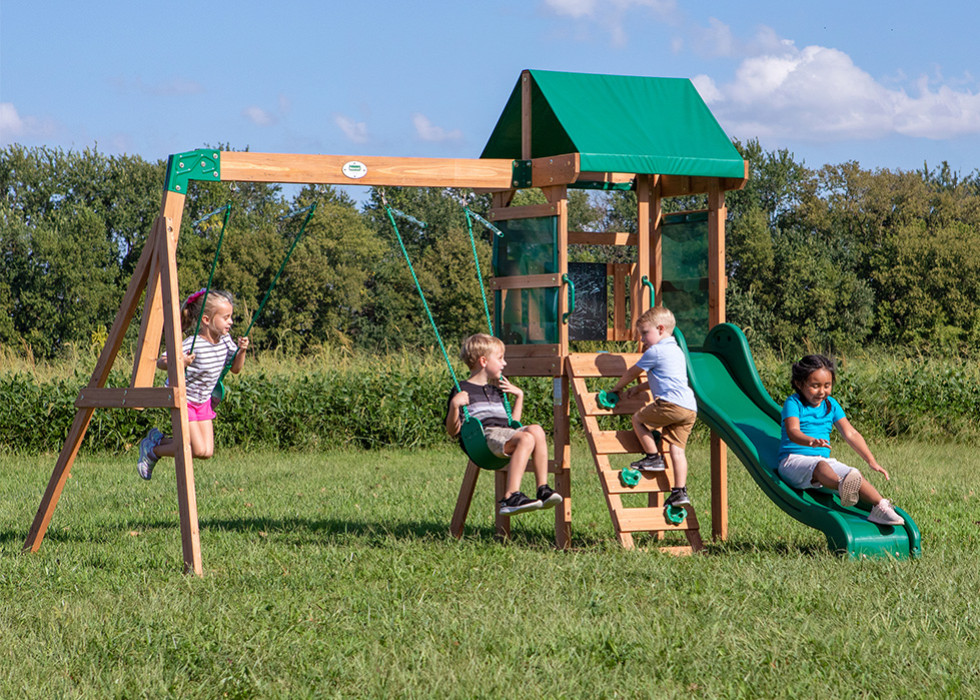
Awooden climbing frameis an outdoor feature that requires a little thought, imagination and know-how. It is important to identify your needs so that the final design is suited to your garden space and your family. The layout of the wooden climbing frame must, first and foremost, meet the requirements and wishes of its future users: the children. Choosing an outdoor woodenclimbing frameis fairly straightforward. You need to take into account a number of criteria, such as your personal taste and your budget. You mustn’t overlook the available space in the garden. It’s important to allow for open spaces so that children can run about freely; you must also consider the age of the users, as each type of play equipment is designed for a specific age group. There are several materials to choose from: wood, plastic, metal… The choice is often dictated by considerations of aesthetics, safety and durability. The natural colours of wood allow different pieces of equipment to blend harmoniously into the garden environment. Structures such as wooden climbing frames are far more weather-resistant than play areas made of steel or aluminium. Unlike steel, wood is a natural, living organic material. Your wooden climbing frame will therefore be sensitive to changes in temperature and humidity. It requires little maintenance and, when exposed to UV light, the wooden climbing frame will take on a beautiful silver colour, though it can also be finished in any colour you wish.
Choosing a model
You can choose between a swing frame with round or square cross-sections. Choosing a wooden swing frame with round beams is not a technical decision, but rather an aesthetic one. Your wooden swing frame may expand or contract in the heat. This results in changes to its appearance, which in no way affect the quality or strength of the frame, as these changes are taken into account during its manufacture. However, round beams will develop cracks where children could trap their fingers. Round beam systems are therefore more susceptible to changes in the weather. Square beams are cut from a thick log and dried before being shaped. As a result, the surface of the wooden play frame’s beams remains smoother. Square posts provide a larger contact surface and ensure greater stability for the structure. Over time, virtually no transverse cracks form in square beams.
Wooden play structures – Modular range and accessories, the benefits of play, design of public spaces
Modular range and accessories
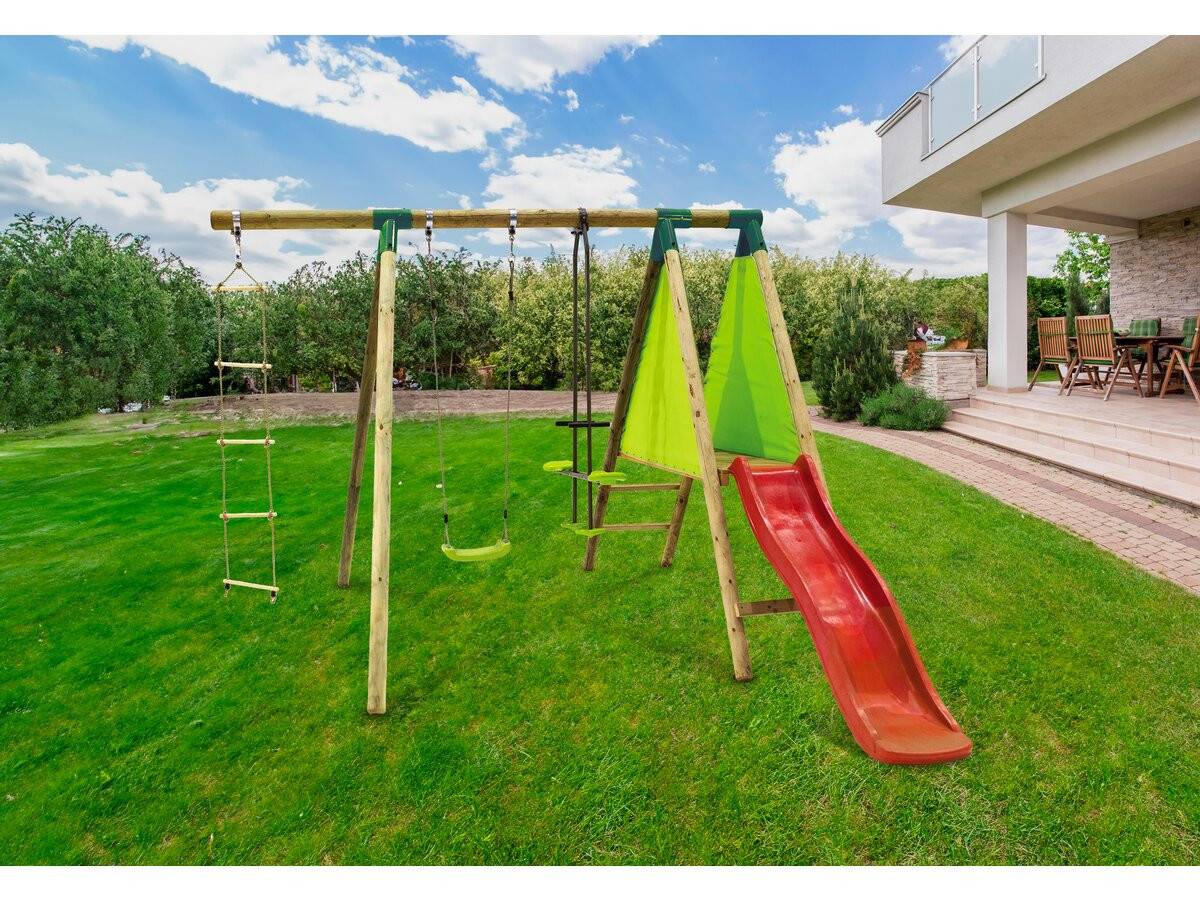
Wooden play frames allow you to transform your garden into a safe play area for your children thanks to a whole range of accessories. First and foremost is a simple product that is sure to be a hit: the swing. It is available in various materials (synthetic, wood or flexible rubber) and can be used in different ways. The wide choice ensures safety for the youngest children (aged 3 and over) with baby seats, as well as for older children who can swing happily on their swings with wooden play frames reaching heights of up to 3.50 metres. You can complement the wooden frame with other items that are both fun and sociable: - a simple slide or one with a wave-shaped slide will be a lovely addition to the swing set. - a play tower with a playhouse will give children a sense of adventure. - The rings, trapeze and horizontal bar will be perfect for budding acrobats. - The rope ladder or climbing wall will delight your little rascals. - The pirate set with a rudder and binoculars will be a hit with the most daring. There is a highly modular and adaptable range with almost endless possibilities, allowing you to expand the wooden play frame alongside and for your children.
The benefits of play
Having a wooden play frame at home is brilliant for your children. Indeed, your little ones, once they’re independent enough, will discover activities that test their dexterity and balance, allowing them to play on their own. With these outdoor play structures, they’ll run, jump, spin round, shout – in short, burn off their boundless energy. All these factors promote oxygenation of their bodies and help them develop their motor skills on a daily basis. A wooden climbing frame is the best way to give lively, energetic children the chance to enjoy the fresh air whilst discovering the secrets of yourgarden. All these fun activities help to significantly reduce children’s sedentary lifestyles. It has been shown that physical activity has beneficial effects on your children’s development. These games therefore help prevent obesity by changing eating habits. To develop properly, children need to be able to express themselves freely in an open space where they can play. Your garden becomes a fun and safe place where your little ones’ imaginations can run wild. You can enhance your garden with non-toxic plants and shrubs that will create a colourful atmosphere that changes with the seasons. The wooden climbing frame will blend perfectly into this rustic setting and ensure your children enjoy hours of fun and discovery through play.
Public space design
There are also public gardens and children’s playgrounds created by your local council. With these outdoor play areas, your children can go there to play either on their own or with others. These spaces often feature a very wide range of modular wooden climbing frames designed by designers or childcare specialists. They are either integrated into the surroundings or bespoke, with specific themes. These facilities are very safe, with shock-absorbing surfacing made from various materials such as recycled rubber chip mulch, sand-filled synthetic mats, or granule surfaces poured on site. The wooden climbing frames incorporated into these communal play areas comply with the European standard EN 1176. This standard sets out high safety requirements, as well as specifying the use of high-quality timber. Furthermore, these urban play facilities encourage new friendships and a different way of playing that will delight your children.
Wooden play frames – Assembly and maintenance advice, and safety standards
Assembly
Wooden climbing frames are supplied as flat-pack kits. You will receive all the parts required for installation. However, before you begin assembling your wooden climbing frame, you must choose its location. You must ensure there is a 2-metre safety perimeter free of obstacles around your wooden climbing frame. As the wooden climbing frame has a large footprint, it is best to install it on level ground, keeping it away from fences, branches and electrical cables. Anchoring the wooden climbing frame is essential. The most reliable method for securing your wooden climbing frame is to anchor its legs in concrete. This will ensure your wooden climbing frame is very stable and has a longer lifespan. Finally, you can assemble your wooden climbing frame by following the assembly instructions precisely. Depending on the size of the wooden climbing frame, assembly time ranges from 3 hours to 1 day for two people. You’ll need to gather all the parts required to install the wooden climbing frame – bolts, screws, wall plugs, suspension hooks, sleeves, etc. – and have a number of tools to hand. You should regularly check the parts for wear and tear and carry out periodic inspections of the structure.
Maintenance
Wooden climbing frames do not require any special maintenance. They are made from Class IV autoclave-treated timber. Despite the treatments against rot and insect damage, your wooden climbing frame is a living structure that changes with the seasons. Autoclave-treated timber will therefore turn grey and develop cracks over the years, without this affecting its structural integrity. To maintain your wooden climbing frame, you can apply linseed oil to it every year using a soft cloth. This inexpensive and easy-to-use treatment helps to preserve and maintain the lustre of your wooden play frame. You can also apply a wood stain to your wooden play frame for aesthetic reasons. A wood stain allows you to choose a colour and thus enhance your children’s play area.
Safety standards
The wooden climbing frame you have just purchased has been designed with your children’s safety in mind. The current regulation for domestic play equipment is the NF S 54-100 standard. Safety is paramount; children must only use the play equipment under adult supervision. Here are a few tips to make your wooden climbing frame safer: - To minimise injury in the event of a fall, ensure the ground surface is soft by laying rubber tiles or simply spreading fine sand. - Swings must be used with seats suitable for the child’s age. - Check the beam joints and fastenings regularly to prevent your children’s clothes, fingers or hair from getting caught. - If your garden has a steep drop or a body of water, you must install a guardrail. Your garden should be a fun and safe place where your little ones can play without a care in the world.
Wooden Play Frame – Manufacturing and Environmental Impact
Manufacture
Wooden climbing frames are often made from Class 4 autoclave-treated timber. Autoclave treatment involves removing the air from the wood’s cells so that it can then be soaked in a solution containing insecticide and fungicide until saturated. These products are harmless to plants and humans but ensure the wooden play frame is protected against the elements and attacks by wood-boring insects. There are several types of timber used to make wooden play frames. Each type of timber has its own specific characteristics. The most commonly used are pines (Scots pine, Laricio pine, black pine, red pine, etc.), European woods (chestnut, oak, poplar, etc.) and exotic woods (yew, teak, red cedar, ipé, etc.). The primary quality of wood is its resilience. This noble, living material lends itself to all kinds of designs, from the simplest to the most sophisticated.
Impact on the environment
The art of managing forests is known as forestry. Its role is to maintain and manage the development of forests, whilst respecting ecological factors and natural potential. Humans must manage these forests sustainably to enable the forest to regenerate as effectively as possible. We must therefore be aware that behind every wooden structure, there are one or more trees that have been used in its construction. It is preferable to choose companies certified by the PEFC (Programme for the Endorsement of Forest Certification), which guarantee that the timber used comes from sustainably managed forests, in accordance with ecological criteria. There are other certifications, such as the FSC (Forest Stewardship Council) label, which is committed to protecting vulnerable forest ecosystems such as tropical forests. The aim is to raise public awareness of sustainable forest management. In this way, your wooden climbing frame will help to preserve our global heritage. By using timber in your building and renovation projects, you are helping to reduce greenhouse gas emissions. Furthermore, items such as wooden play frames act as effective CO₂ sinks. They therefore help to reduce greenhouse gas emissions.