
Your cart
There are no more items in your cart
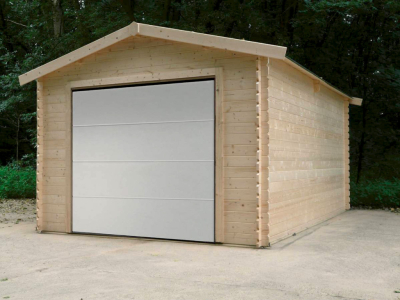
Wooden garage – Definition
Wooden garage – Description
The term ‘garage’ is a singular masculine noun whose meaning varies depending on the context:
- An outbuilding attached to a main dwelling used to house all kinds of vehicles belonging to the owner and members of their family (motorbikes, mini-tractors, cars, lorries, vans, etc.).
- A premises used as a workshop for mechanical services (servicing, repairs and maintenance of vehicles).
- A sales outlet for new or second-hand vehicles run by a dealer or retailer.
- The act of parking a vehicle (in a car park, at the side of the road, etc.).
- The term ‘stabling track’ is used to refer to a railway track used to park trains that are out of service or awaiting repair and maintenance.
A wooden garage is a structure attached to a dwelling and built entirely or predominantly from wood. Its main function is to protect vehicles from theft, vandalism and the elements. Unlike other structures (such as garden sheds…), a wooden garage may be built with or without a floor. Wooden garages come in two forms:
- A carport is a wooden garage that is partially or completely open at the sides.
- A garage box is a fully enclosed wooden garage. Its openings vary greatly (in number, type of material, motorised operation, etc.). Wooden garages blend easily into their surroundings.
Wooden garages – History
Ancient history
The use of wood as a building material dates back to the Neolithic period (5,000 years BC). The first sedentary people chose wood to build their shelters. Wishing to preserve their burial sites, the pharaohs of ancient Egypt (6th–5th centuries BC) crafted wooden sarcophagi for their mummies (embalmed bodies). The Romans built the first half-timbered houses, consisting of a wooden framework (rafter beams, posts, struts and braces) and walls filled with unfired bricks, cob or plaster. This technique then spread throughout the rest of Europe from the 6th century right up to the end of the 19th century, with successive improvements.
In France, after the Hundred Years’ War (1337–1453), ‘Gothic houses’ were built with ‘corbelled’ storeys. Today, the half-timbered houses of Alsace, Normandy, Brittany (Tréguier, Morlaix, etc.), the Landes and Troyes (Aube, Champagne-Ardenne) form part of the Renaissance architectural heritage of the whole of Europe. Of course, there was no such thing as a wooden garage at that time – definition.
Recent history
The construction of wooden garages dates back to the early 20th century (after the First World War) with the advent of the motor car. We thus see the emergence of several garages for exhibitions (trade fairs, etc.) and the promotion of the ‘Dame Auto’ at the Grand Palais in Paris, on the initiative of car manufacturers (Peugeot, Citroën, Renault). The wealthier classes began to fit out their homes with private wooden garages to protect their vehicles, despite the economic crisis of the 1930s. According to research by the Seine-Saint-Denis Cultural Heritage Department, a sawmill and a parquet flooring workshop belonging to the Entreprise Mathieu were established in Aubervilliers in 1918. They were powered by a steam engine and a generator. Their timber was supplied via the Saint-Denis Canal (a navigable waterway).
After 1945, the pace of timber construction slowed down. Several factors favoured concrete: the post-war crisis (fall in income, etc.), the need to rebuild, the desire to increase living space, and changing trends (wood was seen as old-fashioned compared to concrete, a modern material). Since the 1980s and 1990s, new factors have come into play. The rise in energy costs following the two oil crises (1973 and 1979), the rise in greenhouse gas (GHG) emissions and their negative effects on the environment, and the quest for a better quality of life (aesthetics, a return to nature, sustainable development, etc.) all explain the current enthusiasm for timber.
In North America and the Scandinavian countries, 95 per cent of detached houses are now built from timber. Production lines for timber garages are becoming fully computerised, from product design right through to finishing. Digitalisation applied to the timber industry improves quality and diversifies products to suit customers’ tastes.
Copyright protected under Articles L. 111-1 and L. 123-1 of the Intellectual Property Code.