
Your cart
There are no more items in your cart
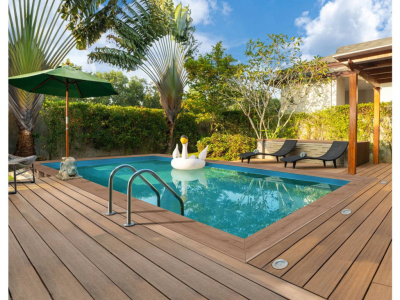
Wooden swimming pools – The guide
Categories :
Practical Guides
, Swimming Pool & Spa
, Wooden swimming pool
You already know why you’re drawn to a timber swimming pool: its natural look, its sturdiness and the way it blends into any garden. What you’re rarely told, however, is when you need to order it to be able to enjoy it as soon as the warm weather arrives, how much it actually costs once you’ve factored in the concrete base, water and electricity, and what the authorities expect of you depending on whether you’re installing it above-ground, semi-inground or inground. That is precisely what this guide is for. To explore the models, take a look at our range of wooden swimming pools made from Class 4 autoclave-treated Northern pine, FSC-certified and manufactured in Europe.
Reverse planning: when should you order your wooden swimming pool to be ready for a swim this summer?
This is the most common mistake made by future pool owners: ordering the pool in June in the hope of swimming in July. However, between placing the order and taking your first dip, there are several essential steps that cannot be rushed. Here is a realistic timeline for an above-ground or semi-inground wooden pool project:
Week 1 – Ordering and preparing the site. Whilst your kit is being prepared and dispatched, choose the location: stable, level ground, away from trees (roots and leaves) and close to a water supply and an electricity supply for the filtration system.
Weeks 2 to 3 – Earthworks and pouring the concrete slab. Excavation, laying the welded mesh and pouring the concrete can be completed in a few days. For a semi-inground installation, you’ll also need to dig the foundation pit and the service trenches.
Weeks 3 to 7 – Allowing the slab to cure. This is the step everyone forgets: concrete reaches its optimum strength after around 4 weeks of curing. Erecting the structure on a slab that is still too fresh risks cracks and structural damage.
Week 7 – Assembling the kit. Allow 2 to 3 days with two people for a timber pool kit: assembling the planks, fitting the wall felt, laying the liner and installing the filtration system.
Week 8 – Filling the pool and bringing the water up to temperature. Filling takes 24 to 48 hours depending on the volume and your water supply flow rate; the water then takes several days to reach a comfortable temperature, unless you fit a pool heating system (heater or heat pump).
Practical tip: to be swimming by the end of June, order your timber pool between late March and mid-April. Ordering in May is still feasible for a full summer; ordering in July means you’ll have to wait until the following season, unless you’re installing a simple above-ground pool on an existing concrete slab. Bonus: ordering early also means you can take advantage of full stock levels and early-season offers.

The real budget: how much does a timber pool cost in the first year?
The prices shown online are for the kit only. To make an informed decision, you need to consider the total cost of ownership for the first year. Here are the approximate figures for a family-sized wooden swimming pool measuring around 5 x 3 m (holding around 15 to 20 m³ of water):
The pool kit: from €2,000 to €9,000. At Habitat et Jardin, entry-level models start at around €2,000 (round ‘Hawaii’ style) and large rectangular swimming pools cost over €7,000. Our kits already include a 75/100th liner, filtration system, coping stones and felt for the base and walls, which saves you from having to buy these items separately. Some packs include a bubble cover and a winter cover: it’s well worth doing the maths, as bought separately, these two pool covers cost several hundred euros.
The concrete slab: €500 to €1,500 if you build it yourself, €1,500 to €3,000 if done by a professional. The most underestimated cost of the project (see dedicated section below). For a semi-inground installation, add the earthworks: allow €1,000 to €3,000 depending on access and the nature of the ground.
Filling the pool with water: €60 to €150. Based on an average water price of €4 to €5 per m³ in France, filling 15 to 30 m³ costs less than you might think. However, check with your local council: some local authorities subject to summer restrictions regulate the filling of swimming pools.
Electricity for filtration: €100 to €200 per season. A filtration pump runs for 8 to 12 hours a day in summer. A simple rule of thumb for daily filtration time: divide the water temperature by two (water at 24 °C requires 12 hours of filtration per day).
Treatment and testing products: €150 to €300 per year. Disinfectant, pH adjuster, test strips and winterising product. Find all the essentials in our pool treatment section.
Safety (compulsory for in-ground or semi-in-ground pools): €200 to €1,500. Alarm, fence, bar-type cover or compliant pool enclosure: see our pool safety section and the regulations section below.
Realistic total budget for the first year: allow for the price of the kit plus 30 to 50 per cent. A wooden pool priced at €3,000 represents a total project cost of €4,000 to €4,500 for an above-ground installation, and more for a semi-inground one. It is this figure that should be compared with the €15,000 or more for a in-ground pool: the difference remains huge.
Declarations, duties and taxes: how the type of installation makes a difference
This is an aspect that almost nobody goes into detail about, even though it can influence your choice between an above-ground and a semi-inground pool. The administrative and tax regime for a timber pool depends on its surface area and whether it is removable:
A removable above-ground pool, installed for less than 3 months a year: no formalities required (15 days in protected areas). This is the most flexible option, but not very realistic for a timber pool that isn’t dismantled every winter.
A swimming pool larger than 10 m² installed permanently: prior notification of works must be submitted to the local council. Most family-sized wooden swimming pools have a pool area exceeding 10 m². The form is free of charge and the processing time is approximately one month — something to factor into your reverse schedule. For pools larger than 100 m², a planning permission is required. Also check your local authority’s Local Planning Regulations (PLU): some impose a minimum distance from property boundaries (often 3 m) or colour restrictions.
Taxation: the key difference between above-ground and in-ground pools. A removable above-ground pool, without a permanently fixed base slab, is generally not subject to tax. On the other hand, a semi-inground or inground swimming pool, which cannot be dismantled without being demolished, is classified as a built outbuilding: this triggers the development levy (a one-off payment calculated on a flat-rate value per square metre of pool surface area, revised annually) and increases the basis for your property tax. You have 90 days after completion to declare it to the tax authorities. Please note: the tax authorities now cross-check aerial photographs against tax returns, so it is best to ensure you are in compliance from the outset.
Safety: compulsory as soon as the swimming pool is in-ground or semi-in-ground. The law requires at least one standardised safety device from the following four: a barrier (NF P90-306), an alarm (NF P90-307), a cover (NF P90-308) or an enclosure (NF P90-309). Above-ground pools are not subject to these requirements, but the installation of an alarm or a barrier is strongly recommended where there are young children.
The concrete base: the step everyone underestimates
All retailers mention the ‘mandatory concrete slab’, yet almost none explain what this entails. A 5 x 3 m wooden swimming pool, when filled, weighs over 20 tonnes: even the slightest differential settlement of the ground will distort the structure and put strain on the liner. The concrete slab serves two purposes: to stabilise the base and to protect the bottom of the pool from stones and roots.
Best practice: a slab 12 to 15 cm thick, reinforced with welded mesh, ideally extending 20 to 30 cm beyond the pool’s footprint, perfectly flat and level (with a tolerance of a few millimetres). On clay or backfilled ground, a bed of compacted gravel beneath the slab is essential. And above all: allow for a curing period of around 4 weeks before assembly. For a semi-inground installation, add a protective membrane to the outer walls and a perimeter drainage system to remove any standing moisture, the main enemy of inground timber.
Above-ground, semi-inground or inground: which installation method is right for your timber pool?
One of the great advantages of timber is its structural versatility: depending on the model, the same kit can be installed above-ground, semi-inground or inground. Above-ground installation is the quickest and most economical option, requiring no major earthworks. Semi-inground installation offers the best aesthetic compromise: ideal on sloping ground, it lowers the waterline and allows you to create a level terrace — it is also the configuration that enhances your outdoor space the most. In-ground installation offers the look of a concrete-built pool at a fraction of the price, though it requires more extensive work (excavation, drainage, gravel backfill).
In terms of structure, opt for thick planks (45 mm in our octagonal ranges) made from Class 4 autoclave-treated pine, the only treatment that guarantees resistance to fungi, wood-boring insects and constant damp. The FSC certification of our Northern European timber also ensures sustainable management of the source forests, with manufacturing taking place in Europe.
Maintaining a timber swimming pool: the water and structure combination
Wood is a living material: its maintenance involves two aspects. As for the structure, cleaning with a soft brush and soapy water is sufficient (never use a high-pressure washer, as this opens up the wood fibres), followed by a wood brightener and then a wood saturator if the wood turns grey due to UV exposure. As for the water, keep the pH between 7.2 and 7.4 and, for a timber pool, opt for bromine or active oxygen, which are less harsh on the coping and liner than high-dose chlorine. A well-maintained liner in a timber pool will last around ten years; the timber structure itself can last over 15 to 20 years provided that Class 4 treatment is maintained and drainage is properly managed. Don’t forgetto winterise your pool: lower the water level, treat the water and fit the winter cover — three simple steps that extend the pool’s lifespan and save you the hassle of getting it up and running again in the spring.
Frequently asked questions about wooden swimming pools
When should you order your timber swimming pool to enjoy a swim in the summer?
Ideally between late March and mid-April. Taking into account delivery, the pouring of the concrete slab, its four-week drying period, assembly (two to three days) and filling with water, allow six to eight weeks from ordering to your first swim.
What is the total budget for the first year?
The price of the kit plus 30 to 50 per cent: concrete base, filling with water, electricity for the filtration system, treatment products and safety equipment. A kit costing €3,000 represents a total project cost of €4,000 to €4,500 for an above-ground installation.
Do you need to register a timber swimming pool, and are there any taxes to pay?
For pools larger than 10 m² that are permanently installed, prior notification of the works is compulsory. A semi-inground or inground pool is also subject to development tax and is included in the basis for property tax, unlike a removable above-ground pool.
Is a concrete slab really essential?
Yes, for a rigid wooden swimming pool: when filled, it weighs several tens of tonnes. You’ll need a reinforced concrete slab 12 to 15 cm thick, perfectly level, with around four weeks’ curing time before assembly.
Which water treatment should you choose for a timber swimming pool?
Bromine or active oxygen are recommended: they are effective and less harsh on the wood and the liner than chlorine. Keep the pH between 7.2 and 7.4 and filter the water for a number of hours each day equal to half the water temperature.