Your cart
There are no more items in your cart
Garden sheds: a comparison of materials and prices for your garden
Categories :
Garden
, Garden shed
, Practical Guides
A garden shed is a practical solution for storing all your tools, garden furniture and materials. This guide aims to help you choose a shed that perfectly suits your needs, by comparing the different materials and sizes available on the market.
For your information, a garden shed, also known as a garden hut, is a lightweight structure often used as an outdoor storage space. When it comes to building a shed, a simple declaration to the local council is sufficient for areas under 20 m², whilst a planning permission is required for larger areas.
We’ll also review the relevant regulations and purchasing options from specialist retailers such as Habitat et Jardin. The aim is to provide you with all the information you need to successfully complete your outdoor landscaping project.
Wooden, metal or resin garden sheds: which material to choose
The choice of material for your garden shed depends on your aesthetic preferences, the level of durability you require andthe amount of maintenance you’re prepared to carry out. Each option has distinct advantages that will influence your final decision and the longevity of your investment.
Advantages and maintenance of wooden garden sheds
When comparing wooden, metal or resin garden sheds, wood is often preferred for its natural, warm appearance. It comes in a range of finishes, such as untreated wood or autoclave-treated wood, allowing you to match the style of the shed to that of your garden.
Furthermore, a wooden garden shed with planks over 28 mm thick offers excellent thermal insulation. This means you can enjoy a pleasant and comfortable space that can be used even when the weather turns cooler.
- A variety of finishes: untreated, autoclave-treated or stained, the wood complements all styles and decorative tastes.
- Natural insulation: the thickness of the timber ensures excellent thermal and sound insulation inside the shed.
- Regular maintenance required: a treatment applied every 2 to 3 years is essential to protect the structure from insects and damp.
- Blends well into the landscape: the shed blends harmoniously into the surrounding greenery for a very natural look.
However,maintaining a wooden garden shed requires constant attention to protect it from wood-boring insects and moss. This care is essential to ensure the shed’s longevity and to preserve its attractive appearance over time.

Performance of metal and modern resin garden sheds
If you want to save yourself the hassle of maintenance,a resin garden shed is the perfect alternative. Its PVC structure is highly resistant to UV rays and corrosion, offering optimal waterproofing for all your belongings.
The fact that it requires absolutely nomaintenance makes it the ideal choice for homeowners who, above all, are looking for simplicity and ease in their day-to-day lives. It is the perfect solution for protecting your tools from damp without having to make the slightest effort.
Metal garden sheds, on the other hand, made from galvanised steel or aluminium, offer structures that are extremely robust in the face of harsh weather conditions. These kits are often very quick to assemble, allowing for almost immediate installation.
Composite and mixed-material structures for a sustainable garden
Composite timber cleverly combines wood fibres and plastic to create a rot-proof and highly stable material. This innovation combines the warm aesthetic of wood with the durability of plastic, without requiring any special treatment.
Choosing a composite garden shed therefore ensures remarkable resistance to UV rays and temperature fluctuations. It is an excellent compromise for creating a storage space in your garden that is both durable and stylish.
What size garden shed requires no planning permission?
In France, the regulations governing garden sheds depend mainly on their floor area and location. It is essential to fully understand these legal limits before installing your structure to avoid any administrative complications later on. Please do not hesitate to contact your local council’s planning department to find out the specific rules applicable to your plot.

Regulations for a garden shed under 5 m²
If you choose a 5 m² metal garden shed or a smaller structure, please note that no administrative procedures are required. This lack of formalities also means you are exempt from paying development tax, which greatly simplifies your outdoor project. You’ll therefore be able to install your small shed quickly and with complete peace of mind.
- No formalities required: there is no need to submit an application to the local council as long as the area remains under 5 m².
- No tax to pay: you’ll make immediate savings when installing your structure thanks to this exemption.
- Consulting the Local Urban Development Plan (PLU) is essential: please note that certain protected areas may impose strict rules despite this general exemption.
- Quick installation: you’re free to start work without having to wait for administrative approval.
Even for a modest structure, check with your local council regarding maximum permitted heights or prescribed colours. These details are often set out in the Local Planning Regulations (PLU) and may influence your choice regarding dimensions and the final appearance. To find out more about the official procedures, see the page dedicated to garden shed declarations.
Prior notification and planning permission depending on size
Where the floor area is between 5 m² and 20 m², a prior declaration is compulsory for any modern, low-maintenance garden shed. You will need to submit the Cerfa 13406*06 form to the local council, attaching a site plan and a description of the materials. Processing the application usually takes around one month.
If your project exceeds 20 m², a declaration is no longer sufficient and a building permit is required. This procedure requires more detailed plans, including elevations, and the processing time often extends to two or three months. The authorities may also request amendments during this review period.
- Prior notification (5–20 m²): the procedure is simplified, with a short processing time of one month to approve your application.
- Building permit (over 20 m²): this comprehensive application often requires professionally drawn-up plans and a longer processing time.
- Extensions attached to the house: these structures generally fall under the notification scheme up to 20 m², barring exceptions.
- Conservation areas: in protected areas, a planning permission may be required even for an area of less than 20 m².
You can submit your application directly online via your local council’s website or send it by registered post. Remember to keep the receipt of submission so you can track the progress of your application with the authorities. This will make it easier to follow up on your application for a metal or wooden garden shed.
Installing and setting up your garden shed
Careful installation is essential to ensure the stability and durability of your garden shed. From choosing the location to the final fixing, every step requires proper preparation. Let’s find out how to prepare the ground and assemble your structure to make the most ofyour storagespace.

Quick assembly and anchoring depending on the type of wooden shed
A modern, maintenance-free wooden garden shed can usually be assembled in a few hours by two people. Flat-pack models, particularly those made of metal, can be assembled even more quickly thanks to simplified systems. Composite materials offer a good alternative, combining ease of assembly with lasting aesthetic appeal.
The type of anchoring depends on the material: timber often requires base plates fixed to a concrete slab. To ensure a sturdy shed, make sure to provide a base that is slightly larger than the structure’s external dimensions. This improves drainage and protects your investment in the long term.
| Material | Assembly time | Anchoring system | Tools required |
| Galvanised steel | Less than 30 mins | Anchoring kit supplied, stakes or base plates | Spanner, mallet, spirit level |
| Solid timber | 2–3 hours | Brackets, screws, wooden shims | Screwdriver, spirit level, saw |
| PVC resin | 1–2 hours | Anchoring kit, reinforced plastic stakes | Spanner, mallet, spirit level |
| Composite | 2–3 hours | Suitable composite mounting plates, stainless steel screws | Screwdriver, spirit level, drill |
Remember to leave a clearance of around 30 cm around your wooden shed so that you can move about easily. This space makes it easierto maintain the cladding and ensures natural ventilation, thereby minimising damp problems.
Flooring, concrete slab and site preparation
Site preparation is an essential step for the success of your project. Whether you opt for a flat or pitched roof, a perfectly level base guarantees a watertight finish. A concrete slab, slightly larger than the floor area of your garden shed, provides strength and stability.
Adding a floor helps to insulate the interior and protect your belongings from damp. Some models already include a floor, which simplifies assembly. Otherwise, a well-levelled concrete slab is sufficient for storing your equipment safely.
- 10–15 cm concrete slab: the thickness required to ensure your shed’s stability.
- Insulated wooden floor: perfect for enhancing thermal comfort and insulation.
- Minimum 30 cm clearance: essential for easy access and cleaning the walls.
- Slight slope: helps water run off and prevents it from pooling.
Before pouring the slab, carefully level the ground using reference marks. A spirit level will help you achieve a perfectly flat surface, which is essential for the structure’s strength. This precision also ensures that the doors operate smoothly and that your workshop lasts for years to come.
Fitting options for a modern garden shed
Personalise your garden shed with features that enhance its everyday practicality. Glazed doors let in natural light and give it a modern look. Good insulation can transform a simple storage space into a room that’s habitable all year round.
LED lighting is ideal for DIY projects or finding your tools without wasting energy. Adequate ventilation regulates humidity and protects your stored belongings. Finally, an adjoining deck can extend your space and create a relaxing corner in your garden.
Buy your wooden or composite garden shed
At Habitat et Jardin, we offer a wide range of garden sheds designed to suit all budgets and tastes. Whether you need a small, compact shed or a large model offering several square metres of space, find out how to choose the perfect garden shed to meet your needs.
Our range of PVC and metal garden sheds at Habitat et Jardin
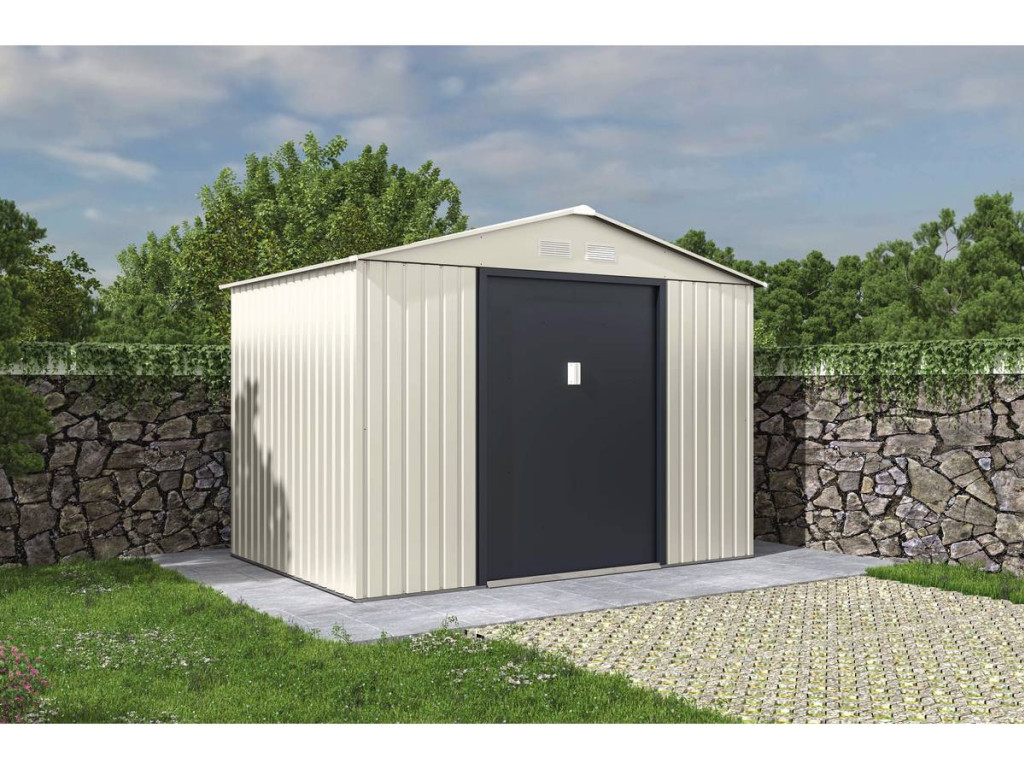
If you’re looking for practicality, a PVC garden shed is an excellent option: lightweight, completely waterproof and requiring virtually no maintenance. UV- and corrosion-resistant, our resin models effectively protect your belongings from damp. Our catalogue also features metal garden sheds, which are particularly sturdy, as well as solid timber sheds with natural charm.
- Lightweight resin sheds: perfect for small-scale seasonal storage, they’re watertight and hassle-free.
- Sturdy metal structures: they offer quick assembly and excellent weather resistance, all at a very affordable price.
- High-quality solid wood: a long-lasting investment that brings a natural look and good insulation to your garden.
- Composite options: modern and stable, these models combine high durability with minimal maintenance.
Feel free to explore our range of garden sheds online to discover all the available sizes, from the smallest storage space to a large professional workshop. Each product page details the technical specifications, practical benefits and the garden shed’s price in real time.
| Type of material | Standard dimensions | Maintenance required | Estimated price |
| PVC resin | 1.2 m² to 12 m² | None | €200–1,500 |
| Galvanised metal | 2 m² to 20 m² | Minimal | €300–2,000 |
| Solid timber | 3 m² to 30 m² | Treatment every 2–3 years | €500–€5,000 |
| Composite | 2 m² to 25 m² | Annual cleaning | €600–3,500 |
Delivery, warranty and customisation options available
If you choose a metal garden shed, please note that delivery is quick and the warranty covers any manufacturing defects. For your peace of mind, you have 30 days to return the product to us free of charge if necessary. Online tracking also allows you to monitor the progress of your parcel right up to your doorstep.
- Tracked home delivery: stay informed about your parcel’s journey and its estimated time of arrival.
- Free returns within 30 days: we guarantee your satisfaction with a full refund, with no hidden costs.
- Optional accessories: personalise your purchase with shelves, LED lighting or reinforced fixings.
To assemble a small standard 3.5 m² shed, allow around 2 to 3 hours for two people, using the right tools. A detailed instruction manual in French guides you step by step, and our customer service team is on hand to provide any assistance. You can also customise your space with glazed doors or insulation to turn it into a proper workshop.
Frequently Asked Questions
What size of garden shed requires a declaration to the local council?
If your garden shed’s floor area is between 5 m² and 20 m², you must submit a prior declaration of works to the local council. To do this, you will need to complete the Cerfa 13406*06 form and attach the required site plans and floor plans.
For areas under 5 m², no administrative procedures are generally required, unless your Local Urban Development Plan (PLU) stipulates otherwise. However, as soon as the area exceeds 20 m², a simple declaration is no longer sufficient and obtaining a planning permission becomes essential.
Which garden shed should you choose: composite wood or galvanised steel?
Choosing a shed that suits your needs depends mainly on your personal preferences. Composite wood offers a natural and durable look, whilst requiring very littlemaintenance. This material also ensures excellent colour stability, cleverly combining the advantages of wood and resin.
Galvanised metal, on the other hand, offers extremely robust models that are easy to assemble and often available at a more affordable price. Before choosing your shed, be sure to take into account your budget,the space available in your garden and the time you can devote to its upkeep.
How much does a standard garden shed cost, and what purchasing options are available at Habitat et Jardin?
The price of a garden shed varies considerably depending on its size and the material chosen. PVC resin sheds can cost between €200 and €1,500, whilst galvanised metal models generally range from €300 to €2,000. Solid wood or composite versions represent a more significant investment, costing up to €3,500 or more.
At Habitat et Jardin, we make your project easier with careful home delivery and a range of options such as insulation or reinforced anchoring systems. Visit our website to compare each storageunit model and to customise your order with the accessories that suit you best.