Your cart
There are no more items in your cart
Metal garden shed – A practical guide
Categories :
Garden
, Garden shed
, Practical Guides
Metal garden sheds are often touted as the cost-effective, maintenance-free solution for storing lawnmowers, bicycles and garden furniture. This is true, but it’s a rather simplistic view. When chosen and installed correctly, a galvanised steel shed becomes a genuine piece of garden equipment: it can withstand specific snow loads, is securely anchored to the ground, collects rainwater from its roof and can even generate its own electricity thanks to integrated solar panels. Here’s everything you need to know before buying, including the points you’re rarely told about: condensation, anchoring and tax implications.
Why galvanised steel is the right choice for durability
The main concern with metal is rust. This is a valid worry with untreated sheet metal, but not with a galvanised steel shelter. Galvanisation involves coating the steel with a layer of zinc that prevents corrosion: the structure retains its strength and colour for years, even in rain and frost. The best shelters also feature a UV-resistant treatment that prevents the painted panels from fading in the sun.
The result: unlike wood, which needs to be stained or painted every two to three years, a metal shelter simply needs cleaning with soapy water. And contrary to popular belief, properly galvanised and lacquered steel also holds up well in damp climates: it is precisely the quality of the zinc coating that makes the difference between a shelter that starts to rust after three years and one that lasts fifteen.
Durability, in figures: snow, wind, anchoring
A garden shed spends the winter outdoors. Two practical questions should guide your purchase: how much snow can the roof bear, and how is the structure secured to the ground?
Roof load: aim for 60 kg/m²
One square metre of compacted or wet snow can weigh between 100 and 300 kg, depending on its depth. A high-quality metal garden shed will specify a rated load capacity: well-designed models, such asthe Nebraska 5.29 m² metal garden shed, can support up to 60 kg/m², which covers most snowfall events in the French lowlands, provided the roof is cleared of snow during exceptional snowfalls. If the product description does not mention any figures, be wary: this is often a sign of sheet metal that is too thin and a frame without reinforcing bars.
Anchoring: the issue that too many buyers only realise after the fact
A metal carport is lightweight: without proper fixing, a gust of wind can move it, or even lift it off the ground. Anchoring it to a concrete slab is therefore not an option; it is a necessary step in the assembly process. Check that the concrete anchoring kit is included with the shed – this is the case with reputable ranges – and ensure the concrete slab extends a few centimetres beyond the frame. For sites where pouring a concrete slab is difficult, there are metal foundations designed specifically for each model, which provide a rigid base and raise the structure slightly.
- A minimum of 4 reinforcement bars on the structure for medium and large areas;
- concrete anchoring kit included, to be set in concrete at all four corners;
- a concrete slab 8 to 10 cm thick, flat and level;
- in windy areas, anchoring supplemented by intermediate brackets.
Condensation: the real issue nobody talks about
Metal does not ‘breathe’. When the air inside is more humid than the cold sheet metal – typically on autumn mornings – droplets form under the roof. This phenomenon is normal, but it can be managed very effectively provided three conditions are met:
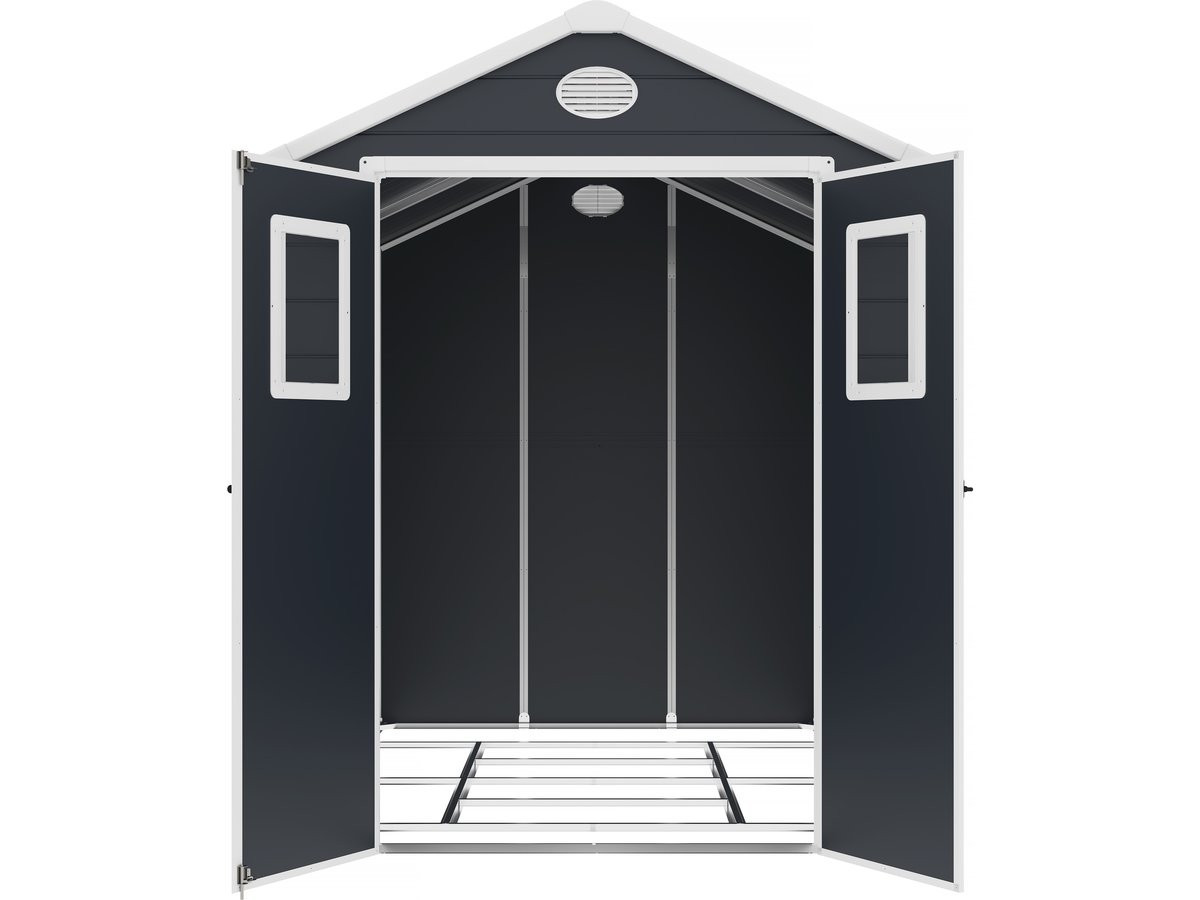
- permanent ventilation: opt for shelters fitted with four ventilation grilles (two at the front, two at the back) which continuously renew the air and prevent odours and mould on your belongings;
- a dry floor: a concrete slab, possibly covered with a polythene sheet, prevents rising damp;
- raised storage: a simple shelf or some pallets are enough to protect boxes and textiles.
With these three simple steps, your metal shed will safely store tools, garden furniture and even power tools, come summer or winter.
Your shed’s roof can water your garden
Here’s an aspect we rarely think about: a garden shed is, first and foremost, a waterproof roof surface. A 5 m² model collects around 3,000 to 4,000 litres of rainwater a year in most regions of France; a large 15 m² model collects over 10,000 litres. That’s a lot of free water that simply seeps into the ground… or into a tank.
Some metal sheds are designed with this in mind: gutters adapted to the profile of the metal sheets, available in different size ranges (2 to 6 m², 6 to 13 m², 13 to 18.5 m²), and a 250-litre rainwater tank for direct connection. At a time when watering restrictions are becoming commonplace every summer, the shelter becomes a water reserve for the vegetable patch and flowerbeds – a benefit that neither timber nor plastic offers with such ease of installation, as the gutter simply clips onto the edge of the metal roof.
A significant bonus: the gutter also prevents muddy water from splashing up the sides of the shed, keeping the lower metal panels clean and prolonging the life of the paintwork.
And why not a shed that generates its own electricity?
Another recent development: metal garden sheds supplied with solar panels integrated into the roof, as seen in certain versions ofthe Dallas metal garden shed. The benefits are very practical for a shed situated at the back of the garden, far from any power sockets: powering interior LED lighting, recharging tool batteries without needing an extension lead, or keeping the robotic lawnmower’s battery charged.
The sloping roof of a metal shed, which is unobstructed and can be freely oriented when installed, provides an ideal surface: bear this in mind when choosing the location and angle the roof so that it faces south or south-west. This is the sort of equipment that transforms a simple storage space into a small, self-contained workshop.
Flat roof or pitched, sliding or hinged: choices that change how it’s used
Beyond the surface area, three design choices are worth considering:
- The roof: a gable roof clears snow and leaves more effectively and offers greater height at the ridge; a flat roof (slightly sloped), such as that ofthe Texas flat-roofed metal garden shed, gives a contemporary look and fits in better alongside a wall or under a height restriction;
- Doors: the double sliding door offers real everyday convenience – it opens without needing space to swing, even if the lawnmower is parked right in front, and its wide opening makes it easier to bring furniture inside; the handles can be padlocked to secure the contents;
- Upgrade accessories: dedicated foundations, guttering, rainwater collection system – check that the range offers these accessories in the exact size for your model, as this is what allows you to upgrade the shed after purchase.
What size for what purpose?
- Less than 3 m²: the tall cupboard – hand tools, cleaning products, small power tools; ideal for city living;
- 4 to 6 m²: the best-selling size, such asthe Vegas 5.29 m² metal garden shed – lawnmower, bicycles, folded garden furniture, tools; the most compact models fall below the 5 m² threshold without any formalities;
- 7 to 10 m²: a DIY workshop or full-scale winter storage for garden furniture;
- 12 to 15 m² and above: a proper outbuilding – permanent workbench, storage for bulky items, or even a metal garage for a motorised two-wheeler, such asthe Dallas 15.16 m² metal garden shed.
Regulations and taxation: what you really need to declare
The planning regulations are well known: no formalities required for floor areas up to 5 m² (outside protected areas), prior notification of works required for areas between 5 and 20 m², and planning permission required for larger areas. But there’s a second aspect that’s almost always overlooked: the development levy.
Any shelter larger than 5 m² with a ceiling height of 1.80 m or more is subject to this tax, which is levied once only after planning permission has been granted. The amount depends on a flat-rate value per square metre, which is revised annually, and on the rates set by your local council and county council – you can generally expect to pay a few hundred euros for a shed measuring 8 to 15 m². There are two ways to reduce this charge: some local authorities grant a partial or total exemption for garden sheds – check with your local council; and a shed with an internal height of less than 1.80 metres or an area of less than 5 m² is completely exempt. Taking this into account when choosing the size will help you avoid any unpleasant tax surprises several months after assembly.
Assembly: 4 tips based on buyers’ experience
Assembling a metal shed is within the reach of any DIY enthusiast, but it shouldn’t be done on the spur of the moment. Customer feedback highlights four key points:
- Plan to have two people on hand, and set aside a full day for a model measuring 4 to 6 m²;
- Read the instructions thoroughly before you start and follow the steps in order – the frame is only secured permanently at the end of the assembly process;
- Self-tapping screws cannot be screwed into the same place twice: be sure of your movements;
- Wait for a windless day: the metal sheets act like sails, and a 2-metre panel is unmanageable in gusts.
FAQ – Metal garden shed
Does a metal garden shed rust?
Not if it’s made of galvanised steel: the zinc coating protects the sheet metal from corrosion and the UV-resistant paint finish preserves the colour. A simple annual clean with soapy water is sufficient, and it’s advisable to touch up any deep scratches immediately with anti-rust paint.
Do you need a concrete base under a metal shed?
This is the recommended solution: it ensures the surface is level, allows the anchoring kit to be fixed in place and prevents rising damp. Alternatively, a metal foundation designed specifically for the model provides a rigid, raised base.
Can rainwater be collected from the roof of a metal carport?
Yes, provided the shed is fitted with a guttering system suited to the profile of its metal sheets, connected to a rainwater tank. A 5 m² roof collects several thousand litres a year – enough to water the vegetable patch all summer long.
Do I have to pay a tax on my garden shed?
If the shed has a floor area of more than 5 m² and a ceiling height of 1.80 m or more, it is subject to a one-off planning charge. Some local authorities exempt garden sheds from this charge: check with your local council before purchasing.
How long does it take to assemble a metal garden shed?
Allow one day for two people to assemble a 4–6 m² model; it will take longer for larger models. The numbered metal sheets and pre-drilled holes make assembly easier; a good-quality screwdriver is essential.
In summary
The metal garden shed ticks all the right boxes – affordable price, flat-pack assembly, zero maintenance – but its real potential lies elsewhere: proven load-bearing capacity (up to 60 kg/m² on the roof), concrete anchoring included to secure the installation, ventilation that tackles condensation, and features that make it productive: guttering, a 250-litre rainwater tank, solar panels. By planning the footprint in line with regulations and planning charges, you’re choosing a shed that will serve you well for fifteen years – and that works for your garden rather than simply cluttering it up. Discover the full rangeof metal garden sheds and their accessories (foundations, guttering, rainwater tanks) at Habitat et Jardin.