Your cart
There are no more items in your cart
Liner – liner prices
Categories :
Pool liner guides - Habitat et Jardin
Pool liners – Description and prices of different pool linings
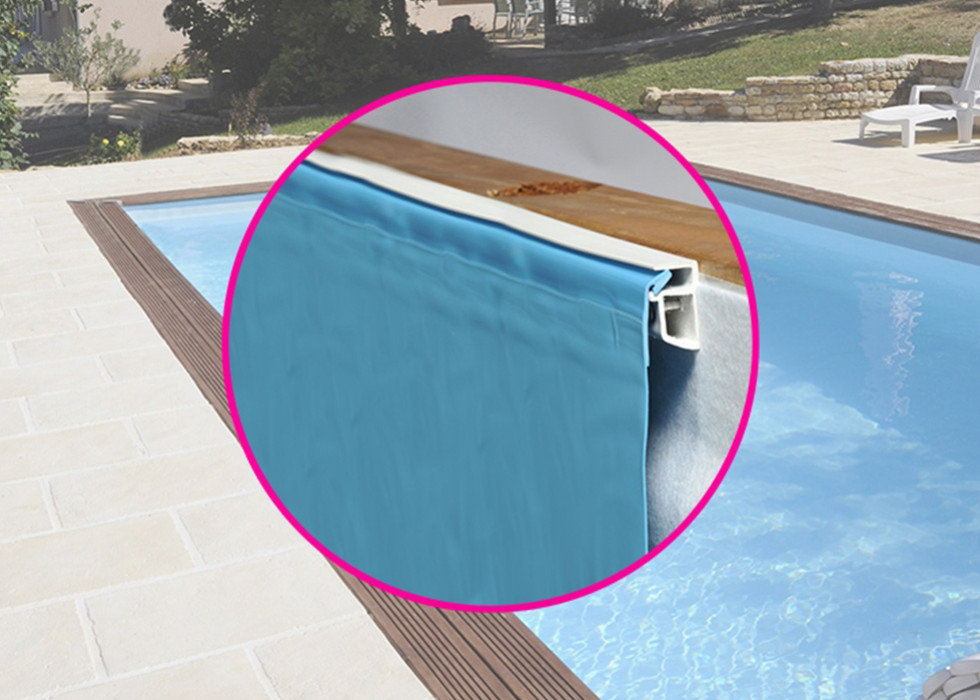
The cavity formed by a swimming pool must be made watertight. Various types of materials can be used to achieve this. These swimming pool linings include tiles, polyester or a pre-formed shell, and a liner. A liner is a PVC lining that is flexible, stretchy and watertight. It is laid over the bottom and walls of a swimming pool to make it watertight. A liner can be used on concrete, timber or metal structures. It is manufactured to fit the shape of the pool.
It should be noted that the supporting structure must be permeable to allow condensation caused by the liner to escape, and that the swimming pool must always be full. The liner is known to be the cheapest option. This is because the materials used and the manufacturing process are less expensive, and installation takes less time. Indeed, once the liner has been manufactured, it is quick and easy to fit. By way of comparison, a square metre of enamel costs between 50 and 150 euros, a square metre of polyester between 80 and 100 euros, whilst a square metre of a 0.75 mm liner (which is of decent quality) costs only between 10 and 20 euros. The price of a liner is therefore relatively low, given that it has a lifespan of over 10 years. There are many factors that influence the price of liners.
Liner prices – Surface area, shapes and types of ponds
Pool surface area
The price of liners depends primarily on the dimensions of the pool, namely the surface area of the base and the surface area of the walls. Prices are quoted per square metre. The price of the liner is proportional to the surface area of the liner and therefore of the pool.
For rectangular pools, the surface area of the base is calculated using the length and width, and the surface area of the walls using the perimeter and height. For round swimming pools, the base area is calculated using the area of the square inscribed within the circle, and the wall area using the diameter and the height of the walls. Unusual shapes are quoted on a bespoke basis.
As large liners require more components and more work, their price increases with their size. It is important to note that liner manufacturers often apply a surcharge if the surface area is less than 30m². They do not manufacture liners for areas smaller than 10m².
Pool shapes
Pool shapes vary widely and range in complexity. The more complex the shape, the higher the price. Indeed, there are standard shapes (rectangular, round, etc.), more expensive non-standard shapes, and so-called free-form shapes, which are even more expensive.
The liner must be perfectly adapted to the shape of the pond; the more complex the liner, the more alterations are required and, consequently, the higher the price. Standard and simple shapes include rectangular ponds with flat bottoms, but there are also more complex shapes. Ponds with slopes – whether constant or compound – a safety rim, steps or even underwater lighting present challenges for the manufacture of the liner. All these specific features therefore contribute to the increased cost of liners, as they are more difficult to manufacture and install.
Types of pool
The price of liners also depends on the type of pool, whether it is an in-ground or an above-ground pool. In-ground pools require a thicker liner than above-ground pools. In fact, it is recommended to choose a liner of considerable thickness, between 75/100 and 85/100, so that it is more effective and better able to withstand water pressure. Furthermore, in the case of an in-ground pool, it is best to hire a professional to fit the liner, as this is a delicate process for this type of pool; you should therefore bear in mind the additional cost of labour.
For a small above-ground pool, a thin liner of 40/100° or 50/100° is sufficient to withstand the lower water pressure. Furthermore, unlike with an in-ground pool where a specialist is essential, for an above-ground pool a handy DIY enthusiast can fit the liner themselves to save money. As thicker liners are increasingly expensive, the price of the liner depends on the type of pool.
Underwater lighting, plumbing installations and other features present challenges during the manufacture and fitting of the liner and therefore contribute to an increase in the liner’s base price. Indeed, these complex installations mean the liners have to be adapted to accommodate them: additional alterations are required, which in turn demands more work and consequently increases the price. The price of a liner is therefore unique and specific to each swimming pool.
Liner prices – Types, quality, uses and installation of liners
Types of liners
Depending on how often the swimming pool is used or the type of use, it is advisable to choose either a standard liner or a reinforced PVC liner. The type of liner naturally affects the price. Indeed, a reinforced PVC liner requires a much greater investment than a ‘standard’ liner.
The ‘standard’ liner, or membrane, consists of a PVC sleeve with a thickness ranging from 20/100° to 85/100°. For a family swimming pool used regularly by children, it is best to choose the thickest possible option to prevent tears. The price of these liners is naturally higher.
A reinforced PVC liner represents a greater investment than a ‘standard’ liner but is also much more durable. Indeed, its thickness is considerably greater than that of standard liners (150/100°), making it significantly more resistant to impact, intense heat and high water temperatures. Furthermore, the reinforced PVC liner has a much longer lifespan as it is also treated to resist ageing. However, this greater thickness does make the liner more expensive. The price therefore depends on the type of liner chosen.
Liner quality
Thickness
The quality and lifespan of the liner depend mainly on its thickness. Indeed, the thinner a liner is, the more fragile it is. It is therefore recommended to choose liners that are fairly thick; however, the thicker the liner, the more expensive it is. The thickness of a liner ranges from 0.20 to 0.85 mm, and can even reach 1.50 mm for a reinforced PVC liner. The price of liners naturally increases with thickness.
Thickness is an indicator of a liner’s quality; therefore, the thicker it is, the higher the quality. Quality always comes at a price. Thin liners are suitable for small pools, mainly above-ground pools, whilst thick liners (from 75mm) are better suited to large pools: in-ground or semi-in-ground.
To give an example, a 0.45mm-thick liner for a round above-ground pool with a diameter of 3.6m and a depth of 1.20m costs between 170 and 250 euros. For an in-ground pool, prices are always set per square metre. Thus, for a 0.50 mm thick liner, prices range from 8 to 20 euros. For a 0.57 mm liner, prices range from 12 to 30 euros, and for a 0.85 mm liner, prices range from 20 to 50 euros.
Treatments applied to the liner
There are numerous treatments carried out on the liner before it is sold, as a liner can become damaged or worn quite easily. Indeed, a treatment applied to the liner can extend its lifespan, help protect it from bacteria and preserve its colour… However, these treatments are not free and therefore also contribute to the variation in liner prices.
A liner can be treated against UV rays to preserve colour, against algae, against bacteria, or against stains to prevent deposits of metals contained in the water and the growth of micro-organisms that would damage the liner. There is also a surface varnish that can be applied to the liner to combat wear and abrasion. An anti-ageing treatment can also be applied to prevent signs of pollution… All these treatments are optional but necessary, so they can cause the price of liners to vary considerably.
Liner colours and patterns
Another important factor affecting the price of liners is their ‘design’ and style. Indeed, there are many different types of liners available: plain, printed, with or without a mosaic border or frieze… The simplest liners are plain; there is a wide choice of colours, and the price can vary depending on the colour chosen. Alternatively, you can choose a printed liner, but the price per square metre is higher. Printed liners can be mosaic, marbled or patterned.
Prices may vary depending on the design. Mosaic or marbled liners are more expensive than those with simple patterns. Furthermore, you can choose a plain or printed liner with a mosaic border or a frieze at the top. The more sophisticated and intricate the liners are, the higher the price. Colours and patterns are therefore very important factors in determining the price of the liner.
Pool usage
How often a swimming pool is used can determine the choice of liner thickness and, consequently, the price. For example, a family pool mainly used by children is more prone to heavy impacts and tears, so it is necessary to choose a thicker liner. A thicker liner is therefore more expensive and consequently affects the price.
As the liner is inherently very fragile, it becomes even more so during periods of intense summer heat. It is therefore advisable to choose a reinforced PVC liner to withstand these high temperatures. However, reinforced PVC liners are significantly more expensive than standard liners.
Fitting the liner
On top of the cost of the liner, there is, of course, the cost of installation. For an above-ground pool, a keen DIYer can save money by installing the liner themselves. However, for an in-ground pool, the risks are too great, so it is essential to call in a specialist.
It is also important, when replacing a liner, to factor in the cost of removing the old one. However, it is worth noting that the ability to replace the membrane is a key advantage of installing a liner-based swimming pool. The price of liners is therefore just one of the advantages of this type of installation.
Copyright belongs to Pixalione (Articles L. 111-1 and L. 123-1 of the Intellectual Property Code).