Your cart
There are no more items in your cart
The coffee table – Description and uses
Categories :
Interior furniture
, Interior Furniture
, Practical Guides
, Tables
Definition and history of the coffee table
Definition
The coffee table, also known as a living room table, consists of a horizontal top supported by a base comprising one or more legs or various supports. Its distinctive feature is that it is low enough in height to allow people sitting around it on sofas, armchairs or pouffes to reach whatever they need. The ideal height for a coffee table is between 25 cm and 30 cm.
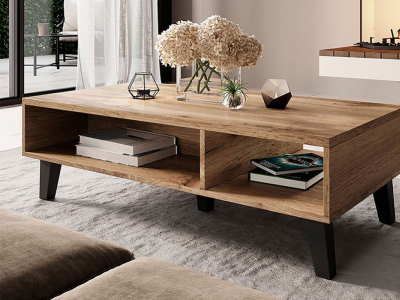
The coffee table is placed in a living room. It is the central piece of furniture in this room, around which the rest of the furnishings and décor are arranged and harmonised. Finally, the coffee table may feature several shelves, drawers or compartments for storing various items.
Coffee tables come in all shapes, sizes and colours, and are made from a variety of materials. The choice of a coffee table will depend, first and foremost, on its intended use. Indeed, for get-togethers with friends over drinks or dinner, it is best to opt for a coffee table made from a durable material such as wood (for example, teak) or smooth-finished concrete, which is easy to maintain.
The coffee table will also need to be of a reasonably substantial size. You might consider models that can be adjusted (folding or lift-top). On the other hand, if the coffee table is intended solely to display decorative items (bouquets of flowers or various ornaments) or to hold books or magazines, you should opt for a coffee table where aesthetics are the primary consideration.
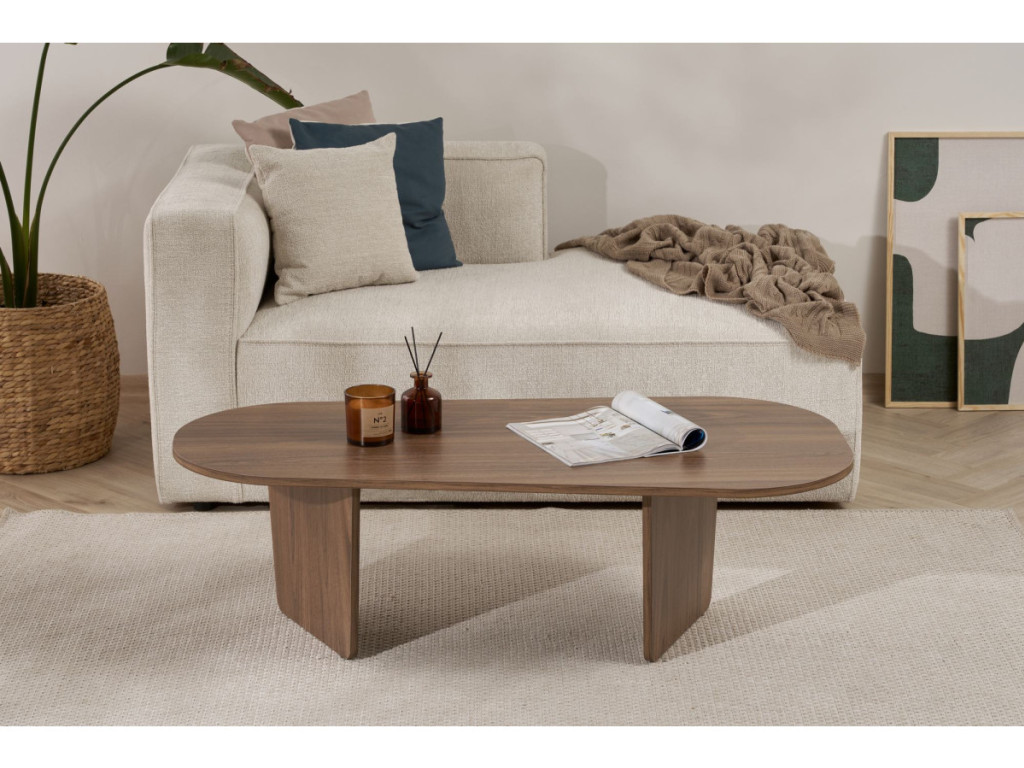
The choice of coffee table will also depend on the size of the living room. Not only must its size be appropriate, but its shape must be too. For example, an oval coffee table will take up less space thanks to its rounded lines. Furthermore, the overall atmosphere of the living room must be taken into account. For instance, a dark room furnished with a glass coffee table will be brightened by the light reflected off the glass top. Finally, the coffee table must be chosen to complement the living room furniture perfectly, but above all the sofa. The dimensions of these two pieces of furniture must be proportional and their heights must be well-matched.
History
In countries such as India, China and Japan, it is traditional to eat whilst seated on the floor. As a result, the use of coffee tables has deep-rooted historical significance for these peoples. Furthermore, the tea ritual in the Arab world, in countries such as Algeria, Tunisia and Morocco, has encouraged the use of coffee tables. In 1725, Laugier de Tassy noted that the most prominent Arabs owned a round coffee table covered in brass.
We should also mention the Ottoman world, where, as early as the 16th century, the use of low tables in gardens for drinking tea was widespread. It was also in these countries that, during the 17th and 18th centuries, writing desks were in use. These took the form of small rectangular wooden chests, with tops adorned with sophisticated marquetry, and fitted with drawers for storing the tools of writers or painters.
However, the origin of the coffee table as we know it today seems to have its roots in the tea table. Indeed, in Britain, during the 17th century and the early 18th century, the custom of ‘tea-time’ gradually developed around armchairs or sofas with a fairly high seat (Bergère style), accompanied by tea tables that were generally round and supported by three legs. However, from 1780 onwards, the height of the seats was lowered closer to the floor, and so tea tables gradually evolved into coffee tables out of necessity.
During the second half of the 19th century, the first wooden coffee tables were produced in Great Britain. In 1868, Edward William Godwin, an English architect and designer, created what appears to be one of the first models of coffee tables in Europe, which was subsequently widely marketed by the firms William Watt and Collinson. The only notable difference from today’s coffee tables is their height. Indeed, Godwin’s coffee table was approximately 27 inches high (or nearly 70 cm).
It is worth noting that, during the same period, the Art Nouveau movement took a keen interest in the design of coffee tables. This artistic movement, which favoured the use of curved lines, applied its principles to this type of furniture. In Britain, during the 1870s and 1880s, the Japanese influence was striking, and the Anglo-Japanese style applied to coffee tables was very much in vogue.
In America, Stuart Foote, CEO of Imperial Furniture, is said to have pioneered the modern coffee table design. The story goes that, whilst he was sawing off the legs of a table, it occurred to him that this low piece of furniture would be perfectly at home in front of a sofa. From 1920 onwards, Stuart Foote marketed his coffee table design on a large scale. At the same time, the production of various types of coffee tables increased, and this piece of furniture quickly became a staple in the average American home.
In France, from the late 19th century and into the early 20th century, there were coffee tables made from woods such as oak, cherry or chestnut. However, these were in fact modestly sized country-style tables with their legs cut short. In reality, coffee tables only began to appear in middle-class homes in the 1920s and 1930s.
Coffee tables come in various shapes: rectangular, round or oval. Their height varies between 30 cm and 40 cm. During this same period, the Art Deco movement (an artistic style influenced by Cubism and characterised by simple lines and straight forms) took a keen interest in this piece of furniture, particularly designers such as Jacques-Yves Rulhman, Paul Dupré-Lefon and Jean Dunand.
Some designs have left a greater mark on the history of the coffee table than others. The French company Chevillard, which specialised in the use of bronze, brass and copper-based metals, created a rectangular, two-tiered coffee table made of solid brass in 1850. In 1858, the Franco-Brazilian firm Objekto produced a wooden coffee table named ‘Moebius’, in reference to the strip created by the German mathematician of the same name.
In 1900, the repurposing of an old vat led to the creation of an industrial-style, riveted coffee table made of raw metal. In 1920, a striking example of Art Deco emerged: the bronze ‘pheasant coffee table’ by the French designer Armand-Albert Rateau. Or, in 1925, the nesting coffee table in lacquered wood by the French designer Gaston Suisse. Also in the Art Deco spirit, dating from 1930, is a wrought-iron coffee table.
In 1928, the Bauhaus style (the school of arts and crafts founded in 1919 in Germany) was introduced with this ‘LC 10’ coffee table. It was designed by the Swiss architect Le Corbusier (in fact, Le Corbusier, whose real name was Charles-Édouard Jeanneret-Gris, did not become a naturalised French citizen until 1930). His coffee table features a chrome-plated metal frame supporting a glass top.
In 1944, the Japanese designer Isamu Noguchi was a leading figure in organic design – that is, a style characterised by fluid, rounded and supple forms. He presented one of his renowned coffee tables, the ‘IN 50’. It is a triangular coffee table with rounded edges, featuring a 19 mm-thick glass top resting on a movable base made of black-lacquered walnut.
Exuding lightness and harmony, the American designer Charles Eames presented his plywood coffee table in 1946; its top features elegant curves that lend the table a sense of fluidity. Once again, Isamu Noguchi, in 1948, returns with a coffee table featuring a solid, curved wooden base upon which a freeform glass top is placed. This delicate, airy piece strikes the perfect balance between sublime sculptural forms and a sturdy, durable table.
In 1950, Pierre Guariche, a French interior designer, designed a coffee table with a base made of black-lacquered metal wire, topped with a Formica-veneered plywood top. In the same year, another French interior designer, André Arbus, created a coffee table with two round rosewood tops. In 1951, Charles and Ray Eames’s iconic coffee table, initially called the ‘Elliptical Table’, was very quickly renamed the ‘Surfboard Table’ due to its oval shape. The legs are made of curved and welded steel wire.
In 1956, Le Corbusier introduced a new model: a coffee table known as the ‘tree trunk’ table. Its top consists of a solid slice of tree trunk resting on ‘V’-shaped legs made of round iron rods. In 1965, the Italian architect Gae Aulenti designed a classic marble coffee table. Its top rests on legs forming double cylinders, striking a perfect balance between elegance and sturdiness.
In 1971, the Simonnet couple, French architects, created a modular coffee table, moulded from polyester and reminiscent of a jigsaw puzzle. Another must-have coffee table is the ‘Glass Table’, designed by the Japanese designer Shiro Kuramata in 1976. With its minimalist style, the top and legs are made of clear crystal, and its craftsmanship is of the utmost finesse.
In 1979, the ‘Carcasse’ coffee table was created by Swiss designer Diego Giacometti. Its glass top rests on four green-patinated bronze legs, each adorned with a small bat motif. In 1984, the Italian designer and architect Michele de Lucchi, a member of the Memphis Group (which influenced 1980s design), created a coffee table made of lacquered wood and laminated plastic.
Unveiled at the ‘Furniture Fair’ international trade fair in Cologne in 2002, the ‘Parabel’ coffee table was created by the Finnish designer Eero Aarnio. Round in shape, reminiscent of a parabola – hence its name – this coffee table is made of fibreglass and features a single-piece base. Finally, let us note the ultra-modern design of this coffee table, a 2011 model. With its organic shape, its base and top form a single unit, blending into the shape of a white or black lacquered fibreglass pebble, evoking a ‘Zen’ feel that is very much in vogue today.
To conclude this historical overview, it is worth noting that the first coffee table designs did not appear until the second half of the 19th century. However, throughout the 20th century, the coffee table underwent a remarkable evolution for various reasons. The first is that this piece of furniture became widely available, meaning its price gradually became affordable to everyone. The second factor is that industrial progress allowed for a diversification of the materials used (for example, chrome, stainless steel, Formica or acrylic). Finally, the third factor is that coffee table designers have intensively developed mass production, thereby broadening their potential customer base.
The shapes and materials of a coffee table
Shapes
The shape of a coffee table is one of the first criteria to consider. Coffee tables come in rectangular, square, round, oval or triangular shapes. In addition, there are coffee tables with original shapes, inspired by the designer’s creativity at the time. Some models are quite striking, such as tables shaped like hearts, stars, animals or even boats.
These shapes will influence the style. Indeed, a square coffee table would be chosen for a living room where the rest of the furniture and décor are traditional or classic. A round coffee table would be preferred for a room where the décor is more modern or contemporary. As for original shapes, these will be unique or limited-edition models that clearly bear the designer’s signature.
Styles, shapes and features overlap and blend across different models or categories of coffee tables. The requirements you have when buying a coffee table will determine, for example, whether it will have a single or double top, whether it will be on castors or not, and whether it will be supported by four legs or a single, solid leg…
Another set of considerations will relate to the specific features of the coffee table. You’ll need to decide on the number and type of storage spaces. These may take the form of shelves, storage compartments, recesses or drawers. The coffee table may also be enhanced with various accessories. Finally, it is important to consider whether it will be used all the time or only occasionally.
Lastly, the size of the living room and the space allocated for the coffee table will determine its shape. Indeed, depending on how it is arranged with the rest of the furniture, it must be possible to move around the coffee table easily. Its dimensions will therefore need to be adjusted accordingly. For example, a rectangular coffee table will be more imposing and take up more space, but will fit perfectly opposite a corner sofa. On the other hand, a round or oval coffee table with its rounded edges will lend a lighter feel to the overall look of the living room.
Materials
Since the coffee table first came into being, the materials used to make this piece of furniture have evolved considerably. This is thanks to advances in technology, chemistry and organic materials. However, older materials such as wood, stone, wrought iron or metal – particularly prized for their sturdiness – remain popular to this day.
The material has a direct influence on the style of a coffee table. This decorative style should harmonise as well as possible with existing or future furniture, as well as with the overall décor of the living room. Indeed, a traditional or contemporary, modern or period-style coffee table will not be made from the same materials.
In a living room with a stylish, contemporary décor, a glass coffee table will fit in perfectly. A wooden coffee table would be the right choice for a living room with a country-style décor. Wood will bring a sense of warmth and authenticity to the room. Taking it a step further, teak can add a touch of exoticism. For added character, the coffee table could be made of stone and wrought iron. As for metal, it is a modern and very contemporary material.
The materials used to make a coffee table are very varied. There is wood or wood veneer, available in practically every type of wood, whether for reasons of colour or strength. These include, in particular, light or grey oak, pine, cherry, beech, bamboo and rattan. Teak, which is very widespread, is a tropical wood originating from India, Malaysia, Laos and Thailand. Perhaps less well-known but rapidly gaining popularity, wenge is a tropical tree from Africa with very durable black wood.
There are also materials that stand the test of time. For example, coffee tables made of stone such as marble, glass, ceramic or natural fibre. There is also wrought iron, steel or metal, which are highly prized in the manufacture of coffee tables to which designers wish to give an industrial style.
Then there are materials used in the construction of coffee tables such as melamine, made from compressed wood panels bonded with amino resins. There is also laminate, better known by its trade name, Formica. Derived directly from melamine, laminate consists of successive layers that undergo a chemical process, causing them to bond intimately to create a single material. Another well-known material is chipboard, which is made from wood particles.
Increasingly, we are seeing coffee tables made from newer materials. MDF, or ‘Médium’, stands for Medium Density Fibreboard. It is a medium-density fibreboard. Composite materials, on the other hand, result from the combination of at least two materials that do not mix but complement one another in order to make the most of the properties of each component.
Another type of material that is rapidly gaining popularity is resins. The best known of these is undoubtedly the lacquer used to coat coffee tables. It is a resin derived from latex which, as it dries, forms a particularly robust coating. There is also shellac. This is an organic resin secreted by an insect found in India and Thailand. Then there is Acrilux, which is a protective acrylic resin.
It is worth taking a closer look at certain materials. The first coffee tables with glass tops were developed and sold in 1934 by a department store in Chicago. They became widely popular in the 1950s. Glass can be frosted, curved or toughened. Frosted glass is all about the finish and gives an opaque appearance. Curved glass can be shaped as desired. Toughened glass is very strong.
Glass coffee tables are particularly ideal for small living rooms. Indeed, they create the impression that the room is more spacious. This impression is enhanced by the fact that the glass top reflects all light sources, thereby illuminating the entire room. Furthermore, a glass coffee table adds a modern, stylish touch to the living room thanks to coloured glass or its endless range of shapes. It is worth noting that the glass top is often paired with a chrome-plated metal base.
For coffee tables made entirely of glass, the tabletop should be at least 12 mm thick. If only the tabletop is made of glass, it should be 7 mm thick. For added safety, it is advisable to choose a glass coffee table with rounded corners – which is much safer, particularly for young children – as well as one made from toughened glass.
At first glance, toughened glass looks no different from ordinary glass. However, the production of toughened glass involves a detailed process of cooling and reheating to make it resistant to thermal shock. Furthermore, the top of a toughened glass coffee table is very robust. Whatever the impact, the top will not break and there will not be the slightest crack.
However, it is important to note that the thickness of a glass top on a coffee table is approximately 2.5 cm, and it is consequently quite heavy. You must therefore ensure that the entire structure of the coffee table can support a top of this weight. Ordinary glass tops are more fragile, but as they are thinner, they are lighter. You should therefore consider whether the benefits of toughened glass actually meet your specific needs: are there children in the household, and will the coffee table be subject to heavy use?
Another material that is both time-honoured and still very much in vogue is metal. In principle, metal is used for the coffee table’s frame or for specific design features. However, throughout the history of the coffee table, there have been a few models made entirely of metal, giving them an industrial style. Most often, metal components will be chrome-plated or, in the case of aluminium, anodised. This gives these components increased strength and a decorative finish.
Coffee tables made of plastic first appeared in the 1960s. The technological and physical properties of these materials are characterised by polymers. There are two main families of plastics: thermoplastics and thermosets. Thermoplastics are composed of resins that become malleable when heated and harden when cooled. They are very strong, very lightweight and pose no risk to human health. They can be coloured and shaped as desired. Thermosets are plastics that solidify when heated and become rigid. This process is known as polymerisation. Once this stage is complete, it is no longer possible to alter the shape of coffee tables made from this material.
The original material used for coffee tables, and one that is still used in their manufacture, is wood. It offers both sturdiness and durability to the furniture. Furthermore, as it is a natural material, the colour tones may vary from one coffee table to another. Colours range from pale wood, with a Scandinavian feel, to the bolder hues of Asia, Africa or Latin America. Finally, coffee tables are available in solid wood or wood veneer. This finish replicates all the colours and textures of the various types of wood.
Coffee tables – The different models
Designer coffee table
The word ‘design’ as applied to coffee tables is an Anglicism referring to the concept of ‘design’, but specifically design in terms of style. This ‘vague’ explanation of design stems from the fact that there is no single definition of the term. It varies according to different eras, cultures, trends and individuals.
It is this multiplicity of criteria that defines design. As proof, the ‘Petit Larousse’ dictionary offers two different definitions of the word. To make sense of it all, we can nevertheless clarify that design is part of the applied arts, and that its aim is the creation of everyday objects—such as a coffee table—based on a constant exploration of the object’s visual appearance, and thus its aesthetic appeal.
Design must reconcile two imperatives: the form and the function of the object. Indeed, a design product, such as a coffee table, must be functional and easy to use. During the 20th century, design evolved in two directions. The first is ‘artist-led design’, which focuses more on the methods employed in the creation process. Human resources take precedence here, drawing on the expertise of experienced craftspeople or technicians. The result is a limited production run of a high-cost product. The second approach is ‘industrial design’, where the primary focus is on the idea, the project and the concept. Production takes place within large companies for mass production at a reduced cost.
These two movements explain why it is now possible to buy an affordable and functional designer coffee table. As well as being practical – often with ample storage space – the designer coffee table will be a key decorative feature that adds elegance to the living room. Of course, it will always be possible to opt for a one-off (or very limited-edition) designer coffee table by a trendsetting designer.
With this in mind, designers have been particularly imaginative. This is the case with this coffee table manufactured by Racine Carré, a company specialising in decorative indoor grass. It features a small square of grass at its centre, which will undoubtedly bring a touch of greenery to the living room.
The flower-shaped coffee table is reminiscent of ‘flower power’. As refined as it is functional, it consists of a wavy black glass top, where each petal appears to be a personal shelf for each guest. The ‘Ripple Effect Tea Table’ was designed by two students at the Design Academy. It replicates the effect of rippling water whenever an object is placed on it.
Very on-trend, the ‘iTable’ is an iPod-shaped coffee table. This model was conceived by designer Mirko Ginepro. With his floating coffee table, the ‘Sancal Elipse’, designer Rafa Garcia immerses us in the world of optical illusions. Indeed, the top of this coffee table appears to be levitating.
The collaboration between the brands Moroso and Diesel has resulted in the ‘X radio’ coffee table. Its glass top conceals a printed image of a DJ’s turntable. Designer Rainer Mutsch presents his ‘Rock elements’ coffee tables, which are shaped like carved ice cubes. On occasion, some of these coffee tables can serve as very comfortable pouffes – a surprising revelation given their rugged and angular appearance. This comfort is due to a polyurethane moulding, which gives these pieces real flexibility.
The ‘Lounge Multicolour LED’ illuminated coffee table, produced by the German brand Moree, truly sets the mood. This round coffee table comes with a remote control that allows you to change its colour. The ‘Olympia’ coffee table by designer Hanjel takes us back in time, specifically to the intimate world of boudoirs. It features a classic design and a top made of quilted fabric in grey, pink or brown.
The ‘Rotor’ coffee table by designer Luciano Bertoncini is original not only in its shape but also in its extreme functionality. It comprises five oak trays, the three middle ones of which rotate 360°. When fully extended, it offers plenty of space, whilst when all the trays are folded away, it is ideal for small spaces.
Finally, we must mention this ephemeral coffee table design: the ‘Writingtable’ by designer Martin Saemmer. It consists of a thousand detachable sheets, much like ‘Post-it’ notes. Once you’ve filled the top sheet, simply remove it and start again on the one underneath: a coffee table you can peel away layer by layer.
Adjustable tables
Lift-top table
Nowadays, saving space is a constant priority. Creators, designers and manufacturers have clearly understood that the current demand for furniture is for minimal bulk and maximum functionality. One such solution is the lift-top coffee table.
The key advantage of lift-top coffee tables is that they combine complex mechanisms, exceptional designs, space-saving features and clever storage solutions. They have succeeded in optimising space, as lift-top coffee tables take up very little floor space but can significantly increase their surface area in height and, in some cases, width too. Indeed, models with extendable tops have now entered the market. These extensions are either built-in, foldable or achieved by doubling the tabletop.
Its main advantage is that the lift-top coffee table can be extended to become a dining table. This makes entertaining friends or family for dinner a breeze and means you no longer need to disrupt the layout of your room. The only drawback to this use is the limited choice of dimensions. This is mainly due to the mechanism of the lift-top coffee table, which restricts its design and construction. It would be desirable for the dimensions to be more flexible, particularly in terms of depth. In its coffee table form, it serves the more conventional purpose we are familiar with. For both uses, the base is also important, both in terms of design and practicality. Some models feature crossed legs, whilst others have vertical legs.
In terms of appearance, the lift-top coffee table offers a wide range of options to suit the décor of any interior. There is a very wide choice of colours and materials (glass, melamine or wood). Melamine is more affordable and easy to maintain. However, it is only available in black, white or a wood-effect finish.
Wood or wood veneer, with a more natural look, ensures the lift-top coffee table remains sturdy and durable over time. There are numerous shades reminiscent of different wood types: walnut, cherry, beech, wenge, grey oak or light oak… Coloured glass offers a wide range of colours and will blend perfectly into a modern interior. However, glass is a more fragile material and is only available for certain models.
The advantages of the lift-top coffee table are clear. It saves space, particularly in smaller homes, with some models doubling the size of the tabletop when opened. The manual opening mechanism is easy to use, instant and efficient, and can be operated effortlessly by anyone – which is, in fact, the aim of this coffee table, designed to be used several times a day. Once extended, the lift-top coffee table can seat between six and eight people.
There are two mechanisms available for lift-top coffee tables, allowing for either automatic or manual opening. With the manual mechanism, the table can be extended in a single movement, instantly doubling its surface area. Atout Design was the first company to offer this opening system in France and has since specialised in this mechanism, which it has patented internationally for its lift-top coffee tables and for which it provides a five-year guarantee.
Furthermore, the gas-spring mechanism offers the advantage of allowing the lift-top coffee table to be raised or lowered to any height, ranging from its lowest setting as a coffee table to its highest as a dining table. This system offers great flexibility and does not in any way hinder the use of extension leaves at any height. It should be noted that the gas-lift mechanism, which comes with a one- or two-year guarantee, must be manufactured by an experienced and reputable manufacturer in this field. Furthermore, the reliability of this system and its durability over time are likely to be questionable in the case of a very cheap lift-top coffee table.
In view of all these factors, choosing a particular model of lift-top coffee table requires careful consideration. Firstly, you will need to analyse your requirements for the table and the specific characteristics of the room in which it will be placed. You’ll need to consider where the lift-top coffee table will be placed, its minimum and maximum dimensions, its finish and colour, the usual number of place settings, and how often it will be used.
Furthermore, the cost of the lift-top coffee table will be a factor. Moreover, practicality is paramount, as the lift-top coffee table is not merely a piece of living room décor but an item for everyday use. Next, you’ll need to select the opening mechanism for the lift-top coffee table. And finally, you should consider the material of the lift-top coffee table. Its lifespan will depend on this material. The most durable is wood or wood veneer, followed by melamine. Lacquer is one of the most fragile finishes.
The lift-top dining coffee table is the latest innovation, but it is still relatively uncommon amongst the general public. With a single movement, it opens out into a desk, with the top rising above your knees and adjusting to your height. It allows you to sit comfortably at the back of the sofa, with good back support, whilst working, browsing the internet or eating.
Depending on the size of the dinette table, it may even seat two or three people. It can also be fitted with a spacious storage compartment. The dining table offers the same choice of materials, colours, shapes and designs as traditional lift-up coffee tables. The ‘Yoyo’ lift-up dining table, available from Atout Design, is a good example of this new type of furniture.
Modular table
The modular coffee table is the ideal piece of furniture for an endless variety of uses. It is worth noting that it also allows you to store all sorts of items (remote controls, magazines, etc.) that tend to clutter up the living room. The term ‘modular’ means that a piece of furniture is easily adaptable and can be used in various settings and in various ways.
The term ‘modular’ is a contemporary concept. The finishes and the use of environmentally friendly materials in the production of modular coffee tables lend a modern feel to your living room or office. As for the modular coffee table, it is most often used in small or cluttered spaces. Saving space – a constant concern these days – applies to both private individuals and businesses.
Indeed, one of the main reasons for limited space is the cost of commercial premises. Office furniture must therefore adapt to these small spaces. The modular coffee table, used as a work table, will meet the requirements of such confined spaces. Furthermore, constantly buying new furniture or replacing old pieces is very expensive. This is no longer an issue with the modular coffee table, as its design means that you simply need to add new modules to the furniture you already have. It should be noted that this possibility must be taken into account from the very first purchase. Private individuals, too, wish to optimise their space and, for example, will appreciate the quick and easy use of their modular coffee table thanks to its ingenious features and built-in seating.
The modular nature of this coffee table means it is generally quite expensive. The best value for money in a modular coffee table will depend primarily on its design and materials. First and foremost, one must consider the design of the modular coffee table. Its lifespan is directly linked to its design, as this will directly influence the materials used in its manufacture.
A traditional modular coffee table model will generally be made from natural materials such as wood and wicker, which may sometimes be crafted. It is worth noting that the tabletop may be made of glass or marble. It is also possible to find modular coffee tables made from bamboo, rattan or even coconut wood. All these models will be reasonably priced. For a more contemporary modular coffee table, the materials used will usually be glass, aluminium, plastic or ceramic. These models, which combine aesthetics and functionality, will be affordable.
In terms of appearance, the tops of modular coffee tables are available in wood or wood veneer, with colours reminiscent of various wood species. However, there are also some models made from laminate or Acrylux in a range of colours, glass or even recycled cardboard for those with an eco-conscious mindset. Whether clever, classic, contemporary or stylish, every living room or office will find a modular coffee table to suit its décor or requirements.
The concept of modularity, utilised in every sense of the word, has given rise to countless models of modular coffee tables. For example, the green ‘Double Face’ modular coffee table by the designers at Rendez-vous Déco brings together two contrasting styles through the contrast between its exterior colour – black lacquer – and its interior colour – fluorescent green. Unique and practical, this coffee table can be easily adapted as required to serve as a side table, a serving table or an end table, offering a variety of uses. To do so, simply and quickly, you just need to open it in two or fold its two sides together.
Another remarkable model is the modular chrome coffee table with swivelling trays, also available from Rendez-vous Déco. Its industrial design is very distinctive, thanks to its shape, its single-piece base and its chrome finish. However, it is also highly functional, offering different configurations thanks to its ingenious swivelling trays. By extending or folding away the three trays, you can instantly transform it from a compact table into an open-plan arrangement.
The ‘Bi-Box’ modular cardboard coffee table is very much in line with current trends. It consists of two separate elements in which you can store everyday living room items. Depending on how you wish to use it, you can join these two elements together to form a coffee table, stack them to create a stylish shelf, or separate them to have two end tables. The ‘Bi-Box’ modular coffee table is made from honeycomb cardboard, which is very sturdy. This is due to its honeycomb structure, which gives it a remarkable strength-to-weight ratio. The smaller the cells, the stronger the honeycomb cardboard.
Convertible table
The convertible coffee table is both functional and stylish. It is ideal for confined or awkward spaces. It allows you to make the most of your living space and offers genuine space-saving benefits. The convertible coffee table is easy to handle and offers a wide range of uses.
Taking up minimal space, it offers undeniable advantages in terms of practicality, storage and mobility. Furthermore, some models are foldable. This allows them to be stowed away when no longer needed or when extra space is required in the room.
As for their appearance, convertible coffee tables come in a wide variety of shapes and feature innovative designs and features. The shape, size or style of the convertible coffee table should be chosen according to personal taste but, above all, in keeping with the existing décor and the overall look of the living room. Indeed, the rest of the furniture should complement this coffee table perfectly.
As for its size, it should be proportionate to the size of the room to ensure a good balance, and its height should be 5 cm to 10 cm lower than the seat height of the sofa. Finally, the budget allocated for purchasing a convertible coffee table must be taken into account. Indeed, its price will be a good indicator of the model’s quality and, in particular, the quality of the materials used in its manufacture.
A convertible coffee table made from high-quality wood will be quite expensive. However, the investment made will ensure its longevity. A convertible wooden coffee table is traditional, attractive and should blend in perfectly with the style of the living room. First and foremost, it is important to define this style in relation to the existing furniture in terms of colours – namely, whether it is classic or modern, antique or contemporary.
Whilst choosing a convertible wooden coffee table is the first step in furnishing the living room, this choice offers greater freedom; subsequently, you simply need to select the furniture that will complement it, as well as the room’s décor. The result will be a harmonious ensemble in which the convertible wooden coffee table will truly come into its own.
Some models of convertible coffee tables can be transformed into a sofa, storage space or a desk. This is the case with the ‘Jazz’ convertible coffee table, which features an innovative design. Indeed, whilst primarily a stylish and practical coffee table, it can be transformed into a three-tiered shelf. To do so, simply lift its anthracite-grey glass top. Its single leg, set into a base, is made of chrome-plated metal.
Another example of this versatility is the ‘U.M.O.’ convertible coffee table from the New York-based company UM Project, spotted at the latest ‘Brooklyn Designs’ fair. It easily transforms into a desk or a bench simply by flipping it over. This instant multi-purpose solution is so surprising that the table is aptly named ‘U.M.O.’, which stands for ‘Undefined Magical Object’. This coffee table also features several storage compartments. Its ultra-trendy appeal is further enhanced by the fact that it is made almost entirely from recycled cork stoppers – an eco-friendly touch that is very much in vogue at the moment.
Another possible conversion is that of the coffee table into a single-person bed. This table consists of a metal base, two aluminium-coloured melamine tops and three plum-coloured cushions with an ‘Arabic chenille’ pattern. The whole unit is stacked and secured by a metal tube with a plate screwed onto the tops. Simply remove this metal tube to lift the top layer and take out the three cushions, arranging them side by side to create a sleeping space for one person.
Also worth noting is the ‘Café and Leche’ piece, created by the designers at the Spanish brand Ebualà, which offers four possible configurations, including one comprising two armchairs separated by a recessed central coffee table. This coffee table can in turn be extended to allow the piece to be used as a three-seater sofa. This transformation is made possible by an ingenious system of foldable two-tone cushions.
Nesting table
The nesting table originated during the Second Empire (1852–1870) and grew in popularity over the following decades. The concept of nesting tables should be viewed in the same way as Russian nesting dolls. These are coffee tables of the same shape and design but of different sizes, allowing them to be stored by nesting one inside the other. The largest coffee table conceals a smaller one, which in turn conceals another smaller one, and so on. Viewed from above, there appears to be just a single coffee table, whilst the others are nested beneath the first, which is also the largest.
In fact, the mechanism of nesting coffee tables is quite simple. It consists of a set of three to five coffee tables that slide one under the other thanks to a rail fixed beneath the tabletop. The legs are generally quite slender and joined by slats that act as stops, making storage easier. Furthermore, when more surface area is needed, one simply pulls out the required number of tables. Once returned to their original position, they take up minimal space. Nesting coffee tables come in all styles, shapes and materials. Some models are decorated with various patterns, whilst others are simply finished in a plain colour.
Featuring a very minimalist design, the nesting coffee table from the manufacturer Leitmotiv comprises three tables that can be used individually or together. These tables have tops made of highly durable clear glass and legs made of chrome-plated steel. Another glass model, but in the Art Deco style, the ‘Design 12MM’ nesting coffee table features simple lines and shapes. It comprises three coffee tables with polished, rounded glass tops. Wood is also used as a material, notably in the teak ‘Nest Table’ nesting coffee table. Consisting of three tables, it is the wooden version of the ‘Nest Table’, which has been produced in a wide range of materials and colours.
Variations can also occur in terms of the number of tables and the structure. This is the case with the ‘780/783’ nesting coffee table, dating from 1966, by designer Gianfranco Frattini. It comprises four stackable tables and, in this model, it is the height of each table’s legs that allows them to be nested. It is available in natural beech, white or black lacquer, or in a walnut finish. The tops of these four coffee tables are made of laminate and are reversible, featuring a two-tone white and black design.
Folding table
The folding coffee table is a small table that serves as an occasional side table. This might be the case, for example, if you need a larger surface to place items on, or if it is the only table available – in small flats, for instance. In any case, once you’ve finished using it, it’s designed to be folded away and stored.
Some models are highly original and, above all, very ingenious in terms of their storage system. This is the case with the folding coffee table by designer Hauke Murken. Made from natural birch, this table consists of two rectangular panels. It folds in the middle and can be hung in a cupboard (folded thickness: 5 cm).
Another innovation is the ‘Miss Folding’ folding coffee table by designer Pierre-Léon Luneau. It is a zipped table. Reversible, it is made from a treated fabric and features zips on each of its legs so that it can be folded away quickly. Furthermore, it is fitted with magnets that allow several folded tables to be stacked and held flat.
The ‘Lieve-Stabile Café’ coffee table features a different shape and mechanism, comprising three trays of varying sizes made from bentwood. Bentwood is wood that has been bent using steam. The base is a folding stainless steel frame. The whole unit is very lightweight and can be stored away easily.
The design of the ‘Ilo’ folding coffee table is child’s play. It is made from a flexible material resembling cork. When unfolded, it takes the shape of a four-pointed star which, once held in place and supported by a metal frame, forms a coffee table.
Other coffee table models
Bar table
The bar coffee table is fitted with storage compartments or recesses for glasses, bottles, etc. There are various opening mechanisms available. The bar coffee table can also be fitted with drawers or shelves for storing other items such as magazines, remote controls or even CDs. They can also be enhanced with features such as side chess boards, for example.
This is the case with the ‘Cunning’ bar coffee table by designer Bartolini. This coffee table, made from solid cherry wood with an inlaid top, offers multiple storage spaces in the form of drawers or shelves for bottles, stemmed glasses, magazines, remote controls or CDs. It is fitted with two side chess boards with pull-out mechanisms.
A change of material and opening mechanism is seen in the Spanish-crafted bar coffee table made from ash and rattan pith. The top splits into two sliding sections on metal rails, providing access to a large storage compartment. In the same spirit of openness, but crafted from solid pine, is the rustic-style ‘Sologne’ bar coffee table.
In a different design, the round ‘Cognac 090’ bar table is fitted with two sliding panels that open at the front. It features a compartment for bottles and another with a divider for storage. Finally, let’s mention the oval bar table sold by Sotemo Turone. It is made from cherry and walnut. The top opens by removing the central section of the top panel. It also features storage compartments all around.
Table and pouffes
The coffee table with built-in pouffes is the solution to the problem of limited space. Space-saving is a constant concern, particularly in flats in major cities, but also for young people seeking ever-greater functionality. Designers have shown great creativity in developing models that are attractive, practical and space-saving.
The coffee table by designer Stéphane Perruchon boasts a striking design. He offers a black coffee table set against his built-in pouffes in bright pink, orange or green. The result is rather reminiscent of a liquorice sweet filled with marshmallow. A softer version is also available, featuring white pouffes. The integrated pouffes come in either round or square shapes, depending on your preference.
Another model by designer Stéphane Perruchon is the ‘Cubitus’ coffee table with pouffes, which boasts a very contemporary design. It is made from ABS (a family of technopolymers, which are glass-fibre-reinforced composite materials) and its Plexiglas top displays an image from the Lab2Design studio, which can be changed as part of updates offered by Lab2Design. The leather pouffes are integrated into the four corners of the table.
The round coffee table with its four pouffes, sold on the Habitat et Jardin website, is made of wenge-coloured MDF. It consists of a tempered glass top supported by four legs, which in turn rest on a central base. The four pouffes are positioned around this central base.
The ‘Sun’ coffee table features an original ‘S’-shaped design and is highly functional. Indeed, it features two storage compartments with sliding doors. Its top is made of toughened glass and its base is made of wenge-coloured MDF, as are the two pouffes, which fit perfectly into the curves of the ‘S’.
End table
The end table is both practical and decorative. End tables are small square coffee tables, pedestal tables or cubes placed at the end of the sofa, perfectly extending it. Genuine side tables that you’ll very quickly find you can’t do without, these end tables are used to hold magazines or remote controls, your phone, a coffee cup or your glasses, a lamp, a vase or any other decorative item. Once you’re comfortably settled on your sofa, you’ll soon get used to having easy access to all these items. The end table is the ideal piece of furniture to complete your living room set-up. What’s more, it will enhance the room’s décor, particularly by complementing the style of the sofa.
The materials used to make coffee tables are very diverse. You can find them on the market made from wrought iron, solid wood, metal, glass, plastic… Another defining feature of a side table is its size. Generally, it measures between 40 cm and 60 cm in height, width and depth. As a coffee table is a small piece of occasional furniture, it will cost between 60 and 300 euros. It is worth noting that there are also nesting coffee tables available.
This is the case with this coffee table made from solid mahogany, MDF and teak veneer, which features two tables that can be placed one underneath the other or at either end of the sofa. Another ingenious feature of this coffee table is the 35 cm x 50 cm suspended shelf, which enhances its practicality. Its top is made of glossy white lacquered MDF, whilst its frame and legs are in chrome-plated metal, giving it a very contemporary design.
The metal and wood end table from the Ferosi collection is an industrial-style piece. This design has been very popular for several years and has the advantage of fitting in with all types of interior décor. The square coffee table from the Holme range offers the convenience of a double top. It can therefore be used in various ways, such as a coffee table, bedside table or side table. Its two tops are made of MDF with a two-tone acrylic lacquer finish in matt white and grey-stained. Its frame, crafted from solid pine that has been brushed and grey-stained, is coated with a layer of polyurethane varnish, which allows the wood grain to show through, creating a stunning effect.