Your cart
There are no more items in your cart
4x3 bioclimatic pergola: the complete guide
Categories :
Bioclimatic pergola
, Garden
, Practical Guides
Do you dream of a comfortable outdoor space that can be used all year round, come rain or blazing sunshine? The 4x3 bioclimatic pergola is undoubtedly the most versatile solution on the market. With its 12 m² of covered area, this size is ideal for most French patios: large enough to accommodate a table for six, yet compact enough to fit easily into a standard-sized garden.
In this guide, we answer all the questions you might have before buying: how does a bioclimatic pergola work? Should you choose a lean-to or a freestanding model? Which materials should you opt for? And above all, how can you find an affordable bioclimatic pergola without compromising on quality?
What is a bioclimatic pergola? How does it work?
A bioclimatic pergola differs from a traditional pergola in that it features adjustable slats built into the roof. These aluminium slats can be adjusted to 0° (horizontal, closed position) or 135° (open position) to control light, ventilation and protection from the elements.
In practical terms, here’s what you can do:
- In hot weather: open the slats to allow air to circulate and create natural ventilation — the ‘bioclimatic’ effect that gives the structure its name.
- In sunny weather: partially close the slats to create shade whilst maintaining ventilation.
- In rainy weather: close the slats completely to protect the space below. The slats are designed with an integrated gutter that channels water towards the uprights.
- In winter: certain models, combined with optional awnings or side glazing, allow you to create a virtually enclosed, temperature-controlled space.
Depending on the model, the slats are operated via a manual crank, remote control or smartphone app with a built-in motor.
Why choose the 4x3-metre size?
The 4x3 bioclimatic pergola (4 metres wide by 3 metres deep) is the best-selling entry-level size in France, and this is no coincidence.

It’s the size that suits most patios
| Size | Covered area | Who is it for? |
|---|---|---|
| 3x3 m | 9 m² | Small terrace or long balcony |
| 4x3 m | 12 m² | Standard terrace, table for 6 people |
| 4x4 m | 16 m² | Large terrace, fully equipped summer lounge |
| 5x3 m | 15 m² | Long terrace |
12 m²: what you can fit on it
- A rectangular table seating 6 (180 x 90 cm) + chairs
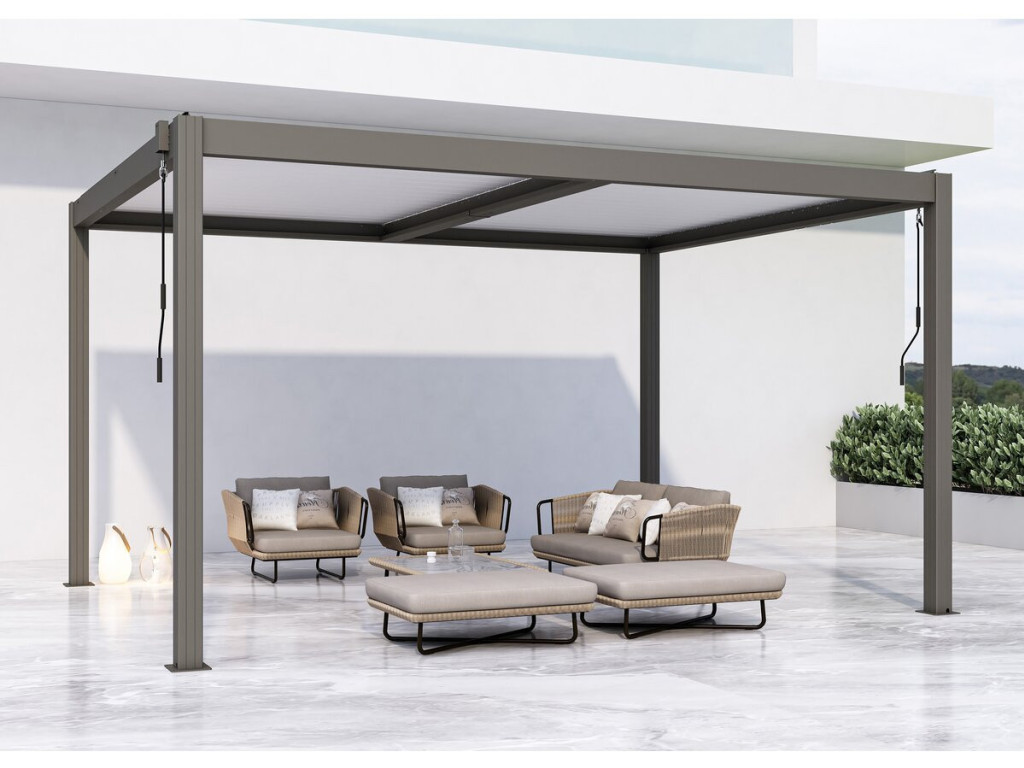
- A 4-seater garden lounge set (sofa + armchairs + coffee table)
- A barbecue or plancha to one side
- Lighting integrated into the posts or slats
An affordable price
The 4x3 size is the most affordable in the ‘large pergola’ range. It’s the ideal entry-level option if you’re looking for an affordable bioclimatic pergola without settling for a model that’s too small to be truly useful.
4x3 bioclimatic pergola: attached or freestanding? Which one should you choose?
This is the number one question buyers ask. The answer depends first and foremost on the layout of your outdoor space.
The 4x3 attached bioclimatic pergola
The 4x3 attached bioclimatic pergola is fixed directly to a wall of your house or your fence. It rests on two posts on the garden side and is supported on the house side by a ridge beam.
Its advantages:
- Blends in perfectly with the house (like a natural extension)
- Space-saving: no posts on the house side, more usable space
- Lower purchase price (2 posts instead of 4)
- Better protection against wind and rain thanks to the wall support
Its limitations:
- Requires a load-bearing wall or one that is sufficiently strong (check before drilling!)
- Fixing to the façade requires prior notification if the floor area exceeds 20 m² (see the ‘Planning Permission’ section)
- Slightly more technical installation (expansion anchors, weatherproofing)
The lean-to bioclimatic pergola is by far the most popular configuration in France, as the majority of patios are adjacent to a house wall.
The 4x3 freestanding bioclimatic pergola
It rests on four posts and can be installed anywhere in the garden, independently of any wall.
Its advantages:
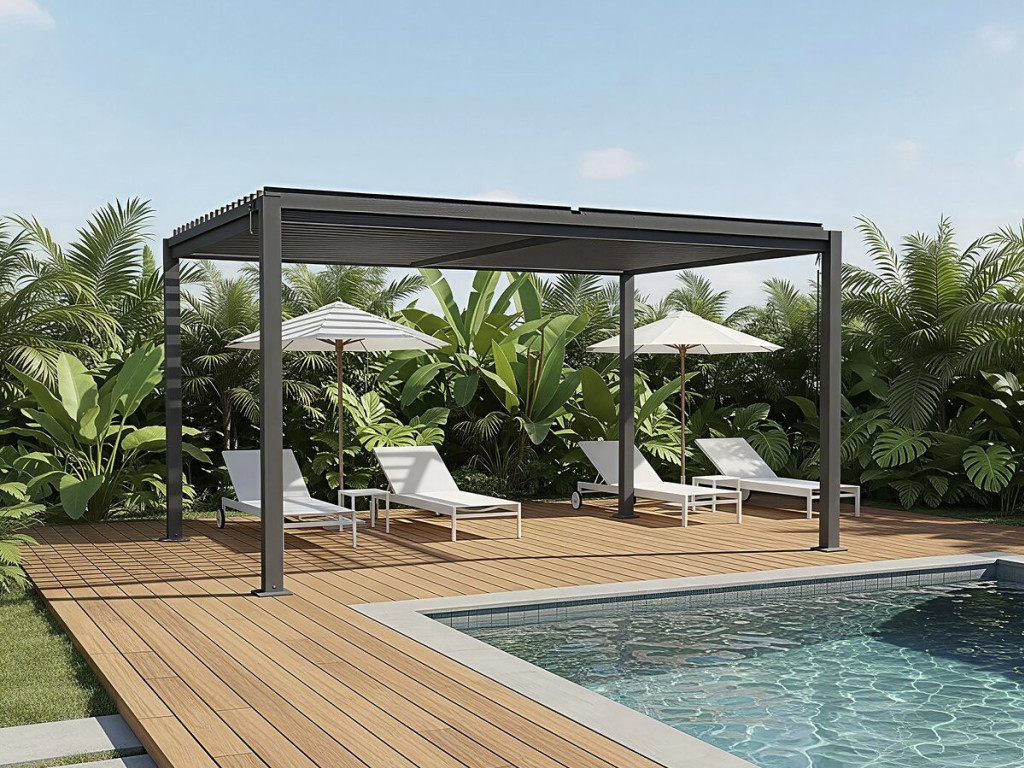
- Can be placed in the centre of the garden, near a swimming pool, or at the far end of the plot
- No restrictions relating to the façade
- Easier to dismantle and move
Its drawbacks:
- Slightly more expensive (4 posts)
- More exposed to the wind on the open sides
Aluminium bioclimatic pergola: why has aluminium become the standard?
Almost without exception, the bioclimatic pergolas on the market are made from aluminium. And for good reason.
The advantages of aluminium
- Durability: aluminium does not rust, rot or warp under the effects of heat or humidity. A high-quality aluminium pergola will easily last 20 to 30 years without requiring major maintenance.
- Lightweight: aluminium is three times lighter than steel, which makes installation easier and reduces the load on load-bearing walls for lean-to models.
- Aesthetics: aluminium profiles allow for sleek, elegant lines that are impossible to achieve with timber. The finish is achieved through a powder-coated or anodised treatment, available in a wide range of colours (RAL 9016 white, RAL 7016 anthracite grey, sand grey, champagne, matt black, etc.).
- Zero maintenance: a simple rinse with clean water is all it takes to maintain an aluminium pergola. No repainting, no wood stain, no fungicide treatment.
How do wood or wrought iron compare?
- Wood: attractive but susceptible to the elements, requires annual maintenance, and is incompatible with precision motorised louvre mechanisms.
- Wrought iron/steel: heavy and prone to rust if the anti-corrosion treatment fails.
When it comes to bioclimatic pergolas, aluminium has no real serious competitor.
How can you recognise a high-quality bioclimatic pergola?
Not all models are created equal. Here are the technical criteria to check before buying.
The thickness and quality of the profiles
A high-quality aluminium profile is at least 2 to 3 mm thick. Be wary of entry-level models with 1.2 mm-thick walls: they will sag under the weight of snow or in windy areas.
Wind and snow resistance
Reputable manufacturers provide the following specifications:
- Wind resistance: look for a minimum of 120 km/h (class 3 according to standard NF EN 1991)
- Snow load: minimum 50 kg/m² (class 2), ideally 80 kg/m² if you live in the mountains or in north-eastern France
The water drainage system
The slats must be profiled with an integrated drainage groove that directs water towards the hollow uprights, which act as gutters. A poorly designed system allows water to overflow or stagnate.
The motor
A good motor should be:
- Quiet (less than 45 dB)
- Home automation-compatible (Somfy, io-homecontrol, Zigbee depending on the model)
- Protected to at least IP44 against rain
The warranty
Opt for manufacturers offering at least a 5-year warranty on the structure and a 2-year warranty on motorised parts. This is a good indicator of the confidence they have in their products.
Affordable bioclimatic pergola: how to save money without making a mistake?
Are you looking for an affordable bioclimatic pergola? It’s certainly possible, provided you can tell the difference between genuine savings and false bargains.
The real ways to save money
- Choose a reliable entry-level model: prices for a 4x3 bioclimatic pergola range from €1,500 to over €8,000. Between these two extremes, there are models priced at €2,500–€3,500 that offer excellent value for money: a sturdy aluminium frame, motorised slats and built-in drainage.
- Opt for the lean-to version: as mentioned above, a lean-to bioclimatic pergola is cheaper to buy (2 posts instead of 4) and often easier to install.
- Order a flat-pack kit and fit it yourself: most manufacturers offer their pergolas as flat-pack kits delivered to your door with detailed assembly instructions. For a 4x3 model, two DIY enthusiasts can get it done in a day. This saves you the cost of installation (expect to pay between €800 and €1,500 for a professional fitter).
- Take advantage of sales periods: end-of-season sales (autumn/winter) are the best times to buy a pergola at a reduced price. Stock from the previous season is cleared at sometimes significant discounts.
- Compare delivery charges: for a 4x3 pergola, delivery often costs between €100 and €300, depending on the carrier. Some websites offer free delivery on orders over a certain amount.
What you shouldn’t compromise on for the sake of price
- The thickness of the profiles: a structure that is too thin may warp or break at the first sign of a storm.
- The slat sealing system: leaking slats render the pergola unusable in rainy weather.
- The motorisation: a poor-quality motor will break down quickly, and spare parts are hard to come by for low-cost brands.
Do you need planning permission for a 4x3 bioclimatic pergola?
This is a question many buyers ask themselves. The answer depends on the area and your specific circumstances.
General rules (as at 1 January 2024)
| Situation | Required procedure |
|---|---|
| Footprint ≤ 5 m² | None (complete freedom) |
| Footprint between 5 and 20 m² | Prior notification of works |
| Footprint > 20 m² | Planning permission |
A 4x3 bioclimatic pergola covers 12 m², so in principle you are required to submit a prior declaration of works (Cerfa form no. 13703).
Special cases to check
- If your house is in a protected area (ABF, conservation area, Natura 2000 site), stricter rules may apply.
- Check your local authority’s Local Urban Development Plan (PLU): some local councils impose additional rules on colours, materials or distances from property boundaries.
- In a block of flats, the consent of the property manager and the general meeting is usually required.
Good to know: a pergola without a fixed roof (with slats that open 100 per cent) may sometimes be considered an ‘open pergola’ not subject to planning permission, depending on local interpretation. Check with your local council.
Installation: is it really feasible to do it yourself?
For a 4x3 aluminium lean-to bioclimatic pergola kit, the answer is yes for a keen DIY enthusiast.
What you’ll need
Tools:
- Drill/screwdriver with concrete/metal drill bits
- Spirit level or laser level
- Allen keys and flat-head spanners in various sizes
- Step ladder or lightweight scaffolding
Prerequisites:
- A solid load-bearing wall (for the wall-mounted model)
- A flat, stable floor surface (concrete slab, tiled terrace, paving)
- At least two people (some parts are heavy to hold with both hands)
Key assembly steps
- Preparing the ground: check the surface is level and mark out the positions for the posts (set in concrete or using base plates)
- Fitting the ridge beam to the wall (for lean-to models): this is the trickiest step, requiring precision and a spirit level
- Install the posts and check they are plumb
- Installing the roof frame and assembling the slats
- Connecting the motor to the mains supply (ensure there is a nearby power point or call in an electrician)
- Fitting the accessories: guttering, integrated LED lighting, side awnings if ordered
Estimated time: 1 day for 2 experienced people, 2 days if you take your time.
Options and accessories to customise your 4x3 pergola
A 4x3 bioclimatic pergola can become a proper outdoor living room with the right accessories.
Awnings and side screens:
- Zip-up side awning: protection from the sun from the side and visual privacy
- Screen awning: filters the light without obstructing the view
- Sliding glazing: transforms the pergola into a light-filled conservatory for winter
Lighting:
- LED spotlights integrated into the slats: creates a soft, subdued atmosphere in the evening
- Adjustable spotlights in the uprights: functional lighting for the table
Heating:
- Infrared radiant heaters mounted on the roof: to extend use during the colder months
Mist system:
- Mist system integrated into the slats to cool the air in hot weather
Home automation:
- Internet connection to control the opening of the slats, awnings and lighting from your smartphone
Our selection of 4x3 bioclimatic pergolas at habitatetjardin.com
At habitatetjardin.com, we have selected models offering the best balance between build quality and affordability.
Our selection criteria:
- Aluminium profiles ≥ 2 mm thick
- Wind resistance ≥ 120 km/h
- Guaranteed watertightness when slats are closed
- Quiet motorisation with remote control included
- Powder-coated finishes available in a range of colours
- Minimum 5-year structural warranty
Whether you’re looking for a 4x3 attached bioclimatic pergola for your patio or a freestanding version for your garden, you’ll find models to suit every budget in our catalogue.
View all our 4x3 bioclimatic pergolas | Attached pergolas | Freestanding pergolas
Conclusion: the 4x3 bioclimatic pergola – a worthwhile investment
A 4x3 bioclimatic pergola represents an investment of between €1,500 and €4,500 depending on the options chosen, but it is a feature that will bring lasting improvements to your quality of life. No more eating indoors the moment a cloud appears, no more abandoning your patio at the first heatwave in July.
In short, the 4x3 aluminium lean-to bioclimatic pergola is perfect for you if:
- Your terrace measures between 10 and 15 m²
- You want to enjoy the outdoors from March to November
- You want a maintenance-free and durable solution
- You’re looking to add value to your property
Browse our online catalogue to find the affordable bioclimatic pergola that suits your project and contact our team for personalised advice.
Do you have any other questions? Check out our FAQs or contact our team at habitatetjardin.com