Your cart
There are no more items in your cart
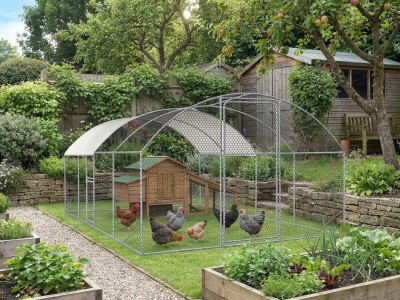
Chicken coops – How to choose the right one
Categories :
Garden furniture
, Practical Guides
Keeping hens in your garden is now a major trend, driven by a desire to eat fresh eggs, reduce food waste and reconnect with a more natural way of life. But before you set up your hens, one thing is essential: the run. Much more than just a simple wire fence, a chicken run ensures their safety, their wellbeing and your peace of mind.
In this guide, we explain everything you need to know to choose the right coop, suited to your garden, the number of hens you have and your budget.
Why set up a chicken run?
Chickens are relatively independent animals, but they remain vulnerable to predators (foxes, martens, birds of prey, stray dogs) and can quickly damage a vegetable patch if they are not confined to a designated area. A well-designed run allows you to:
- Protect your hens from predator attacks, both day and night
- Protect your garden and plants by creating a designated foraging area
- Organise the space between the living area, the henhouse and the outdoor run
- Make daily maintenance easier (cleaning, feeding, collecting eggs)
- Comply with local regulations, as some local authorities require a minimum distance between the enclosure and neighbouring properties
What size chicken run should you choose?
The size of the run depends directly on the number of hens you wish to keep. A hen needs a minimum amount of space to feel comfortable and avoid stress, which can lead to aggressive behaviour or a drop in egg production.
As a general rule, the following is recommended:
- 2 to 3 m² per hen in an enclosure with free access to the henhouse
- A minimum of 10 m² for a small group of 3 to 4 hens
- 20 m² or more for a group of 6 hens or more
The more space you provide, the more the hens will be able to express their natural behaviour (scratching, dust bathing, exploring), which reduces the risk of them pecking one another.
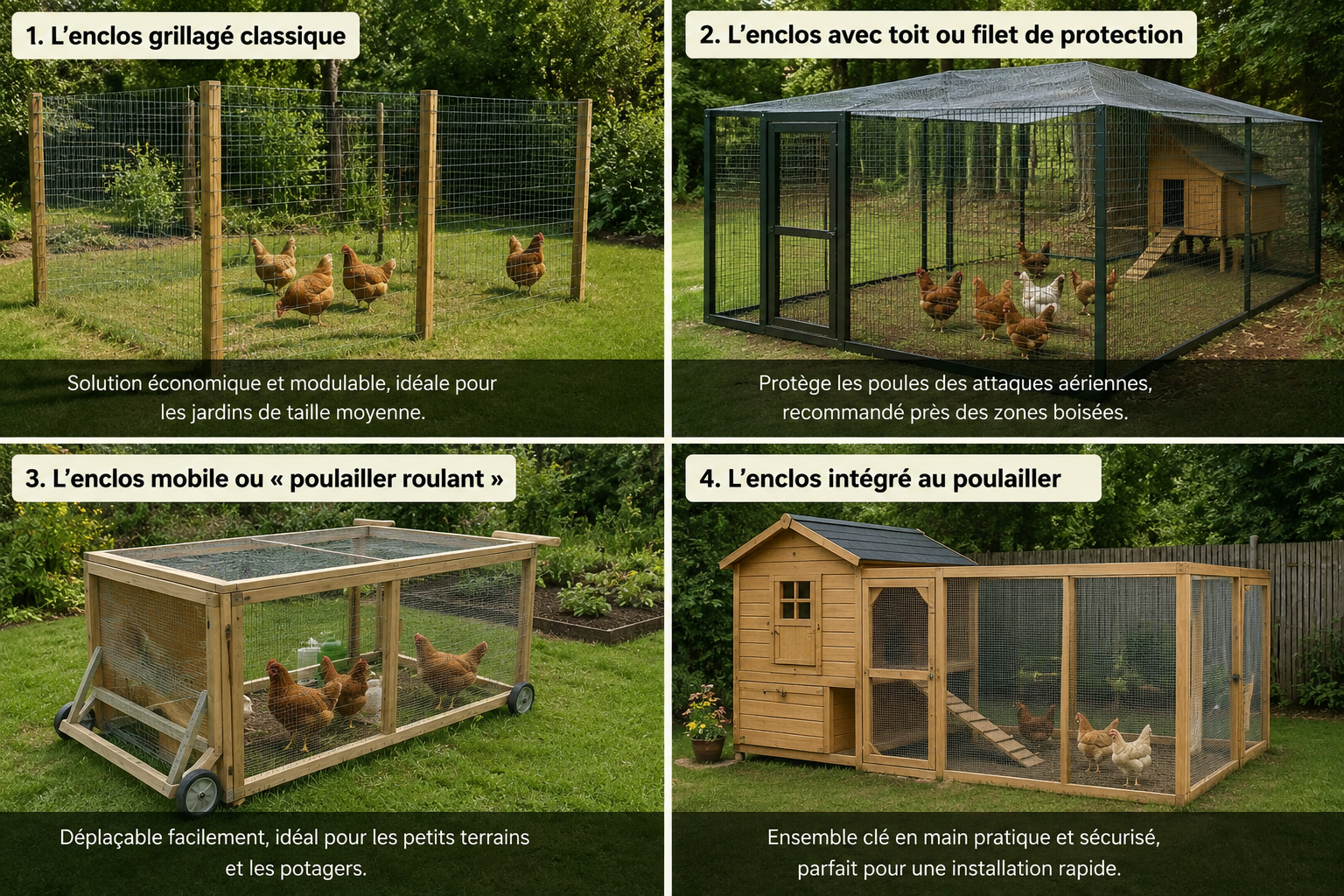
Different types of chicken runs
The classic wire mesh run
Made up of wire mesh panels fixed to posts, this is the most economical and versatile solution. It is ideal for medium-sized gardens and can be easily extended over time.
The enclosure with a roof or protective netting
To protect against attacks from above (notably from birds of prey), some runs feature a net or mesh roof over the living area. This is a recommended option if your garden is close to a wooded area.
The mobile pen or ‘mobile chicken coop’
Ideal for small plots or vegetable gardens, this type of run can be moved regularly to allow the grass to regrow and provide the hens with a varied environment.
The run integrated into the henhouse
Many chicken coops are sold with an adjoining run, forming a ready-to-use set. This is a practical solution for beginners who want a quick and secure setup.
What materials should you choose for a durable run?
The choice of materials is crucial for the durability and safety of the run:
- Galvanised wire mesh: corrosion-resistant, it offers excellent longevity even when exposed to the elements
- Steel or treated timber posts: choose according to your preferred look and the level of strength required
- Fine mesh: essential for preventing predators from slipping a paw through or digging under the fence
- Burying the wire mesh: burying the bottom of the fence to a depth of 20 to 30 cm limits intrusions from the ground, particularly by foxes
How can you effectively secure the enclosure?
Safety is the number one criterion when choosing an enclosure. Here are some practical tips:
- Check the height: at least 1.80 m to deter predators from jumping or climbing over
- Bury the wire mesh or add a ground-level border to prevent digging
- Opt for double security on the gates (latches, bolts)
- Add a protective net if birds of prey are present in your area
- Inspect the run regularly for any signs of wear and tear or breaches
Chicken run: what daily maintenance is required?
A well-maintained run directly contributes to your hens’ health:
- Clean the foraging areas regularly to minimise parasites
- Replace the litter if the run includes a covered area
- Check the condition of the wire mesh after strong winds or frost
- Provide shaded areas and a clean water source in summer
How do you choose a run to suit your budget and space?
Before buying, ask yourself the right questions:
- How many hens do you want to keep now, and in the long term?
- How much of your garden can you set aside for the run?
- Is your land exposed to predators (near a woodland, in a rural area)?
- Do you want a fixed or mobile run?
- Your budget: modular flat-pack runs remain the most affordable option for beginners
Discover our selection of chicken runs
Habitat et Jardin offers a wide range of chicken coops to suit all needs: wire mesh coops, modular kits, coops with or without a roof, in various sizes. You’re bound to find the right solution for your garden and the number of chickens you wish to keep.
Discover all our chicken coops at Habitat et Jardin
FAQ: frequently asked questions about chicken coops
What is the minimum area required for a run for 4 hens?
Allow around 10 to 12 m² to ensure that 4 hens have plenty of space and can express their natural behaviours without stress.
Do you need permission to set up a chicken run?
In most cases, no permission is required for domestic use, but it is advisable to check your local council’s regulations, particularly regarding the distance from neighbouring properties.
How can you protect your hens from foxes?
A wire mesh buried 20 to 30 cm deep, a fence of sufficient height and a securely locked henhouse at night are the best defences against foxes.
Can you set up a chicken run in a small space?
Yes, mobile enclosures or compact kits are perfectly suited to small gardens, provided you take care not to exceed the recommended density of hens per square metre.