Your cart
There are no more items in your cart
Tilting parasol: The complete guide
Categories :
Garden
, Garden furniture
, Practical Guides
Summer is finally here, with its long, sunny days, leisurely family lunches that seem to go on forever, and moments of complete relaxation in the open air. However, whilst the sun is our best ally for topping up our vitamin D levels, it can quickly turn a pleasant moment into an ordeal of stifling heat. This is where the essential piece of summer equipment comes in: the tilting parasol.
More than just a decorative accessory, this type of equipment has established itself as the ultimate solution for effortlessly adjusting the shade throughout the day. Gone are the days when you had to move a heavy base weighing several dozen kilos every hour to escape the scorching rays of the late afternoon.
In this comprehensive article, we’ll explore in detail why this investment will revolutionise your summers, and how to choose the perfect model to enhance your outdoor space.
Why the tilt makes all the difference: the secret to continuous comfort
The sun isn’t stationary. From sunrise to sunset, its path constantly changes the angle of its rays. A classic upright model, whilst very elegant, only provides effective protection when the sun is at its zenith. As soon as it begins to set, the low-angled rays will dazzle you from beneath the awning.
The great advantage of the tilting system is that it offers you adjustable patio shade on demand. With a simple movement, you can tilt the canopy to block out the setting sun. Combined with a swivelling base, some top-of-the-range models offer 360-degree rotation for optimal shade, allowing you to follow the sun’s path millimetre by millimetre whilst remaining comfortably seated in your sun lounger.
This exceptional ergonomics radically transforms how you use your outdoor space. You can create a true haven of coolness, infinitely adaptable, that’s just as suited to a morning read as it is to a leisurely evening drink.
Which style should you choose for your outdoor space?
The outdoor furniture market is brimming with a wide variety of models. Making the right choice requires a clear understanding of the layout of your space.
The classic dilemma: centre-post vs. offset parasols
The choice between these two main types depends above all on how you intend to use it. In the straight vs. offset parasol showdown, each has its merits. The straight model fits perfectly in the centre of a table with a hole in the top or between two sun loungers. It is often lighter and easier to handle.
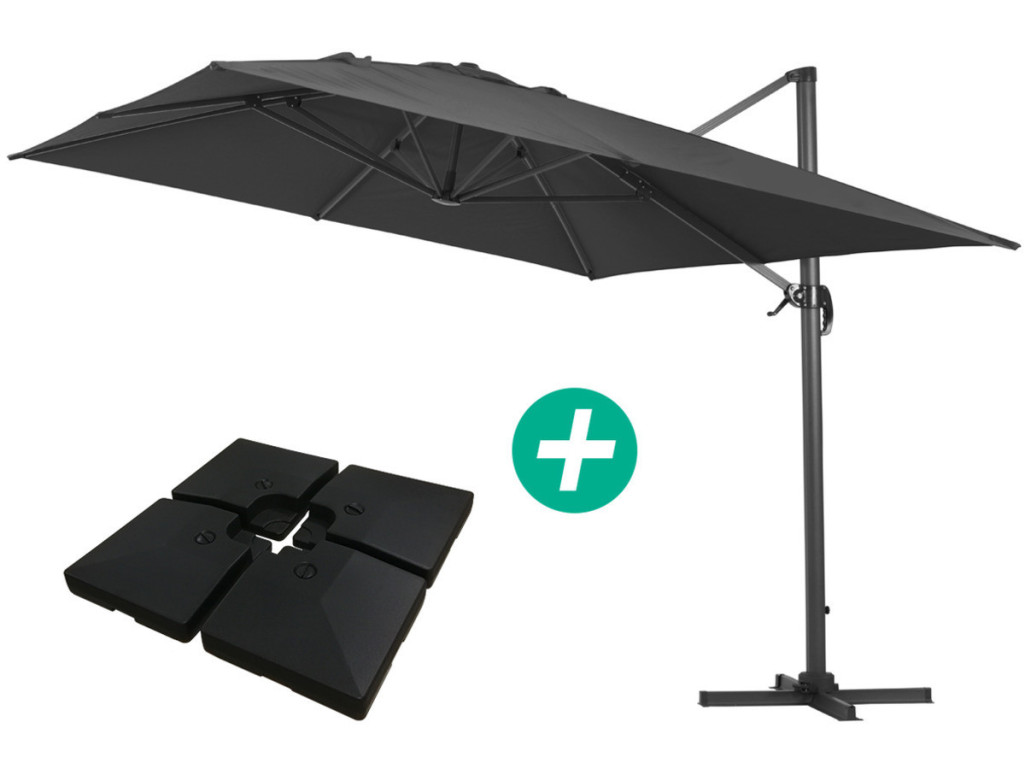
Conversely, the offset parasol has a pole positioned to one side. It is the quintessential grand solution. It leaves the floor space completely unobstructed, which is ideal for shading a large garden seating area, a children’s play area or even an inflatable spa. A tilting offset parasol combines absolutely all the advantages: not only does the pole not get in your way, but the canopy tilts to block the sun’s slanting rays.
Shapes and sizes: adapting to your surroundings
Every space has its own constraints. Whether you have a large garden or a small loggia, the shape of your garden parasol will be a key factor.
- Large spaces: for a long dining table seating eight to twelve guests, the tilting rectangular parasol is a strategic choice. Its shape follows that of your table, ensuring that no one ends their meal in direct sunlight.
- Versatile spaces: the square-shaped, tiltable offset parasol (often 3x3 m or 4x4 m) offers a massive, very modern span, perfect for a large woven rattan lounge set. It is the undisputed king of all large patio parasols.
- Small spaces: if you live ina flat, you’re probably wondering: what diameter should you choose for your balcony? Opt for a round or half-moon model with a maximum diameter of 2 metres, or a small rectangular size (e.g. 2x1.5 m) that will fit perfectly against a railing without encroaching on the walkway.
Technical buying guide: the criteria that make the difference
.jpg)
Buying good-quality equipment isn’t just about choosing a nice colour for the canopy. It’s an investment that needs to stand the test of time. So how do you choose the right angle for your parasol and ensure it’s sturdy? Here are the technical criteria to consider carefully.
1. The canopy: your shield for the summer
The canopy is the most important element. It’s what protects you from the heat and the dangers of UV rays. During your research, you’ll often come across comparisons between acrylic and polyester fabrics.
- Polyester: more affordable, it’s used in the majority of consumer models. The UV protection offered by polyester canopies has improved significantly in recent years. It’s often coated to withstand light showers.
- Acrylic: this is the absolute top of the range. Dye-through, this fabric hardly fades in the sun at all, offers superior thermal insulation and is more tear-resistant.
Whatever the fabric, UV protection is non-negotiable. Always insist on a fabric with a UPF 50 (or UPF 50+) sun protection factor. This rating guarantees that the fabric blocks around 98 per cent of harmful UV rays, thereby protecting you from sunburn and preserving the health of your skin.
2. Structure and mechanics: ease of use and durability
The frame must combine lightness (for ease of handling) with rigidity. Ideally, opt for a rust-proof aluminium pole. Aluminium has the advantage of not rusting, which is crucial if you live by the sea or if your equipment is left outdoors for much of the year.
The opening and tilting mechanism must operate smoothly. Opt for a one-way crank opening system. This mechanism amplifies the force: even a 12-square-metre canopy can be opened with one hand, smoothly, without the risk of the crank snapping back violently if you let go. As for the tilting mechanism (often a trigger on the handle), check that it locks into place with a clear, reassuring ‘click’.
Safety and installation: coping with the vagaries of the weather
A large, taut canopy acts just like a boat’s sail. Safety is therefore paramount, especially with large-span models.
The wind resistance of offset parasols is the number one priority for manufacturers. Due to its off-centre pole, the structure is subjected to significant leverage forces during gusts. To counteract this, the canopies are often fitted with a vent at the top, allowing the wind to escape and thus reducing the windage.
However, even the best vent will not be enough if the base is not securely anchored. It is essential to invest in a suitable weighted base. Forget about small plastic bases filled with water for offset models. Fitting a parasol base with slabs (usually cross-shaped) is the safest method. You’ll need to stack four slabs (made of concrete, granite or filled with sand/water), each weighing between 15 and 25 kilos, to achieve a total weight of at least 80 to 100 kg.
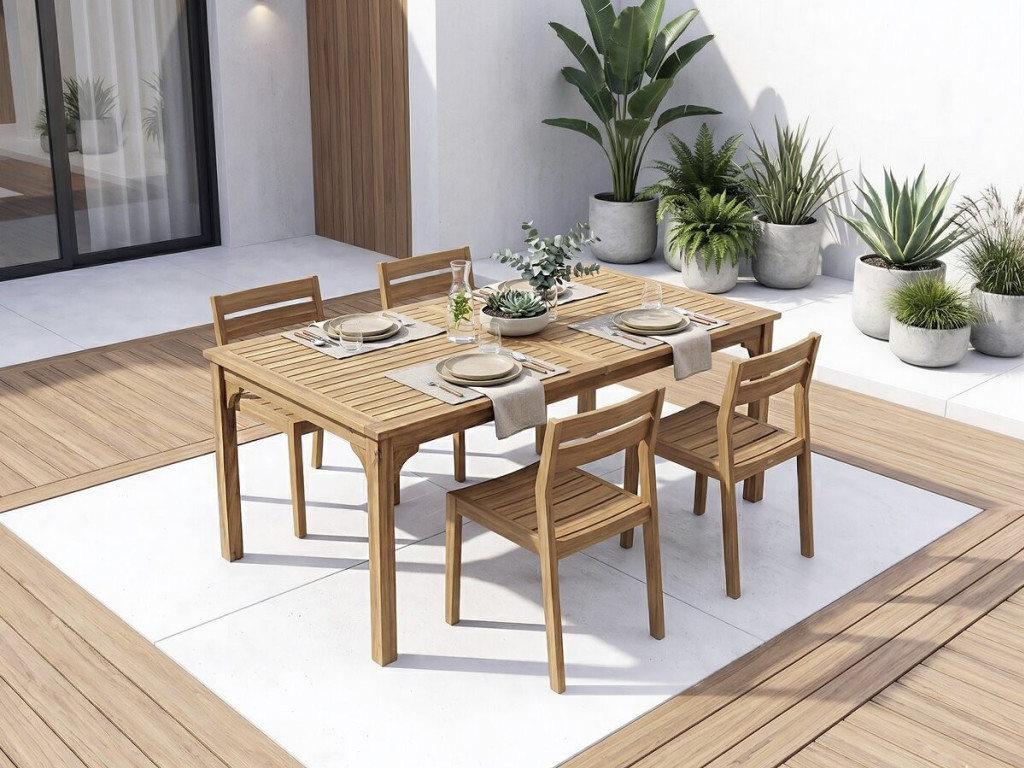
Finally, ensure your overall setup is harmonious. A lovely shaded area really comes into its own when it features weather-resistant outdoor furniture (aluminium, woven resin, teak). Together, they’ll form a durable summer lounge, capable of weathering the seasons with ease.
Tips for looking after your parasol
High-quality equipment requires minimal maintenance to ensure its longevity.
Mechanical maintenance: once or twice a year (at the start and end of the season), remember to service the parasol’s rotating mechanism. A simple spray of lubricant (such as silicone-based) onto the bearings of the rotation pedal, inside the handle’s slide rail and onto the crank cable will prevent squeaking and premature wear.
Cleaning the canopy: brush the canopy regularly whilst dry to remove dust and pollen. If there are any stains, use lukewarm water with a mild soap (such as Marseille soap). Rinse thoroughly with a water jet and, above all, leave the canvas to dry fully unfolded before folding it away, to prevent the growth of mould.
Storing for the winter: as soon as the fine weather comes to an end, cover your equipment with a waterproof and breathable protective cover. If possible, store it in a garage or garden shed to protect it from frost.
In summary: the charm and comfort of your summers
Investing in a reclining model means choosing not to simply endure the sun on your terrace, but to control it. Whether you opt for the practicality of a fixed-angle model for your balcony, or the luxury of a large, adjustable cantilever model for your garden, you’ll save precious time and enjoy unrivalled comfort.
By bearing in mind the essential criteria – from the need for effective UV protection with a UPF 50 rating, to the necessity of sturdy ballast in the form of paving slabs, not to mention the reliability of an aluminium frame with a secure crank handle – you now have everything you need. Get your sunglasses, chilled drinks and favourite books ready: this summer, you’re the one who decides where the shade falls on your patio!