Your cart
There are no more items in your cart
Stylish designer coffee table
Categories :
News & Updates
Designer coffee tables for an elegant living room
The coffee table visually frames the living room and its furnishings: it should complement the sofa, armchairs and the overall décor.
A black or white graphic coffee table
A modern, white coffee table makes a statement in a dark or colourful living room, playing on contrast without overwhelming the space. Conversely, a black coffee table creates a strong graphic statement in a light-coloured interior and immediately defines the living area.
| — | Graphic contrast: the combination of black and white suits a wide range of decorative styles, from Scandinavian to the most minimalist contemporary designs. |
| — | Decorative versatility: on a simple black or white base, the decorative items placed on the tabletops – such as a plant, a candle or a brass tray – make all the difference aesthetically. |
| — | Visual longevity: neutral colours never go out of fashion; they adapt to changes in décor without requiring the central piece of furniture to be replaced. |
The Scandinavian style extends this two-tone approach with lightweight, white-lacquered wooden frames that are understated yet functional. A Scandinavian coffee table in a matt lacquer finish blends naturally into a minimalist living room, provided the space allows for it without obstructing movement.
Marble, glass and metal coffee table
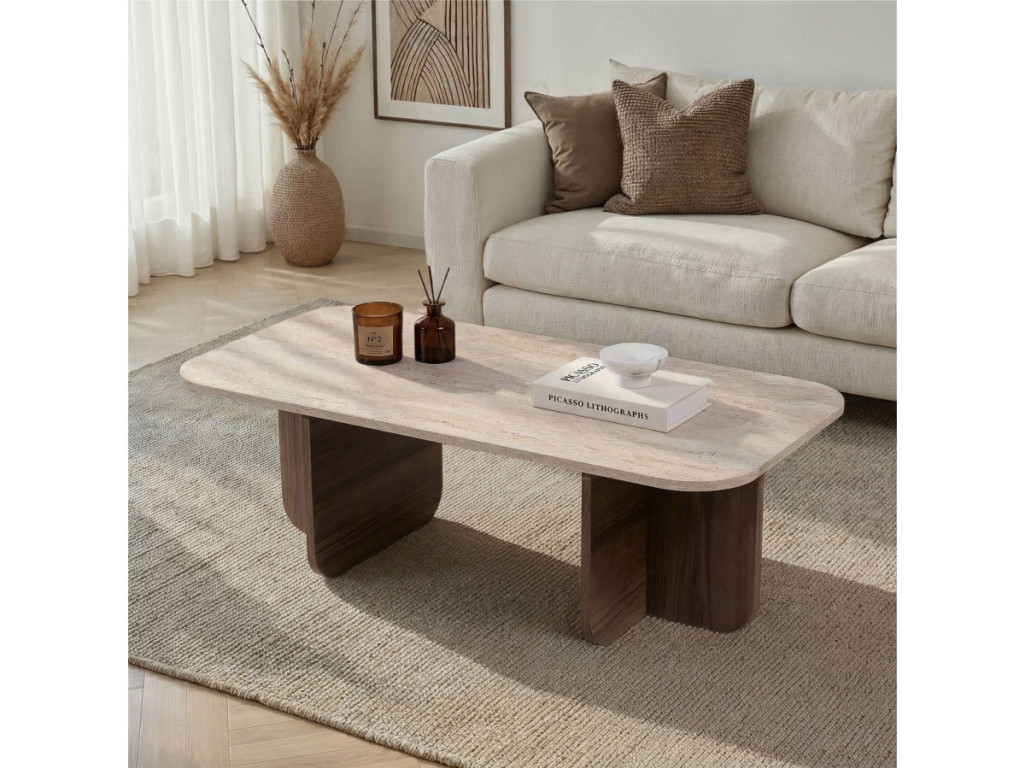
A white or black marble coffee table provides a striking visual contrast; its natural veining and mineral-like appearance make it a statement piece that stands on its own next to a simple sofa. When choosing a contemporary coffee table, the focus is often on combining lacquered metal with natural stone or toughened glass.
Which design style for your living room?
The industrial style combines black metal, exposed steel and solid wood with structures that are deliberately showcased rather than concealed. The chic and glamorous style relies on marble, mirrors, gilded coffee tables and polished brass to create a luxurious atmosphere, whilst the retro style draws on the rounded shapes and tapered legs of the 1950s to 1970s, combined with smoked glass and brass for timeless elegance.
Choosing the perfect coffee table for your living room
The shape and dimensions of a coffee table determine both its practicality and the visual harmony of the living room.
Round, square or rectangular tables
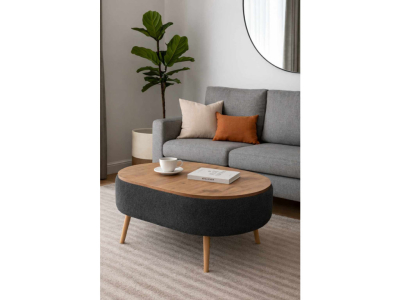
A round coffee table is particularly well-suited to small living rooms and corner sofas: it allows for easier movement, eliminates sharp corners and makes the space feel safer. A modern coffee table with a round or oval top facilitates movement; the oval coffee table is also suitable for layouts with a two-seater sofa where space is limited.
The square coffee table is ideal for symmetrical living rooms with two sofas facing each other, provided you break up the symmetry with differently shaped pieces, such as round pouffes.
| Shape | Ideal layout | Main advantage |
|---|---|---|
| Round / oval | Small living room, corner sofa | Ease of movement |
| Square | Symmetrical living room, two sofas facing each other | Visual balance |
| Rectangular | Large corner sofa, generous space | Extensive seating area |
Dimensions and space around the table
For a well-proportioned, modern-style coffee table, the length should not exceed two-thirds of the sofa’s length: for a 240 cm sofa, a table measuring 120 to 140 cm. A comfortable height is between 35 and 45 cm, i.e. 2 to 5 cm below the sofa seat, so that you can pick up an object or set down a glass effortlessly.
It is recommended to leave 35 to 45 cm between the edge of the table and the edge of the seating to allow for easy movement and sitting; a space of around 1 m between the table and the TV unit.
Side tables and modular configurations
Nesting tables are a space-saving solution: they slide one under the other, allowing you to adjust the table surface as required, whether to entertain guests or free up space for everyday use. A set of two such tables offers greater flexibility than a single fixed model.
A contemporary coffee table with a lift-up top is a useful option in small homes: the top raises to serve as a dining or work surface, then lowers back down to its original function. In addition, some models feature a sliding top or a storage compartment.
Stylish coffee tables with practical features
The difference often lies in the quality of the frame, the thickness of the tops and the built-in features – all factors that influence the budget you’ll need to set aside.
The black and white Zen coffee table
Choosing a well-designed coffee table also means opting for a structure that maximises surface area without making the space feel cluttered. The Zen coffee table, with its three stacked square tops in black and white, exemplifies this concept of distinct levels: the chic and modern Zen coffee table provides multiple surfaces without making the space feel cluttered.
Product details
Zen coffee table — black & white
| — | Three-tiered structure: each square shelf measures 75 × 75 cm, providing a generous surface area for displaying decorative items, books or everyday essentials at three different heights. |
| — | Overall dimensions: 141.5 cm long, 75 cm deep and 30 cm high – a low-profile design well-suited to placement in front of a standard sofa. |
| — | Material and finish: MDF structure, 4 cm thick per shelf, lightweight yet stable construction, available in black and white to complement a wide range of living room styles. |
Current price: €279.00 €319.00 — the lowest price listed on the website over the last 30 days.
Delivered in a single parcel measuring 0.82 × 0.82 × 0.185 m and weighing 34 kg. Can be assembled without the need for complex tools.
Storage compartments and lift-up top
The storage features transform a luxury designer coffee table into a truly multifunctional piece of furniture, thanks to the everyday use they facilitate. Drawers, compartments, storage compartments and double tops are found in both the more affordable ranges and the high-end models crafted from genuine marble or selected solid wood.
| — | Built-in drawers: these conceal remote controls, chargers and small items, keeping the main tabletop clear for decorations or drinks. |
| — | Double shelf or recess: the lower level accommodates books or baskets, whilst the upper surface remains free for immediate use. |
| — | Lift-up top: it raises to create a dining area or work surface, then tucks away discreetly when lowered. |
| — | Sliding top: it extends sideways to increase the surface area for serving guests, without having to move the table or obstruct the passageway. |
A marble coffee table with a built-in compartment or lift-up top combines the elegance of a fine material with the practicality of a versatile piece of furniture.
Budget for a designer coffee table
The price difference between models rarely stems from the shape, but rather from the material and finish: genuine marble, hand-applied gilding or solid oak, walnut or acacia wood justify a higher price tag than a veneered MDF frame. Tempered glass combined with a lacquered steel base offers a good balance between contemporary aesthetics and an affordable price, as does MDF with a matt or gloss lacquered finish for interiors that favour geometric lines.
Frequently Asked Questions
What shape of coffee table should you choose depending on the size of your living room?
The shape of the table should be chosen based on the available space and the arrangement of the seating. In a small space, a round or oval coffee table allows for easier movement and avoids sharp corners; a set of nesting tables offers greater flexibility as they can be stacked one inside the other. For a medium-sized living room with two sofas facing each other, a square coffee table provides the desired visual balance. As the living room gets larger and a large corner sofa dominates the room, a rectangular coffee table better complements the length of the sofa: for a 240 cm sofa, a model measuring 120 to 140 cm is a suitable choice.
Which materials should you choose for a stylish, modern coffee table?
The choice of material determines both the aesthetic and day-to-day maintenance. Tempered glass, whether clear or tinted, visually lightens the space by allowing the floor and rug to show through; it pairs well with a slender base in black or white lacquered metal. Solid wood – such as oak, walnut, acacia or beech – brings warmth and durability, with a grain pattern unique to each piece. Ceramic, available in marble, polished concrete or terracotta finishes, is scratch-resistant and withstands the heat from cups. Finally, lacquered MDF offers a clean finish and an affordable price, as seen on the Zen model available from Habitat et Jardin for €279.00.
What is the ideal height for a living room coffee table?
A comfortable height is between 35 and 45 cm, which is 2 to 5 cm below the seat height of the sofa, generally between 45 and 48 cm. This slight difference in height allows you to pick up a glass or place an object on the table without having to bend over excessively. If you regularly eat meals at the coffee table, a slightly taller model or one with a lift-up top will be more comfortable. It is also advisable to leave 35 to 45 cm between the edge of the table and the edge of the seating to allow for easy movement, and around 1 m between the table and the TV stand. A low, square coffee table can thus maintain visual harmony in a living room with low seating.