Your cart
There are no more items in your cart
Benefits of a bed-and-desk combination for small spaces
Categories :
News & Updates
Bed and desk combo: the space-saving solution for small spaces | Home and Garden
Furnishing small spaces is a daily challenge for many households. Whether you live in a cramped city flat, are getting your teenage child ready for university, or are simply looking to free up some floor space in your home, every square metre counts. Faced with this reality, smart furniture stands out as the ideal solution.
Among all the innovations in interior design, the bed-and-desk combo stands out as a true champion of functionality. By combining the sleeping area and the workspace within the same floor space, this clever design completely transforms the way a room is perceived and used.
Let’s explore together how this two-in-one (or even three-in-one) piece of furniture can revolutionise your home, what criteria to consider when choosing it, and how to optimise it for maximum comfort in everyday life.
Why is modular furniture essential today?
Living in a small space should never mean compromising on comfort or productivity. The key lies in making the most of the room’s vertical space.
The art of making the most of ceiling height
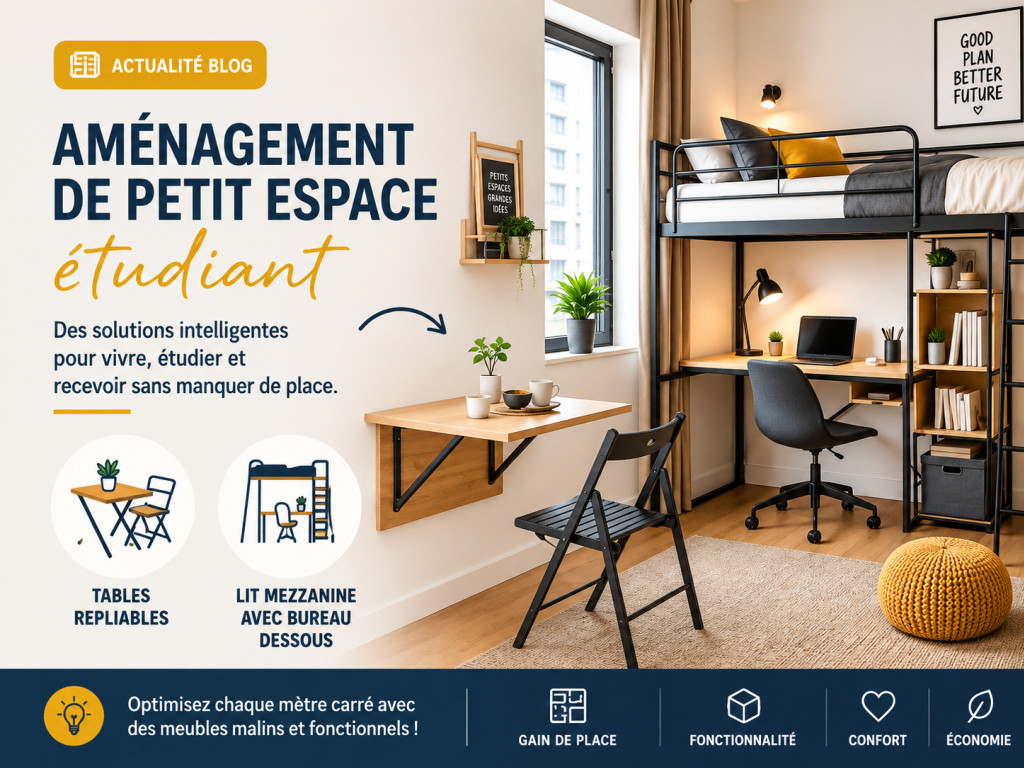
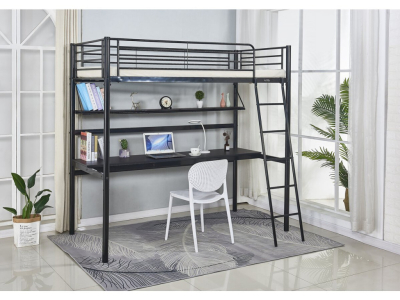
When floor space is limited, the only way to go is up. Space-saving modular furniture allows you to organise the room into distinct zones without the need for partitions. Raising the sleeping area frees up valuable space underneath, offering the possibility of creating a proper office area, a reading nook or a walk-in wardrobe.
A cost-effective and sustainable investment
Rather than buying a bed, a desk, a chest of drawers and a bookcase separately, opting for an all-in-one piece of furniture significantly reduces the overall cost. What’s more, modern designs are created to adapt to the needs of their users, making them a long-lasting choice for many years to come.
The ideal layout for every age and lifestyle
There are now models to suit every stage of life and every interior design style.
Children’s world: play, study and sleep
Furnishing a small child’s bedroom successfully requires creativity. The space must be conducive to rest, but also to homework and play. The children’s bed-and-desk combination perfectly meets this threefold requirement. Often featuring cheerful colours or specific themes, these pieces of furniture stimulate the imagination. Whether you’re looking for a neutral design in pastel shades or something more specific, such as a girl’s bed-desk with storage space for arts and crafts and decorations, manufacturers offer highly customisable models with interchangeable panels or built-in magnetic boards.

Teenagers and students: concentration and independence
In secondary school, needs change. Homework assignments get longer and a computer becomes essential. Particular attention must therefore be paid tothe ergonomics of a teenager’s desk: it must be deep enough to accommodate a monitor, a keyboard and exercise books, ideally with a minimum depth of 60 cm.
Later on, when it comes tomaking the most ofa student’s studio flat, this piece of furniture will become the centrepiece of the home. In a 15 or 20 square metre space, being able to conceal the sleeping area up high allows you to retain a proper ‘living’ area where you can study comfortably and entertain friends.

Adults: remote working and design
Contrary to popular belief, loft beds are not just for the young. The adult bed-and-desk combination is becoming increasingly popular as remote working becomes more widespread. For a couple living in a small flat, a double bed with a built-in desk is a real godsend. Made from sturdy materials (industrial steel, solid wood), a double bed with a desk offers a mature and elegant look. It allows you to transform a small guest bedroom into a functional office during the day, whilst still providing a proper double bed for the night.

Safety and standards: criteria that must never be overlooked
Sleeping at height requires strict safety precautions. Before falling for a piece of furniture’s design, safety must be your guiding principle when making a purchase.
The golden rules of safety at height
Parents often ask: at what age is a loft bed suitable? Paediatricians and furniture experts are unanimous: this type of bed is strictly not recommended for children under 6 years of age for obvious reasons relating to motor skills and the risk of falls.
When making your purchase, always check that the product complies with the NF EN 747 safety standards. This European standard guarantees the sturdiness of the structure, the correct height of the safety rails and the reliability of the ladder.
For those wondering how to make a loft bed safe, here are a few essential rules:
- Wall mounting: always secure the frame to the wall using wall plugs suitable for the type of wall (plasterboard, brick, concrete).
- Checking the fixings: retighten the screws one month after assembly, then once or twice a year.
- Continuous guardrails: ensure that the guardrails run all the way round the bed, except for the opening for the ladder.
Choice of materials and weight capacity
It is crucial to check the maximum weight capacity of a raised bed frame. A children’s model will generally support between 70 and 90 kg, whilst an adult model (especially if it is a double bed) must be able to support between 150 and 250 kg. Opt for thick tubular steel or solid wood (pine, beech, oak) for rock-solid stability.
Comfort and optimised storage space
A well-designed loft bed does more than just provide a mattress and a desk. It’s the details that make all the difference.
Clever storage solutions to keep everything tidy
To maximise space, a bed with storage and a desk is the ultimate solution. Built-in under-bed storage comes in the form of shelves, sliding drawers and even small wardrobes. It’s ideal for storing clothes, books or stationery without taking up space in the rest of the room.
One particularly popular innovation isthe ladder with storage steps. Instead of a simple rung ladder (which can sometimes be hard on the soles of your feet), this design features proper steps, with each one concealing a drawer or a storage compartment. It offers phenomenal space-saving benefits and is a major safety feature, making it easy to climb up and down.
Bedding and lighting: the keys to well-being
Don’t overlook the thickness of the mattress! You must choose the right mattress for a loft bed, taking into account the safety marking indicated on the bed posts (generally, the thickness must not exceed 15 cm for the safety rails to remain effective).
Furthermore, the sleeping platform often casts a shadow over the desk below. To prevent eye strain, install LED lighting beneath the loft structure. LED strips or recessed spotlights cast a soft, even light over the work surface without cluttering the desk.
Alternatives, choices and installation
If you’re still unsure about the perfect model, a few points of comparison may help you make up your mind.
Mezzanine or bunk beds?
This is a classic dilemma for shared bedrooms. When comparing a loft bed with a bunk bed, bear in mind their intended purpose. A bunk bed is perfect for accommodating two children in the same room. A loft bed, on the other hand, is designed to maximise the personal living space for a single person (or a couple in the double version) by incorporating a desk or a sofa.
Alternatives for those who don’t want to sleep up high
If the ceiling height in your room is less than 2.40 metres, or if you’re not comfortable with the idea of climbing, there is an alternative to the traditional loft bed. You could opt for a fold-away bed (wardrobe bed) with a desk that tilts under the bed when it’s lowered, or for a pull-out bed with spacious storage drawers.
Practical assembly tips
One final essential point: assembly. Even though there are tutorials online, it’s often unrealistic to try and assemble a multifunctional piece of furniture without help. These structures are heavy and bulky.
- Prepare the space: clear the room completely before you start.
- Make sure there are at least two of you: especially for lifting and securing the bed base to the posts.
- Sort out the fittings: before you make the first turn of the screwdriver, organise your screws by size into small bowls so you don’t get lost in the instructions.
In conclusion
Choosing a bed with a built-in desk is one of the smartest furnishing decisions you can make for a small space. Whether it’s to provide a study area for your child, furnish your eldest’s studio flat or create a clever home office for yourself, this piece of furniture literally reinvents your interior. By ensuring the quality of the materials, compliance with safety standards and overall ergonomics, you’ll transform any small space into a truly functional and stylish haven of peace.