Your cart
There are no more items in your cart
Choosing a dining table
Categories :
Interior Furniture
, News & Updates
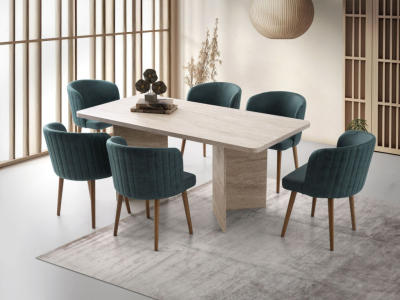
Choosing a dining table that suits your home involves balancing several factors: available space, lifestyle, number of seats, shape, material and style. To choose a dining table without disrupting the balance of the room, the key rule is simple: a dining table should comfortably seat your guests whilst allowing for free movement around the dining room.
How to determine the right size for your dining room
The size of the dining table depends primarily on three factors: your day-to-day needs, how often you have meals with others, and the actual dimensions of the room. Measure the length and width of the room before buying: the difference is often just a few centimetres, especially when chairs need to be pulled back without obstructing the passageway.
Spacing guidelines around the dining table
To choose a suitable table, you need to consider the layout around the tabletop as much as its dimensions. Three key measurements guide the sizing:
- Minimum clearance: 60 to 90 cm of free space around the table.
- Chair clearance: 70 to 90 cm between the tabletop and a wall.
- Frequent passage: 90 to 110 cm near an open-plan kitchen, a hallway or a corridor.
In practice, a floor test is very revealing: mark out the table’s dimensions with adhesive tape. You’ll immediately visualise the actual space it takes up, even with the chairs pulled out.
How to assess your needs before buying
Before deciding on a size, distinguish between everyday use and occasional meals. A household where four people have lunch together does not have the same needs as a family that often hosts guests; depending on the layout of your space, a large permanent table can quickly make the dining room feel cramped.
If you’re torn between two sizes, it’s best to opt for a model suited to everyday use. Large gatherings are easier to manage with an extendable table or extension leaves, without unnecessarily taking upavailable space.
Recommended dimensions based on the number of guests
The basic principle remains the same regardless of the shape: allow around 60 cm in width per person, with 40 to 45 cm in depth for plates and elbow room.

The table below sets out the most useful guidelines for comparing a rectangular table, an oval table, a round table or a square table.
| Number of guests | Rectangular/oval table | Round table | Square table |
| 2 people | 80 to 100 × 60 to 80 cm | Ø 70 to 90 cm | 70 to 80 cm |
| 4 people | 120 to 140 × 75 to 90 cm | Ø 100 to 120 cm | 90 to 110 cm |
| 6 people | 160 to 180 × 80 to 95 cm | Ø 120 to 130 cm | - |
| 8 people and over | 200 to 240 × 90 to 100 cm | Ø 140 to 160 cm | - |
A rectangular table makes good use of a room’s length. Conversely, a round table encourages conversation in a compact space, whilst an oval top makes movement around the table easier; a square table is best suited to small settings or meals for four.
The material is just as important: woods such as oak, mahogany, cherry, beech or wenge for a warm feel, or tempered or blown glass to make the whole piece appear lighter. Habitat et Jardin organises its range around these practical and decorative criteria: choosing a dining table.
Round, rectangular or oval table: which one to choose
The shape of the table affects the number of guests it can seat, how easily people can move around the table and the visual balance of the dining room. Making the right choice comes down to one simple factor: the space available, how you entertain and the space you need to leave around the dining table.
Rectangular and square tables for organising the room
The rectangular table remains the standard choice in many homes. It suits long, narrow rooms well, helps to structure the space and can seat up to twelve guests depending on its dimensions. With extension leaves, it remains unobtrusive for everyday use yet adapts easily to larger gatherings.
The square table is better suited to two to four people. Its more geometric style works well in compact spaces, provided there is plenty of room to move around the table. The choice often comes down to how it will be used: a compact dining nook, everyday meals or a dedicated dining room.
Round and oval tables for a more convivial atmosphere
When choosing between a round or rectangular table, the decision often comes down to how the meal is shared. A round table, with a diameter of between 110 and 140 cm, encourages conversation, eliminates sharp corners and is well suited to small spaces.
The oval table captures this same convivial spirit whilst offering more generous seating capacity: it allows for more flexible movement than a large, angular model, but requires more space around it.
Which table shape to choose depending on the floor space
In a compact room, a table with soft contours minimises the feeling of clutter. Conversely, in a large dining room, a more elongated tabletop makes the most of the available space.
- Small room: a round or oval table visually lightens the overall look and improves movement around the room.
- Long room: a rectangular table makes better use of the layout and increases the number of seats.
- Large room: an elongated table, whether oval or rectangular, defines the space more clearly.
Finally, the shape of the dining table should be consistent with the rest of the furniture. A table with soft lines softens a very angular interior, whilst an angular design reinforces a more minimalist scheme. In addition, central legs often make it easier to position chairs and make the table more comfortable to use once seated.
Which material to choose for your dining table
The choice of material directly affects the table’s lifespan, day-to-day maintenance and the visual balance of your room. To choose the right dining table, you need to weigh up the qualities of each material against your actual use and the existing décor style.

Wood: a classic and versatile material
This dining table material brings warmth and effortlessly transcends trends, whatever the desired atmosphere.
Different wood species offer distinct looks: oak and beech are well-suited to Scandinavian or country-style interiors thanks to their light tones and robustness, whilst mahogany and wenge make a bolder statement, suited to contemporary or modern-industrial décor. The 18 mm solid walnut adds a significant degree of stability, with a meticulous finish that retains its appearance over time.
All that’s needed afterwards is a simple protective finish: a suitable varnish or clear lacquer, as appropriate. To complement this, black metal legs beneath a wooden top create a striking contrast and reinforce the table’s structure.
Glass, ceramic and metal for a contemporary style
If your priority is a more contemporary look, the right choice comes down to three options: glass, ceramic or metal.
Tempered or blown glass is well suited to smaller spaces, as it allows light to pass through and brightens up the room. On the other hand, it requires greater care to avoid breakage. Ceramic stands out for its resistance to scratches, heat and stains, with highly sought-after marbled or concrete-effect finishes. Metal, for its part, blends easily into an industrial or contemporary interior and allows for understated or more striking designs depending on the chosen structure.
In a heavily used dining room, ceramic tiles really do make maintenance a breeze: a quick wipe-down after a meal is all it takes.
How to match materials with interior styles
To choose your table’s material coherently, a marbled grey ceramic top with black metal legs complements a sleek, contemporary décor; a walnut finish pairs more naturally with a warm, classic or minimalist atmosphere.
The difference often comes down to striking a balance between authenticity and ease of use. Laminate and melamine offer an affordable alternative: sturdy, waterproof and non-porous, they replicate the look of wood, concrete or metal at a lower cost. This type of material is ideal when ease of care takes precedence over the character of a natural material.
Height, depth and ergonomics of the dining table
Beyond the tabletop, the height, depth and width of a dining table really do make a difference to everyday comfort.

Standard height and its ‘snack’ or ‘bar’ variants
The standard dining table height is 75 cm. This pairs well with chairs whose seat height is between 45 and 48 cm – a reliable guide for maintaining a comfortable posture whilst eating, regardless of the height of the diners.
- Standard table (75 cm): the most common size, suitable for classic chairs and most uses.
- Snack table (90 cm): an intermediate option designed for open-plan kitchens or more informal dining areas, with suitable high-back chairs.
- Bar table (110 cm): a compact size, ideal for small spaces or as an additional dining area.
The right choice depends on the actual use and the size of the room. A high table may be suitable in a contemporary kitchen, whilst a standard table is more appropriate in a dedicated dining room, especially if prolonged comfort takes precedence over visual appeal.
Depth, width and length: the right proportions
The ergonomics of a dining table also depend on the depth of the tabletop. Allow 80 cm as a minimum: 90 to 100 cm allows for smoother use when placing dishes in the centre without getting in the way of each guest.
For a rectangular family table, the most comfortable width is often between 80 and 95 cm. Width and length together determine the ideal size depending on the expected number of seats.
In practice, you should allow 60 to 70 cm in width per person, as well as 40 to 45 cm of usable depth for plates and elbows. This guideline helps you estimate the right size for your dining table without making the space too large.
How to make the most of the space around the table
- Corner bench or bench seat: allows you to seat one or two more people along the same length as you would with separate chairs.
- Extendable table: adjusts the size for everyday use and increases the number of seats when you’re entertaining.
- Drawer under the tabletop: discreet storage for table linen or accessories, useful when storage space is limited.
- Pendant lighting: positioned 60 to 80 cm above the tabletop, it visually defines the dining area and enhances comfort.
In terms of proportions, a light fitting whose width is similar to that of the table creates a more balanced look, without overwhelming the room’s style.
Extendable tables and tips for a successful purchase
Once you’ve decided on the material, size and finishes, the right choice comes down to everyday use: a fixed-top table or an extendable one. Depending on the layout of your space, this flexibility meets very practical needs, especially when the room needs to remain comfortable for day-to-day use whilst still being able to accommodate more guests.
Why choose an extendable dining table
An extendable dining table offers immediate practicality. Whether in a dining room or an outdoor space, it allows you to keep the table compact during the week and then extend the top when you need to seat 6, 8 or 10 people. Some models extend from 132 to 170 cm in length, whilst others extend from 160 to 240 cm.
The difference often lies in the design of the extension leaves. When they are built-in or fold-away, there are no separate parts to store, which makes them much easier to use. The extendable dining table in marbled grey ceramic illustrates this point well: a scratch- and heat-resistant tabletop, extending from 160 to 240 cm, black metal legs for stability, and measuring 90 cm wide and 76 cm high.
- Integrated extension: quick to open, with no separate parts to store.
- Adjustable capacity: several configurations to adapt the table to the number of guests.
- Compact when not in use: the available space remains uncluttered for everyday use.
- Choice of materials: ceramic, wood or melamine, depending on the desired finish.
Another useful example when choosing a table: the extendable wooden table with a walnut finish. It extends from 132 to 170 cm in length, with a compact size of 78 x 80 cm in its standard position, and features built-in storage comprising a shelf and two doors.
Mistakes to avoid when choosing your table
Failing to plan the table’s size properly is enough to obstruct movement, block the chairs or throw the whole room out of balance. As soon as the measurements are approximate, the discomfort becomes apparent in use: restricted passage, seats that are difficult to pull out, or a layout that’s too cramped.
- Neglecting to take measurements: without checking the available space precisely, you’ll face immediate problems when positioning the table and chairs.
- Forgetting to allow for chair clearance: you need to factor in actual usage, not just the table top’s footprint.
- Underestimating future needs: children, regular guests or family meals may justify a solution with extension leaves.
- Ignoring proportions: a table that is too bulky or too narrow disrupts the visual balance of the dining room.
Consistent dimensions and sufficient space for movement remain the primary criteria; an extendable table can accommodate regular guests without making the everyday size too large. The same logic applies to the layout: a dining table chosen with care will remain suitable for longer.
Our tips for finding the table that suits you
Style matters just as much as the measurements. Unlike a purchase guided solely by aesthetics, a successful piece of furniture combines appearance, function and proportions: a walnut finish for a warm atmosphere, ceramic for a more streamlined look, and wooden or metal legs depending on the desired style.
To narrow down your selection, start by considering three criteria: table size, table type and material. Checking the length, width and height precisely allows you to confirm the table’s intended use, placement and the comfort of the chairs.
Once in place, this piece of furniture defines the entire room. A well-chosen dining table allows you to entertain with ease, adapts to changing needs and retains its appeal over time.
Frequently Asked Questions
What is the ideal size for a family dining table?
For four people, the ideal size for a dining table is generally between 120 and 140 cm in length, with a depth of 75 to 90 cm. This size is sufficient for everyday use and ensures there is plenty of space to move around in the dining room.
If you entertain frequently, the key is to choose a modular design: an extendable table allows you to seat more guests without cluttering the room the rest of the time. Some models can extend from 132 to 170 cm, or from 160 to 240 cm, with a capacity of up to ten guests.
Which table shape takes up the least space in a small room?
In a small room, the most space-efficient shape is often a round table. With no corners, it makes the space feel more open and makes it easier to move around it.
For a compact dining room, aim for a diameter of 100 to 120 cm for four people. A diameter of 120 to 130 cm generally allows for six seats.
An oval table is a good alternative if the room offers a little more space.
Which material should you choose for an easy-to-maintain dining table?
For everyday use, the difference often comes down to the material’s durability. Ceramic remains a very practical choice: it is resistant to scratches, heat and stains, and can be easily cleaned with a damp cloth.
Tempered glass is similarly easy to maintain, whilst offering a lighter visual presence depending on the layout of your space. Conversely, wood requires more care, with suitable protection such as varnish or oil, but it brings a natural warmth that is highly sought after in a dining room.