Your cart
There are no more items in your cart
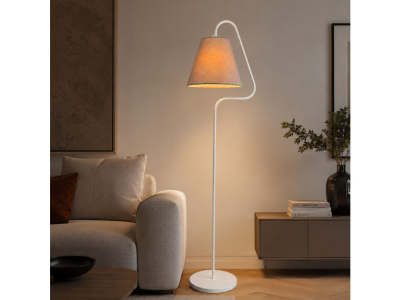
Living room lamp: the right style, the best spot
Categories :
Furniture trends
, Trends & Inspiration
Living room lamp: style, brightness and placement
The size, height, lumens, colour temperature and price will then help you decide which models are best suited to your living room.
What type of lamp should you choose for each location?
A living room lamp can fulfil three possible functions: lighting the whole room, creating a mood, or providing light for a specific activity such as reading. The right choice depends on this intended use, which in turn determines the suitable sizes and where they should be placed in the living room.
Table lamp, floor lamp, wall lamp or pendant light
Each type takes up a different area of the room. A table lamp or floor lamp complements the lighting without requiring anything to be fixed to the ceiling. Conversely, wall lights and pendant lights need to be mounted on the wall or suspended from the ceiling:
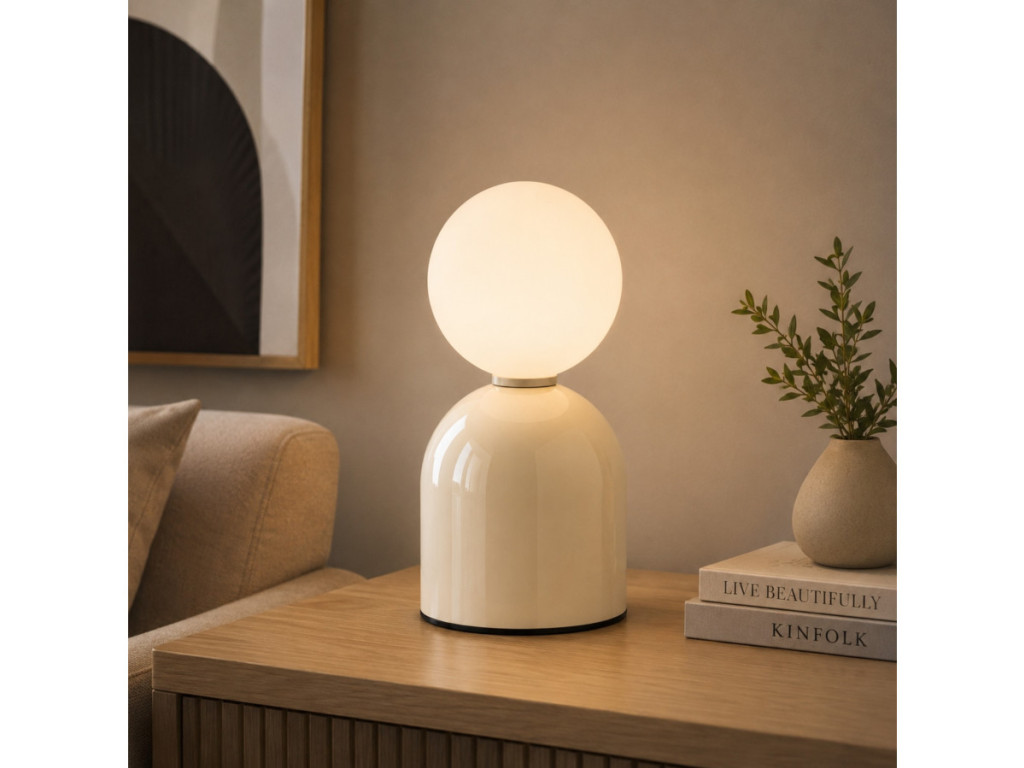
- Table lamp: placed on a console table or piece of furniture and easily moved around.
- Floorlamp: stands on the floor, in a corner or near an armchair, without taking up any furniture space.
- Wall lamp: is fixed to the wall, leaving both the floor and furniture free.
- Pendant light: casts light down from the ceiling and requires a power socket in that location.
If your ceiling does not have a power outlet, lamps plugged into a socket are sufficient to provide lighting throughout the living room, without the need to install a pendant light.
Sofa, reading corner, television and living room corner
Near the sofa, a directional lamp or reading lamp directs light towards the book. The official French website dedicated to older people also recommends this location for reading.
When watching television, indirect lighting means you don’t have to place a lamp directly in line with the screen. In addition, a console table or a corner of the living room can be fitted with supplementary lighting that extends the light from other areas.
Dimensions and ordering a floor lamp
The height of the lampshade determines what you see when seated. To avoid having the bulb directly in your line of sight, the bottom of the lampshade should be at eye level: approximately 100 to 110 cm from the floor.
Most floor lamps measure between 130 and 180 cm. A living room floor lamp measuring 140 to 160 cm, with a diffusing shade, is a versatile choice. When comparing sizes, also bear in mind the base width and the width of the shade.
Once you’ve chosen the height, check the cable: a length of 1.5 to 2 metres gives you more freedom to position the floor lamp. A switch at the base, on the cable or at eye level also saves you from having to bend down.
What sort of lighting should you choose for a cosy living room?
The quality of lighting depends on three distinct factors: the amount of light, its colour temperature and colour rendering. Each factor has its own unit of measurement, and reading comfort also depends on how the light source is shielded.
Lumens and light distribution
According to ADEME, lumens measure the amount of light emitted, whilst watts indicate the electrical power consumed. To compare two bulbs, therefore, look at the number of lumens.
Promotelec recommends a total of at least 3,000 lm for an average-sized living room. This total does not correspond to a single bulb: it is distributed across several light sources.
- Main light source: provides general lighting for the room.
- Accent lighting: supplements this total near the sofa, on a console table or in a corner.
- Hallways: France Rénov’ recommends ensuring they are adequately lit.
- Shaded areas: several evenly distributed light sources reduce the contrast between light and dark areas.
Colour temperature and colour rendering
Kelvin values indicate the colour of the light. For a cosy atmosphere, UFC-Que Choisir recommends 2,500 to 3,000 K, whilst Promotelec suggests 2,700 K for a welcoming atmosphere. Between 2,200 and 2,500 K, the light becomes very warm and golden, and is primarily decorative. At 4,000 K, it is more functional, and appears very cold from 6,000 K onwards.
The CRI, or Colour Rendering Index, indicates how faithfully a light source renders colours. Promotelec recommends a CRI of at least 80 for everyday domestic use. Above 90, colour rendering becomes more accurate.
Lampshades, glare and flicker
A living room lamp fitted with a fabric or paper lampshade diffuses the light rather than leaving the bare LED visible. An opaline globe or an opal bulb achieves the same effect. From the sofa, check that the light source is not directly visible and that the light does not fall on the screen. According to the INRS, a bare LED positioned within the line of sight can cause glare.
The INRS also points out that flickering caused by adjusting the brightness of LEDs strains the eyes and should be avoided. Once this has been checked, a dimmer switch allows you to adjust the brightness for reading or to create a cosy atmosphere.
What technical points should you check before buying?
When comparing two models, first check whether the light source is replaceable or built-in. Next, check its electrical compatibility, followed by safety and efficiency markings.
Replaceable bulb or integrated LED
With a replaceable bulb, you can change the light output or colour temperature at a later date without replacing the light fitting. Conversely, a built-in LED allows for a more compact light fitting and may include brightness or colour temperature controls.
The difference often lies in repair options. Before choosing an integrated LED, check what can be replaced if the light source or its electronics fail.
Base, power supply and dimming
The base – that is, the part that fits into the light fitting – must match the socket. According to ADEME, an E27 socket has a 27 mm screw thread, whilst an E14 socket has a 14 mm thread. Before purchasing, check the following points:
- Voltage: a GU10 LED replaces a halogen bulb operating at 230 V mains voltage, whilst a 12 V GU5.3 LED requires you to check its power supply.
- Maximum permitted wattage: this must not exceed the value specified for the light fitting.
- Bulb dimensions: the bulb must fit under the lampshade or inside the globe.
- Dimmer or transformer: check that the LED is compatible with the existing device.
On this last point, Promotelec points out that a ‘dimmable’ LED does not necessarily work with all dimmers: the compatibility of the two must be checked.
Safety and energy label
The CE marking indicates that a product complies with the applicable European requirements. According to AFNOR Certification, the NF mark is a voluntary certification, distinct from this marking. In addition, a Class I luminaire is earthed, whilst a Class II model relies on double insulation or reinforced insulation.
Light sources carry an energy label rated from A to G, in accordance with Delegated Regulation (EU) 2019/2015. Class A is the most efficient.
What style and budget should you choose for your lamp?
Once the technical criteria have been checked, two questions remain: style and price. The style should complement the living room furniture. The budget depends on the size and range, and you should also take running costs into account.
Style and finishes to suit your décor
Each style influences your choice differently, depending on the layout of your space and the existing furniture:
- Industrial and designer: suit a designer living room lamp with bold lines.
- Scandinavian and natural: these styles go well with light-coloured materials and wood.
- Bohemian: leaves more scope for soft materials and free-form designs.
For a contemporary décor, a white, nickel-plated, brass-coloured or wooden finish blends in easily. At Habitat et Jardin, the Lite-up Play portable Bluetooth lamp combines a Nordic design, a wooden handle, warm ambient lighting and a Bluetooth speaker.
Prices of floor lamps and table lamps
In France in 2026, an entry-level floor lamp costs around €8 to €30. Models made from fabric, wood or metal are available for between €30 and €80. For a standard floor lamp, expect to pay between €40 and €80: this is a rough guide, not a guaranteed price.
If you’re looking for an inexpensive living room lamp, very simple table lamps cost less than €20, and the choice widens between €20 and €50. Above that, the price mainly reflects the materials, features and design, as shown in the table.
| Price range | Floor lamp | Table lamp |
| Entry-level | €8 to €30: simple design | Under €20 |
| Mid-range | €30 to €80: fabric, wood or metal | €20 to €50: wider choice |
| Top-of-the-range | €80 to €150: more sophisticated materials or features | €50 to €100: sophisticated features or materials |
| Designer or premium range | From €150 up to several hundred euros | €100 to €200: more sophisticated design or features |
To assess value for money, compare the features that justify each price range: materials, a speed controller or a more sophisticated design.
Running costs and battery life of portable models
Running costs depend on actual power consumption, the number of light fittings, hours of use, the electricity tariff and any replacements. According to a reference table from ADEME, lighting an entire home consumes an average of 105 kWh/year across 31 light fittings, amounting to approximately €21/year. With highly efficient new equipment, this consumption drops to 25 kWh/year. The Lite-up Play from Habitat et Jardin, meanwhile, runs on a 2,600 mAh battery. Its claimed battery life is up to 18 hours for the lamp alone and up to 10 hours with music. Charging takes 4 hours via USB Type-C.
Frequently Asked Questions
Does an LED bulb really use less energy than a halogen or incandescent bulb?
Yes. According to ADEME, an LED bulb can use up to 10 times less energy than an incandescent bulb, and up to 20 times less than a halogen bulb.
Does a dark lampshade affect the amount of light required?
Yes. According to ADEME, a dark lampshade or wall absorbs more light. You may therefore need a light source that provides more lumens.
Is the stated lifespan of an LED bulb guaranteed?
No. According to ADEME, this lifespan is an estimate based on specific conditions: individual bulbs may not necessarily last as long. An LED generates less heat than a halogen or incandescent bulb, but it still needs to be able to dissipate its heat.