Your cart
There are no more items in your cart
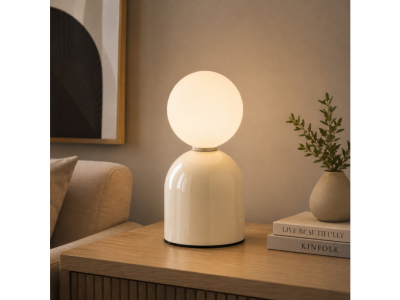
Modern table lamps to suit any room
Categories :
Furniture trends
, Trends & Inspiration
Table lamps in wood, ceramic, metal or fabric: styles and lampshades
The contemporary, Scandinavian, minimalist and bohemian styles of a designer table lamp are distinguished by their shapes, colours and materials. The choice of material also affects the appearance and finish of the base or lampshade:
- Wood and ceramic: materials that help define a style.
- Glass and metal: materials whose finishing costs differ from those of wood or ceramics.
- Fabric: a fabric lampshade that softens the light emitted.
Habitat et Jardin offers table lamps as part of its range of decorative lighting, designed to complement your furniture. Its catalogue of home lighting features these table lamp models.
Living room, reading or bedside lamp: a lamp to complement a floor lamp
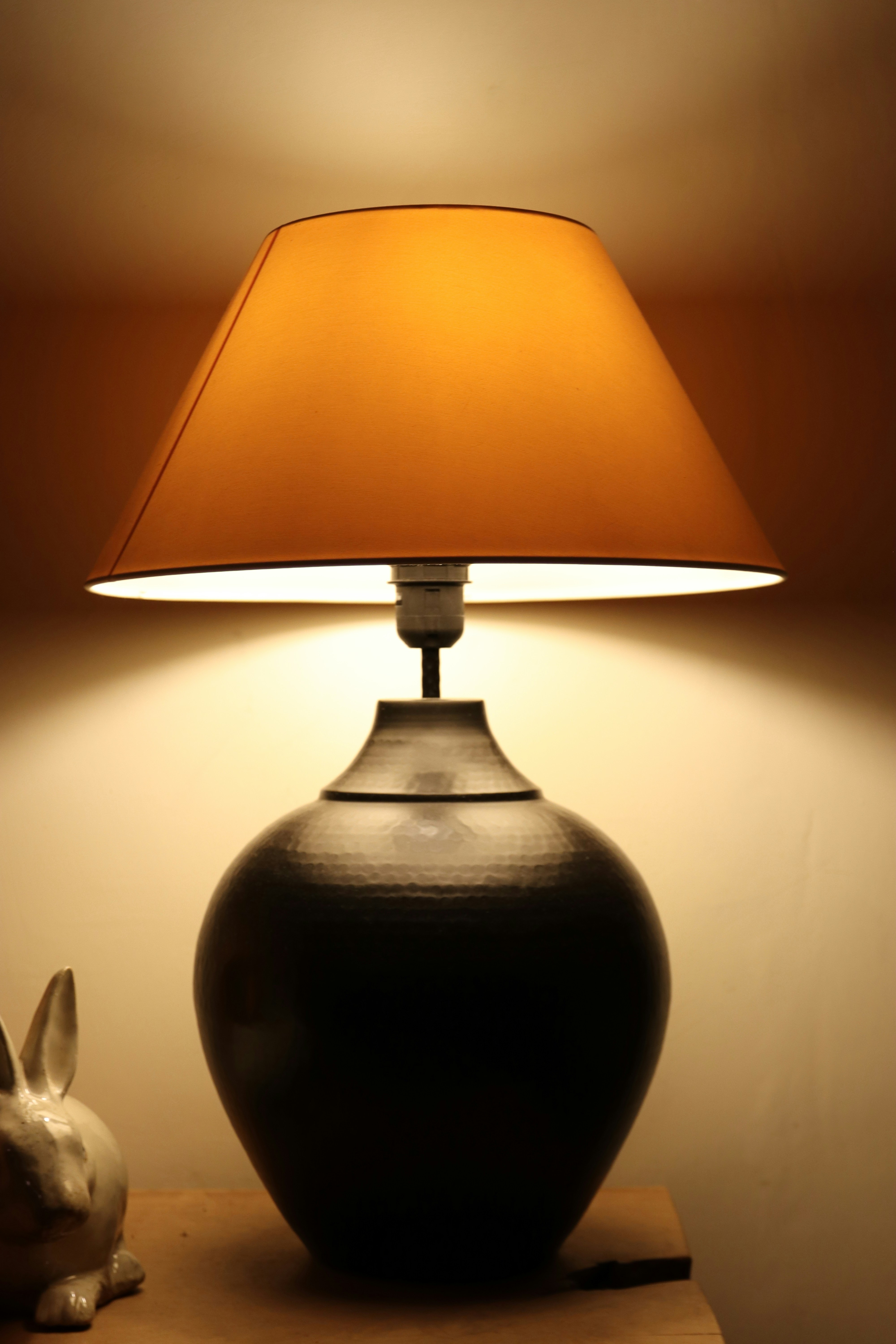
A single lamp cannot serve every purpose, and the right choice depends on the function you intend it to fulfil. Each location has its own specific requirements:
- Atmosphere in the living room: a fabric or diffusing glass shade for soft light.
- Accent lighting: a living room lamp to complement the ceiling light or a floor lamp.
- Reading in an armchair: an adjustable light, sufficient brightness and a switch within easy reach, like on a desk lamp.
- Bedside lamp: a compact design, an easy-to-reach switch and a cosy light for the evening.
When it comes to reading, these practical considerations matter more than style alone. Conversely, a modern bedside lamp prioritises discretion and ease of use at bedtime.
Height, base and stability of the bedside lamp
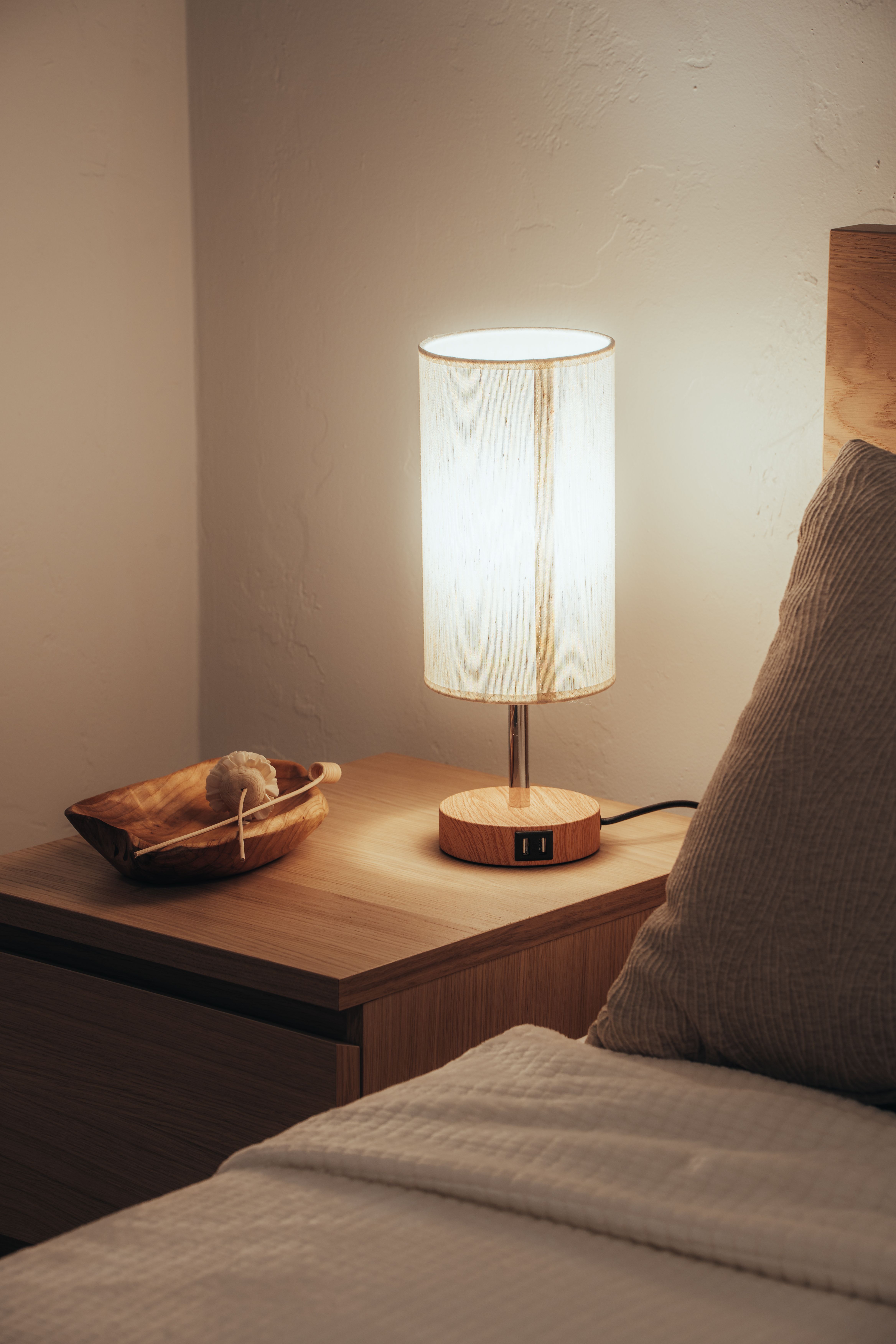
A small accent lamp is around 25 to 35 cm tall. A more prominent living room model may exceed 50 cm.
Modern living room lamps are typically around 50 to 55 cm tall. Their proportions should be considered in relation to the console table, side table or end table on which they stand, as well as any nearby floor lamp.
The Lite-up portable lamp from Habitat et Jardin is 26 cm high and 20 cm in diameter. It weighs 760 g. If placing it on a frequently used piece of furniture, do check that the base is stable before setting it up, whether it’s this lamp or a taller bedside lamp.
What kind of light and bulb should you choose?
A table lamp’s appearance says nothing about the light it gives off. The technical specifications of the light source allow you to make an informed comparison between a living-room lamp, a bedside lamp or a reading lamp, taking energy efficiency into account.
Lumens, kelvins and colour rendering
Luminous flux, expressed in lumens (lm), indicates the amount of light emitted. Watts (W) measure power consumption: they are not a substitute for lumens when comparing lighting, but are used to assess energy efficiency.
Colour temperature, expressed in kelvins (K), distinguishes between warm light and more neutral light: the LED in the Lite-up lamp is rated at 3,000 K. In addition, a high colour rendering index (CRI) helps to reproduce the colours of furniture, fabrics and decorative items more faithfully.
Comparing light sources and visual comfort
Two E27-base LED bulbs can have very different specifications. One has an output of 470 lm and 3.4 W at 2,700 K. The other produces 1,521 lm at 11 W, at 4,000 K. When choosing between two light sources, energy efficiency in lm/W, beam spread or direction, and the ability to dim the light are key factors alongside luminous flux, colour temperature and CRI. Finally, comfort depends on the position of the beam and direct visibility of the light source. According to the INRS, the power supply or dimming of certain LEDs can cause flickering, and the organisation also highlights the risk of glare.
E27 or E14 socket, or integrated LED
A lamp with an E27 or E14 socket accepts a bulb with the corresponding base. By changing this bulb, you can alter the luminous flux or the colour of the light, for example by switching to a dimmable model if the lamp allows it.
On an LED table lamp with an integrated module, the ability to replace the light source depends on its design. Check its lighting specifications as well as the availability of the module, its power supply and spare parts. Some LEDs are advertised as having a lifespan of 20,000 hours or 40,000 hours: this technical specification does not constitute a guarantee of performance.
Mains-powered or rechargeable: which controls should you choose?
A table lamp’s power supply determines where it can be placed, whilst the controls determine how easy it is to use on a day-to-day basis.
Positioning, battery life and power source of a table lamp
A mains-powered lamp requires access to a power socket. However, it does not have a battery that needs maintaining.
A rechargeable table lamp can be placed more freely, depending on the layout of your space. Before comparing two models, note the following points:
- Stated battery life: expressed in hours, this determines how long the lamp can be used between charges.
- Power supply: the type of cable or connector used for recharging.
- Charging time: the length of time the lamp must remain plugged in whilst charging.
- Replaceable battery: a separate consideration from charging time, which affects maintenance.
The example of the Lite-up portable lamp
Habitat et Jardin offers the Lite-up portable LED lamp in the Ocean colour, with a wooden handle, as shown on the Lite-up Ocean product page. The model is also available in the Earth colourway of the Lite-up range: a soft-touch PE body, mounted on wooden and silicone feet. The range also includes the Lite-up Play portable Bluetooth LED lamp.
Its rechargeable battery has a capacity of 2,000 mAh. The product details state ‘up to 40 hours of play’. It also lists ‘4 hours’ alongside ‘USB Type-C’, without specifying what this duration refers to.
Switch, touch control and dimmer
A switch on the cable, a button on the base or a built-in control may not be so easy to reach, depending on where the lamp is positioned. On a bedside table, the control should be within easy reach without having to search for it.
A touch-controlled table lamp is operated by simply touching it. However, this touch control adds electronic components compared to a conventional switch.
A dimmer adjusts the brightness, provided the lamp and bulb are compatible with dimming. The Lite-up is a good example: it has four brightness settings.
How much does a modern table lamp cost?
The price of a table lamp varies depending on its features, dimensions and materials. A few guidelines can help you get an idea of a model’s price before buying.
Prices observed based on features
The price of a table lamp is typically between €25 and €50 for a simple model with an E27 socket or a basic LED lamp. Rechargeable, touch-controlled or dimmable versions tend to cost between €40 and €80. Within each price range, several factors influence the price:
- Dimensions: the overall height and diameter.
- Materials: wood, ceramic, glass, metal or fabric.
- The finish: the surface treatment of the base and body.
- The lampshade: its size and shape.
The two price ranges overlap: a simple but well-crafted model can therefore cost as much as a more feature-rich lamp.
| Type of table lamp | Usual price |
|---|---|
| E27 socket or basic LED | €25 to €50 |
| Rechargeable, touch-controlled or dimmable | €40 to €80 |
Compare features before style
A built-in LED, a dimmable module or an electronic control add components compared to a simple socket. Similarly, mains, USB or battery power rely on different components, which partly explain the price differences.
The difference often lies in these features rather than the design. So note down the price including VAT, the dimensions, the intended use and the lighting specifications of two models to compare what they actually offer.
Check the product information sheet and warranties
The product information sheet for a lamp sold online must allow you to identify the product and find its electrical specifications, instructions and warnings. It also provides information on the light source and, where applicable, the battery. Since 1 September 2021, the energy label for light sources has used a scale from A to G: it indicates energy consumption in kWh per 1,000 hours and features a QR code – for the light source itself, not the entire lamp – which helps you compare the energy efficiency of two different light sources.
According to Service-Public, a new lamp purchased from a retailer is covered by the statutory guarantee of conformity. Any fault that arises within two years is presumed to have existed at the time of delivery. This guarantee is separate from any commercial warranty.
Frequently asked questions
Which E27 or E14 bulb should I choose for a table lamp?
The bulb’s base must match the socket: E27 with E27, or E14 with E14. For a warm light, aim for 2,700 K, which is a ‘warm white’. For a dimmable lamp, the bulb must be explicitly compatible with dimming.
Will the battery in a rechargeable lamp need to be replaceable?
Regulation (EU) 2023/1542 sets out requirements, with effect from 18 February 2027, for the removal and replacement by the end user of certain portable batteries incorporated into products, along with information obligations. However, not all rechargeable lamps are covered by these provisions.
Does a table lamp have a repairability index?
Not necessarily. According to the Ministry for Ecological Transition, the French repairability index applies only to product categories defined by regulation. To assess maintainability, check whether the light source, battery, LED module and its power supply are replaceable, and whether spare parts and documentation are available.