Your cart
There are no more items in your cart
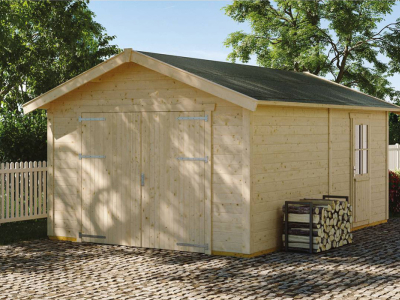
Wooden garage – Benefits
Categories :
Practical Guides
, Sheds & Garages
, Wooden garage
Wooden garage – Cost-effective
Construction and heating costs
In terms of construction and heating costs, a timber garage offers the following advantages:
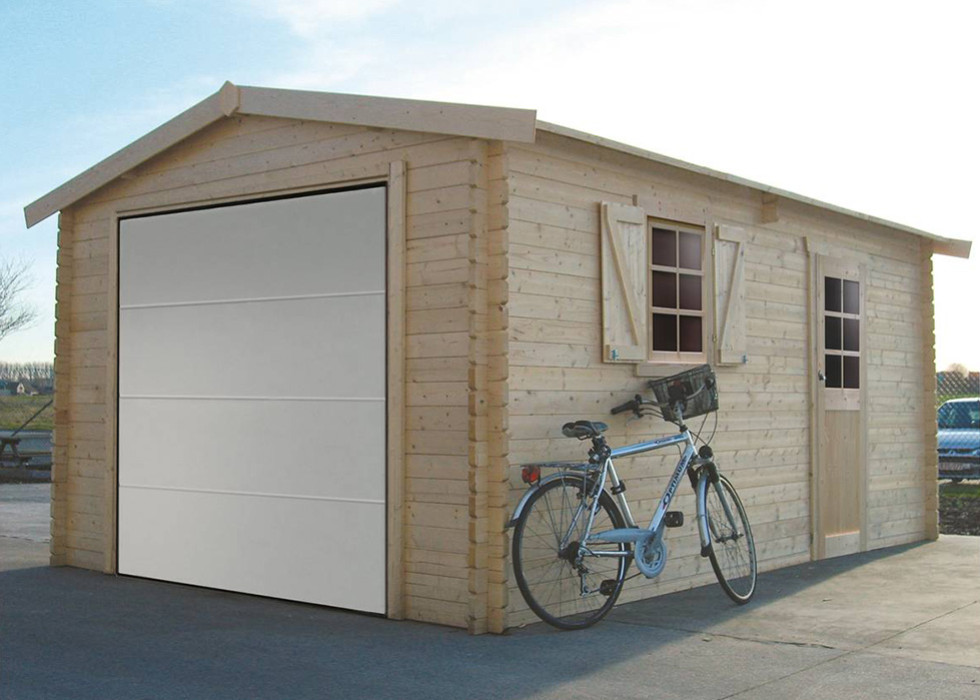
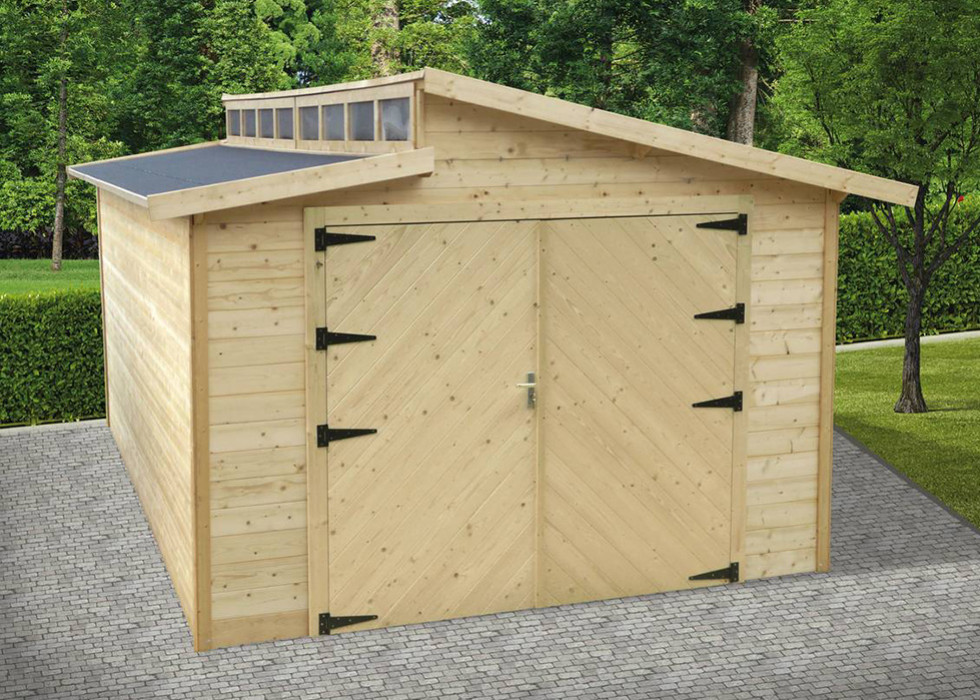
- Relatively low construction costs compared to a concrete, aerated concrete or brick garage. Indeed, there is no need for costly foundations. Most timber garages require only a simple concrete screed (slab) 10 to 15 cm thick. Even large garages with timber frames only need a 30 cm thick foundation slab. Construction time is relatively short for flat-pack garages and even shorter for prefabricated garages (lighter components, quick assembly on semi-cured concrete screeds), which will reduce the cost of labour and machinery (concrete mixers, etc.).
- Savings on heating costs and increased usable floor space. The timber used in timber garages is a thermal insulator six times more effective than brick and twelve times more effective than concrete (450 times more effective than steel and 1,700 times more effective than aluminium). Wood is a first-rate hygroscopic material. It absorbs some of the water vapour inside the garage and releases it into the atmosphere. This ensures optimal humidity levels. The thinness of the timber walls allows insulation to be fitted between the studs. With a negligible thermal effusivity (0.56), this results in dry air and a comfortable environment. Finally, as the timber walls are narrower (15 to 20 cm) than those made of concrete or brick, this results in a gain of over 10 per cent in the internal (usable) floor area of the timber garage.
Durability and adaptability
- The durability and fire safety of a timber garage are well established. Timber is highly resistant to corrosion. Natural timber requires no maintenance. Coloured timber, treated with microporous wood stains, is remarkably durable. Half-timbered houses built in Malmédy (Belgium) in 1750 have suffered no major deterioration. Investing in timber is highly cost-effective in the long term. The fire safety of a timber garage is significantly better than that of a concrete garage. As wood burns very slowly (4.2 cm per hour), this prevents the rapid collapse of the structure, meaning vehicles can be saved.
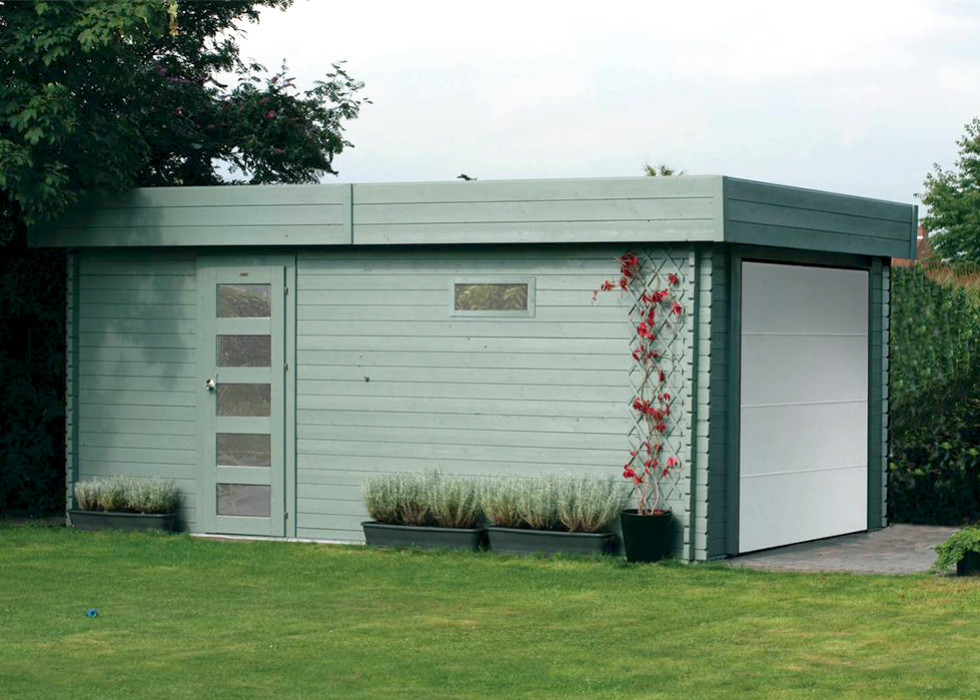
- Adaptability is another advantage of a timber garage. The design of a prefabricated timber garage can be tailored to the client’s requirements. It differs from that of ‘standard’ models sold as flat-pack kits. For garages that have already been erected, the owner can make alterations without any restrictions (adding, widening or closing doors and windows, extending the garage with a canopy, etc.).
Wooden garages – Environmentally friendly
Consumption of non-renewable fossil fuels (particularly hydrocarbons) is rising steadily. Indeed, it has risen continuously over the last 20 years, particularly following China’s ‘economic awakening’ (home to almost a quarter of the world’s population). This consumption is the main driver behind the rise in CO₂ emissions (the primary greenhouse gas) into the atmosphere. CO₂ and other GHGs (such as methane) pose a serious threat to our planet (climate change, etc.). Choosing a timber garage in construction helps to reduce GHG emissions and ensure a healthy environment for future generations. Here are the reasons:
- Building a timber garage supports sustainable development. Timber is a renewable resource. Despite felling and fires, forests regenerate quickly, especially when managed sustainably. Using timber slows the rate at which non-renewable resources such as minerals or fossil fuels (hydrocarbons, etc.). Wood’s lightness and its excellent thermal insulation properties explain its low energy consumption throughout all stages of the cycle (felling, transport, processing, transport and assembly). Unlike concrete construction, building a timber garage also consumes very little water, another natural resource that is becoming increasingly scarce.
- Building with timber helps to protect the environment in the long term. Wood waste is non-polluting as it is fully recyclable in the medium and long term: carpentry waste can be converted into fuel (compressed sawdust), composite wood or chipboard used in the manufacture of panels, or into paper (cellulose). Whatever its form, wood absorbs carbon dioxide (CO₂), which is the primary greenhouse gas (GHG) responsible for global warming, climate change and the resulting disasters (floods, droughts, heatwaves, etc.).
At the initial stage, the process of photosynthesis enables forest trees to absorb CO₂ and release oxygen. Forest areas have now become the second-largest reservoir of CO₂ after the oceans and seas. At the intermediate stage, timber used in construction (timber garages, timber houses, etc.) retains this property, asit can store 1 metric tonne of CO₂ per cubic metre – equivalent to roughly 3 to 5 metric tonnes of CO₂ stored by a 20 to 25 m² timber garage, and certainly more than 20 metric tonnes of CO₂ for a large garage with a traditional timber frame measuring 70 m² ! In the final stage, wood used as fuel (compressed sawdust) stores more carbon than it releases when burnt. Thus, 4 m³ of wood fuel will save 1 tonne of oil and prevent the emission of 2.5 tonnes of CO₂ into the atmosphere!
Wooden garages – Disadvantages
The disadvantages of a timber garage are minimal. They can be summarised in five points:
- Wood’s thermal inertia is significantly lower than that of other building materials. Concrete, brick and stone retain the heat accumulated during the day and release it over a longer period than wood. It will therefore be necessary to install an air-conditioning system in a timber garage, particularly if the owner wishes to convert it into a living space.
- Natural timber’s sensitivity to damp makes it vulnerable to attack by fungi and mould. Treated timber (pressure-treated) offers a solution to this problem, but it is more expensive.
- Products such as OSB (oriented strand board bonded with resin), chipboard, bracing, cladding and timber framing that are not CE or NF certified may contain toxic substances (such as adhesives). CE certification guarantees that the timber used in your garage comes from a forest managed in accordance with environmental standards, as the origin of certain imported exotic timbers remains questionable. NF certification applies to firewood. It guarantees compliance with the specified species group, the quality delivered and the moisture content of the timber supplied.
- Whilst the quality of solid timber is undeniable, that of composite timber or treated timber is less so! An analysis of the treatments is essential to detect any potential toxic effects. Finally, it should be noted that the costs of timber construction can be high for timber garages with 2, 3 or more parking spaces. They will require regular maintenance using special wood stains.
Copyright protected under Articles L. 111-1 and L. 123-1 of the Intellectual Property Code.